

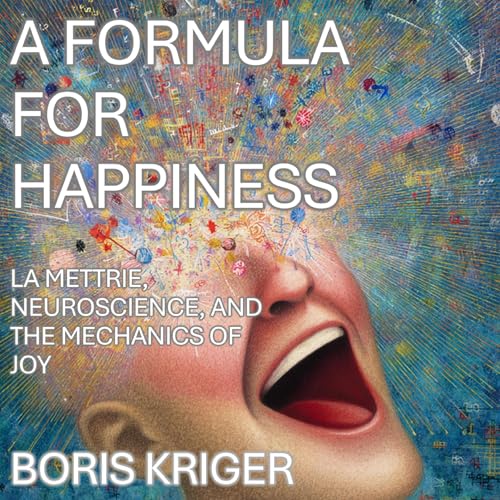
A Formula for Happiness
La Mettrie, Neuroscience, and The Mechanics of Joy
Failed to add items
Add to basket failed.
Add to wishlist failed.
Remove from wishlist failed.
Adding to library failed
Follow podcast failed
Unfollow podcast failed
3 Months Free

A Formula for Happiness
Buy Now for £13.79
-
Narrated by:
-
M James
-
By:
-
Boris Kriger
In 1748, a French physician named Julien Offray de La Mettrie published a book so scandalous that it was publicly burned. His crime? Suggesting that humans are machines—gloriously complicated, exquisitely sensitive machines, but machines nonetheless. He was exiled, mocked, and eventually died under suspicious circumstances after a lavish dinner involving truffle sauce. The Enlightenment, it turns out, had a dark sense of humor.
Nearly three centuries later, neuroscience has confirmed much of what La Mettrie intuited from the sickbed where a bout of fever first convinced him that the soul is merely the body talking to itself. Dopamine, serotonin, oxytocin, endorphins—these are the true authors of our joy and misery, our love affairs and existential crises. The dualism of body and soul, so dear to philosophers and theologians, turns out to be less a fundamental truth and more a comforting bedtime story we have been telling ourselves for millennia.
This book follows La Mettrie's audacious trail from his satirical demolition of Stoicism in "Anti-Seneca, or Discourse on Happiness" to his blistering critique of the medical profession in "The Machiavellian Physician." Along the way, it asks the questions that keep both neuroscientists and insomniacs awake at night: Can happiness be reduced to chemistry? Are we better off as contented fools or tormented geniuses? Is Stoicism a path to wisdom or a sophisticated form of sour grapes? What are the odds—quite literally, using Bayesian probability—that the soul is immortal? And why does doing good for others feel so unreasonably pleasant?
©2026 Boris Kriger (P)2026 Boris Kriger