

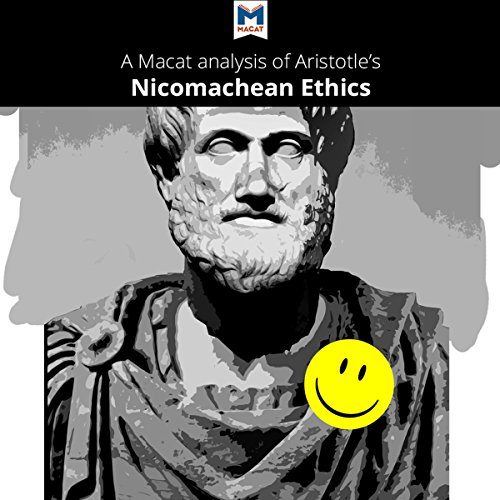
A Macat Analysis of Aristotle's Nicomachean Ethics
Failed to add items
Add to basket failed.
Add to wishlist failed.
Remove from wishlist failed.
Adding to library failed
Follow podcast failed
Unfollow podcast failed
3 Months Free + £10 Audible voucher

A Macat Analysis of Aristotle's Nicomachean Ethics
Buy Now for £6.57
-
Narrated by:
-
Macat.com
Aristotle wrote Nicomachean Ethics in Greece in the fourth century BCE, a period of extraordinary all-round intellectual development. He was a student of Plato, who in turn was a student of Socrates. Aristotle went on to teach the warrior and empire builder Alexander the Great. More than two millennia later, Aristotle's thorough exploration of virtue, reason, and the ultimate human good still forms the basis of the values that lie at the heart of Western civilization.
According to Aristotle, the ultimate human good is eudaimonia, an ancient Greek word that can be translated as happiness, or flourishing. Eudaimonia comes from a life of virtuous (or good) action. Virtues such as justice, restraint, and practical wisdom cannot simply be taught - they must be developed over time by cultivating virtuous habits. The making of virtuous choices can be developed by using practical wisdom and by recognizing the desirable middle ground between extremes of human behavior.
©2016 Macat Inc (P)2016 Macat Inc