

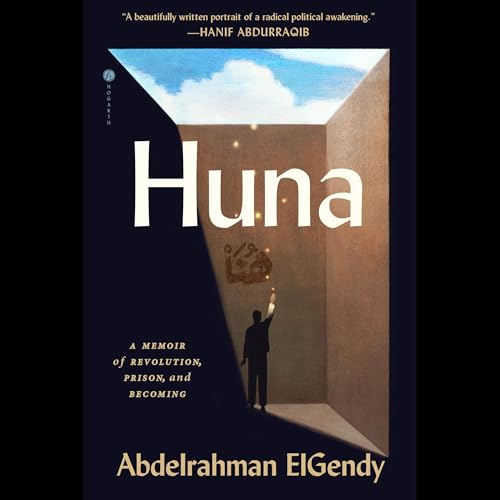
Huna
A Memoir of Revolution, Prison, and Becoming
Failed to add items
Sorry, we are unable to add the item because your shopping cart is already at capacity.
Add to basket failed.
Please try again later
Add to wishlist failed.
Please try again later
Remove from wishlist failed.
Please try again later
Adding to library failed
Please try again
Follow podcast failed
Unfollow podcast failed
Pick 1 audiobook a month from our unmatched collection - including bestsellers and new releases.
Unlimited access to our all-you-can-listen catalogue of 15K+ audiobooks and podcasts
Access exclusive sales and deals.
£8.99/month after 30 days. Renews automatically.

Huna
Narrated by:
Abdelrahman ElGendy
Pre-order Now for £14.05
-
Narrated by:
-
Abdelrahman ElGendy
“I will never be the same after reading Huna.” —Javier Zamora
“A beautifully written portrait of a radical political awakening.” —Hanif Abdurraqib
“The work of a truly liberated writer.” —Fady Joudah
In 2013, two years after the January 25 revolution, seventeen-year-old Abdelrahman ElGendy was a budding student activist in Cairo. Hope for a free Egypt had dissipated, and when that summer’s military coup unleashed unprecedented massacres of protesters, Abdelrahman didn’t hesitate—he joined the street movement. His father, fearing for his son’s safety, accompanied him to a mass demonstration. But minutes after they arrived, they were swept up in a brutal police crackdown, and their lives were shattered.
Crushed inside a holding cell, Abdelrahman first heard the words of the Arab world’s most enduring protest song, “Sawfa Nabqa Huna”—We Will Remain Here. He wondered: If no one wanted to remain behind bars, what was the “here” they chose to inhabit?
Abdelrahman would spend the next six years as a political prisoner chasing this Huna, shuffled, alongside his father, from jail cell, to pre-trial detention center, to The Scorpion, Egypt’s most infamous prison complex. As his body broke under the grind of incarceration with no end in sight, he turned to the only refuge left to him: the page. He earned his bachelor’s degree in engineering while imprisoned, read and wrote voraciously, and, through writing, bore witness.
In his remarkable debut, Abdelrahman offers not a promise of hope but a provocation. When the very things that can save you—tenderness, family, friendship, language—are used against you, how can you find the courage to love? Huna is a reckoning with what it takes—and what it costs—to remain when erased, and of what endures, perhaps more faithfully, beyond hope.
adbl_web_anon_alc_button_suppression_t1
No reviews yet