

Miscast: Who Owns the Story on Stage?
Failed to add items
Add to basket failed.
Add to wishlist failed.
Remove from wishlist failed.
Adding to library failed
Follow podcast failed
Unfollow podcast failed
3 Months Free + £10 Audible voucher

Miscast: Who Owns the Story on Stage?
Buy Now for £13.72
-
Narrated by:
-
Dick Terhune
-
By:
-
David Boles
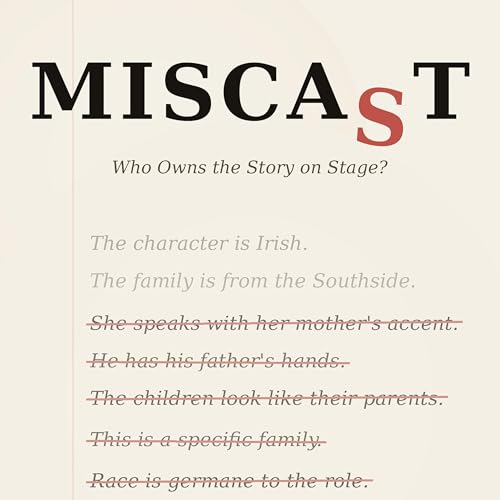
Who decides what a character is on the American stage? The playwright who created the character, or the institution that controls the production?
Miscast traces the history of non-traditional casting from the all-male stages of fifth-century Athens through Shakespeare's boy actors, the blackface minstrelsy of the nineteenth century, the founding of the Non-Traditional Casting Project in 1986, and the contemporary institutional mechanisms that now govern who is permitted to play whom in the American theatre. Along the way, it examines specific cases: Samuel Beckett's refusal to allow directorial alteration of his stage directions. August Wilson's 1996 declaration that Black plays require Black actors. The casting of Hamilton and the 2022 revival of 1776. The debate over who should play Helen Keller. The removal of a white ASL interpreter from The Lion King because the actors on stage were Black. Ali Stroker's Tony-winning performance in Oklahoma! The cultural architecture of Eugene O'Neill's Irish families. And the Dramatists Guild's 2021 Inclusion Rider, the first contract addendum in theatre history that asks playwrights to redirect their copyright authority toward institutional demographic objectives.
Written by a Dramatists Guild member of more than forty years (member number 45010, enrolled July 2, 1984), Miscast argues that the playwright creates the characters, the playwright determines what the characters are, and no institution has the right to override that determination. When the playwright chooses to cast non-traditionally, that is art. When the institution imposes non-traditional casting over the playwright's objection or without the playwright's knowledge, that is something else.
The audiobook includes fourteen chapters, a glossary of key terms, a timeline of events from 534 BCE to 2053, a comprehensive list of plays and productions discussed, full source documentation organized by chapter.
©2026 David Boles (P)2026 David Boles