

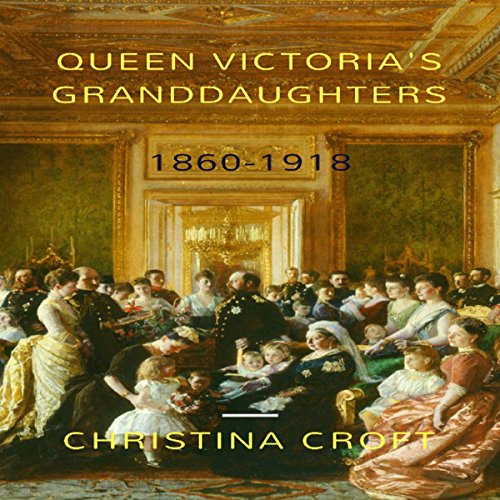
Queen Victoria's Granddaughters: 1860-1918
Failed to add items
Add to basket failed.
Add to wishlist failed.
Remove from wishlist failed.
Adding to library failed
Follow podcast failed
Unfollow podcast failed
3 Months Free + £10 Audible voucher

Queen Victoria's Granddaughters: 1860-1918
Buy Now for £15.28
-
Narrated by:
-
Fleur Edwards
-
By:
-
Christina Croft
On 6 July 1868, when told of the birth of her seventh granddaughter, Queen Victoria remarked that the news was "a very uninteresting thing for it seems to me to go on like the rabbits in Windsor Park". Her apathy was understandable - this was her 14th grandchild, and, though she had given birth to nine children, she had never been fond of babies, viewing them as "frog-like and rather disgusting...particularly when undressed".
The early years of her marriage had, she claimed, been ruined by frequent pregnancies, and large families were unnecessary for wealthy people since the children would grow up with nothing worthwhile to do. Nevertheless, her initial reaction to the birth of Princess Victoria of Wales belied the genuine concern that Queen Victoria felt for each of her 22 granddaughters. "As a rule," she wrote, "I like girls best," and she devoted a great deal of time to their well-being and happiness, showering them with affection she had seldom shown her own children.
By 1914, through a series of dynastic marriages, the queen's granddaughters included the empress of Russia; the queens of Spain, Greece, and Norway' and the crown princesses of Rumania and Sweden. As their brothers and cousins occupied the thrones of Germany, Britain, and Denmark, Prince Albert's dream of a peaceful Europe created through bonds of kinship seemed a real possibility. Yet in little more than a decade after Queen Victoria's death, the prince consort's dream would lie shattered in the carnage of the First World War. Royal cousins and even siblings would find themselves on opposing sides; two of them would die horrifically at the hands of revolutionaries, and several others would be ousted from their thrones. They had lived through the halcyon days of the European monarchies, but their lives, like the lives of millions of their people, would be changed forever by the catastrophe.
©2013 Christina Croft (P)2017 Christina CroftInteresting history
Something went wrong. Please try again in a few minutes.
Excellent book
Something went wrong. Please try again in a few minutes.
Lovely read by the narrator too, really helped to make the subject come alive. Spot on with the variety of strange pronunciations and names.
Would highly recommend.
Lovely listen
Something went wrong. Please try again in a few minutes.
However, the narration spoiled it for me. Several words were mispronounced - dowager, Ypres, for example - and the voice was monotonous and rather plaintive.
A moving story
Something went wrong. Please try again in a few minutes.
Informative book
Something went wrong. Please try again in a few minutes.