

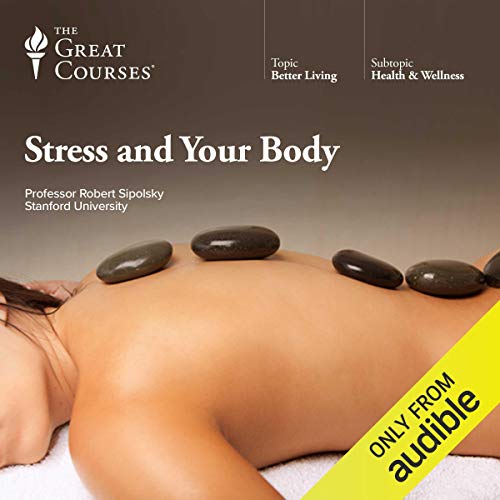
Stress and Your Body
Failed to add items
Add to basket failed.
Add to wishlist failed.
Remove from wishlist failed.
Adding to library failed
Follow podcast failed
Unfollow podcast failed
3 Months Free + £10 Audible voucher

Stress and Your Body
Buy Now for £14.69
-
Narrated by:
-
Robert Sapolsky
Feeling stressed?
You're not alone. Stress is an inherent aspect of life that can have tremendous negative effects on your mental and physical health. This makes coping with stress a critical part of how well we live.
Once you understand the inner workings of your stress response system, you'll possess powerful knowledge that will help you understand and better deal with this common aspect of your busy life. Now, from one of the world's foremost researchers on stress and neurobiology, comes a fascinating series of 24 lectures that guide you through the psychological and psychosocial stress that is a central part of everyday life in Western society.
You'll learn how the stress-response system is actually a natural survival system-giving, for example, a zebra the best chance to escape from a pursuing lion - that can change from a safety mechanism into a real problem for our physical and mental well-being. You'll see it coming into play against situations it wasn't designed to combat, such as traffic, troublesome thoughts and memories, and concerns over the economy, environment, and international events. And you'll gain valuable insights into how and why stress can affect every part of your body-including your cardiovascular, digestive, and immune systems - and learn about its relationship to important disorders and behaviors, like depression, anxiety, and even addiction.
PLEASE NOTE: When you purchase this title, the accompanying reference material will be available in your Library section along with the audio.
©2010 The Teaching Company, LLC (P)2010 The Great CoursesContinue the series










Good
Something went wrong. Please try again in a few minutes.
Loved it. Highly recommend it.
Something went wrong. Please try again in a few minutes.
Fabulous
Something went wrong. Please try again in a few minutes.
In some of the later lectures he reference case studies. However, with one or two acceptions he doesn't acknowledge the cruelty of these experiences. Some were performed on animals mostly mice/rats, monkeys and others on children. While I don't expect him to reference this after every study a brief acknowledge at the start of the lectuers would be respectful. Personally I feel that some of studies could use trigger warns as they could be triggering for people who have gone through similar circumstances. But thats just my opinion.
I found it funny how he says assess to universal health can't be factor (lecture 22). As the same or similar issues occur in countries with universal health care. I assume he means free or subsided health care by this. I live in the UK so have assess to the NHS. And while there isn't the same financial cost as other countries, getting an appointment is a nightmare. When you do get one chance are you'll have to take time off work to attend it. You will A. Have to make that time up B. Have to find someone to cover you C. Not be granted the time off. This obviously presents barriers to lower earners particularly if they are disabled, parents or carers. It definitely results in people within these systems putting off or not seeking treatment. Access to universal health care doesn't necessarily equal easy assess to it. Employers have a lot to answer for on this front. Still an interesting lecture though.
Very Good
Something went wrong. Please try again in a few minutes.
Where does Stress and Your Body rank among all the audiobooks you’ve listened to so far?
This is one of the best non-fiction audiobooks I have ever downloaded. Robert Sapolsky has studied stress for a very long time, but manages to make it easy to understand for the lay person, and really draws you into the subject. It is absolutely fascinating. I confess I do also own the actual book and didn't manage to finish it because it was hard going, but this audio presentation was perfect because he really brings the subject alive. I couldn't stop listening. A word of warning - this audiobook is exactly what the title says - the effects of stress on your body, which it explains in great detail. It does not go into a great deal of depth on how to cope with the various stressors in your own life, you pretty much have to work that out for yourself (or buy a different book). Brilliant, nonetheless. I loved it.Was this a book you wanted to listen to all in one sitting?
YesSo interesting it's almost addictive
Something went wrong. Please try again in a few minutes.