

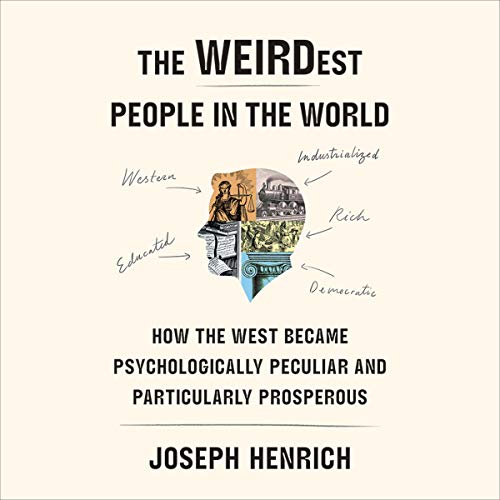
The WEIRDest People in the World
How the West Became Psychologically Peculiar and Particularly Prosperous
Failed to add items
Add to basket failed.
Add to wishlist failed.
Remove from wishlist failed.
Adding to library failed
Follow podcast failed
Unfollow podcast failed
3 Months Free

The WEIRDest People in the World
Buy Now for £18.57
-
Narrated by:
-
Korey Jackson
-
By:
-
Joseph Henrich
A bold, epic account of how the co-evolution of psychology and culture created the peculiar Western mind that has profoundly shaped the modern world.
Perhaps you are WEIRD: raised in a society that is Western, Educated, Industrialized, Rich, and Democratic. If so, you’re rather psychologically peculiar.
Unlike much of the world today, and most people who have ever lived, WEIRD people are highly individualistic, self-obsessed, control-oriented, nonconformist, and analytical. They focus on themselves—their attributes, accomplishments, and aspirations—over their relationships and social roles. How did WEIRD populations become so psychologically distinct? What role did these psychological differences play in the industrial revolution and the global expansion of Europe during the last few centuries?
In The WEIRDest People in the World, Joseph Henrich draws on cutting-edge research in anthropology, psychology, economics, and evolutionary biology to explore these questions and more. He illuminates the origins and evolution of family structures, marriage, and religion, and the profound impact these cultural transformations had on human psychology. Mapping these shifts through ancient history and late antiquity, Henrich reveals that the most fundamental institutions of kinship and marriage changed dramatically under pressure from the Roman Catholic Church. It was these changes that gave rise to the WEIRD psychology that would coevolve with impersonal markets, occupational specialization, and free competition—laying the foundation for the modern world.
Provocative and engaging in both its broad scope and its surprising details, The WEIRDest People in the World explores how culture, institutions, and psychology shape one another, and explains what this means for both our most personal sense of who we are as individuals and also the large-scale social, political, and economic forces that drive human history.
PLEASE NOTE: When you purchase this title, the accompanying PDF will be available in your Audible Library along with the audio.
©2020 Joseph Henrich (P)2020 Brilliance Publishing, Inc., all rights reserved.Critic reviews
"A fascinating, vigorously argued work that probes deeply into the way “WEIRD people” think." (Kirkus)
"Joseph Henrich has undertaken a massively ambitious work that explains the transition to the modern world from kin-based societies, drawing on a wealth of data across disciplines that significantly contributes to our understanding of this classic issue in social theory." (Francis Fukuyama, author of The Origins of Political Order and Political Order and Political Decay)
"Ambitious and fascinating...This meaty book is ready-made for involved discussions." (Publisher's Weekly)
Very insightful
Something went wrong. Please try again in a few minutes.
enlightenment puzzle
Something went wrong. Please try again in a few minutes.
Think game changer
Something went wrong. Please try again in a few minutes.
A Fascinating Yet Overconfident New Worldview
Something went wrong. Please try again in a few minutes.
Helped me understand myself better
Something went wrong. Please try again in a few minutes.