

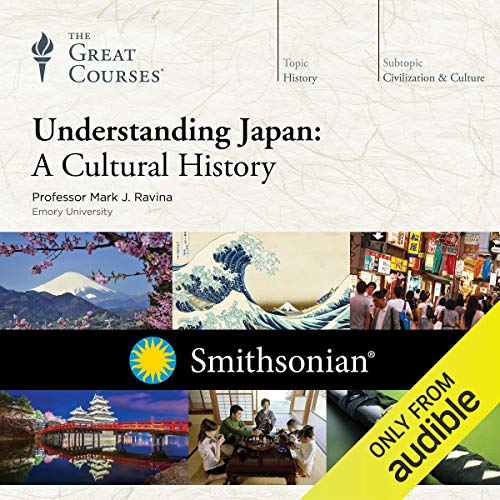
Understanding Japan
A Cultural History
Failed to add items
Add to basket failed.
Add to wishlist failed.
Remove from wishlist failed.
Adding to library failed
Follow podcast failed
Unfollow podcast failed
3 Months Free + £10 Audible voucher

Understanding Japan
Buy Now for £14.74
-
Narrated by:
-
Mark J. Ravina
Japan's extraordinary culture is like no other in the world, and it remains mysterious to many of us. And that's unfortunate, because to truly understand Japan's influence on the world stage, one needs to understand Japan's culture - on its own terms.
In an exciting partnership with the Smithsonian, The Great Courses presents these 24 lectures that offer an unforgettable tour of Japanese life and culture. Professor Ravina, with the expert collaboration of the Smithsonian's historians, brings you a grand portrait of Japan.
From the dawn of Confucianism and the Meiji Restoration to World War II and the economic miracle years of 1955 to 1975, you'll explore landmark periods of Japanese history and learn how broad events and movements introduced, innovated, and revised everything from spirituality to popular entertainment. Along the way you'll get revealing insights into Shinto (Japan's indigenous religion), the art of Katsushika Hokusai, literary works like The Tale of Genji and the haiku of Basho, the everyday lives of samurai, the universal appeal of filmmakers like Akira Kurosawa, foods like yakitori and tempura, and so much more.
You'll come away from Professor Ravina's final lecture with a stronger sense of the very soul of this one-of-a-kind nation.
©2015 The Great Courses (P)2015 The Teaching Company, LLCContinue the series


5 Star Course
Something went wrong. Please try again in a few minutes.
Highly recommended.
Excellent course
Something went wrong. Please try again in a few minutes.
excellent
Something went wrong. Please try again in a few minutes.
Would you recommend this audiobook to a friend? If so, why?
I would definitely recommend this to any friends or listeners who want to learn about the real Japan, as opposed to the image of Japan thst Westerners give themselves through some niche elements of Japanese culture or history - such as Japanese anime or the pop culture versions of samurai and ninjas - which can give a completely wrong impression.I admit I have never been to Japan myself but having listened to this excellent series of lectures - I particularly enjoyed the theme of the different phases of globalisation and the lectures on the true history of the samurai - I feel that if I ever went I would find it much easier to understand why certain things were the way they are.
The lectures were all at a perfect pace and I came away from each one feeling like I knew more about the subject having listened to it and looking forward to the next one. I would not be surprised if I listened to these again in the near future or recommended them to some close friends in particular.
What about Professor Mark J. Ravina’s performance did you like?
Professor Ravina was a man I coukd have listened to for hours. His voice was very measured and calm befitting the subject matter but his clear interest and passion was infectious and obvious. Half the time I couldn't help but smile.By the time I finished the lectures I felt sad to be leaving his virtual classroom. If he ever gives another series of lectures for The Great Courses I will be sure to get them from Audible.
Was this a book you wanted to listen to all in one sitting?
Yes completely and totally. I was enraptured from beginning to end and found the entire thing fascinating. I truly hope they release more lectures focused on Japan or Asia in general as I'm sure I would love every minute of it like I did these. I have come away truly thinking I know far more about Japan's history and culture than I did when I entered. I cannot recommend these enough.A lesson on how Japan became Japan
Something went wrong. Please try again in a few minutes.
Great lecture series.
Something went wrong. Please try again in a few minutes.