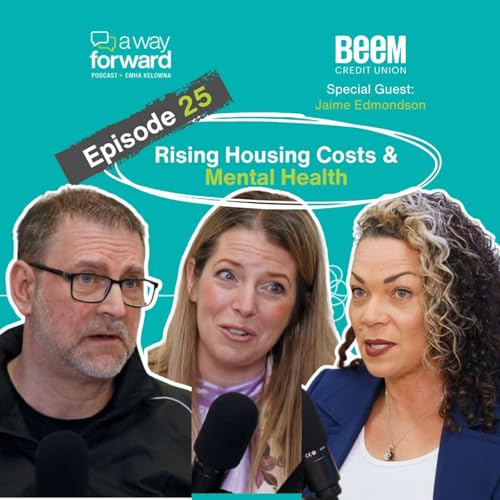
A Way Forward: Conversations on Mental Health cover art

A Way Forward: Conversations on Mental Health

A Way Forward: Conversations on Mental Health

By: CMHA Kelowna and Jessica Samuels
Listen for free

Summary

A Way Forward podcast, presented by Beem Credit Union, examines the challenges that can wear down our individual and collective mental health. Host Jessica Samuels focusses on the stressors, the core issues and contributing factors, and the approaches and practices that can help address these issues. Listeners will leave feeling they have the information and tools to better manager their well-being and able to find...a way forward.© 2026 CMHA Kelowna and Jessica Samuels Hygiene & Healthy Living Psychology Psychology & Mental Health Social Sciences
Episodes
  • Episode 26: Mental Health in South Asian Communities
    May 13 2026
    In this episode of Canadian Mental Health Association Kelowna & District’s A Way Forward Podcast: Conversations on Mental Health, presented by Beem Credit Union, host Jessica Samuels is joined by community advocate and businessman Balzor Singh and CMHA Kelowna counsellor Sureet Dosanjh for an honest conversation about mental health in South Asian communities.Together, they explore the realities of stigma, cultural expectations, gender roles, resilience, language barriers and the importance of culturally competent mental health support. Balzor also shares his family’s deeply personal experience navigating mental health crises and how that journey inspired him to become an advocate in the community.In this episode:How stigma around mental health continues to affect South Asian familiesWhy many people “suffer in silence” instead of seeking helpThe pressure placed on men and women within cultural and family expectationsThe impact of language and cultural understanding in counsellingBalzor Singh’s personal story supporting his mother through mental health challengesThe importance of creating safe, community-based conversations around mental healthWhy culturally responsive care can help break barriers to supportFeatured Program: South Asian Outreach InitiativeSureet Dosanjh shares details about CMHA Kelowna’s South Asian Outreach Program, which offers free and confidential counselling services in:PunjabiHindiUrduEnglishServices are available Tuesdays from 3 p.m. to 7 p.m. at the Rutland Community Clinic.Community members can walk in or book an appointment through Foundry Kelowna by calling 236-420-2803.Memorable moments from the conversation:“The conversation is what I need to start. I’m not looking to cure or save this person. I’m looking for a quick conversation that can lead to multiple more conversations.” — Balzor Singh“Resiliency is a double-edged sword. People suffer in silence and convince themselves they are fine.” — Sureet Dosanjh“Your purpose is to serve. Even if you help five or ten people, that matters.” — Balzor SinghResources & Supporthttps://helpstartshere.gov.bc.ca/SouthAsianCommunitieshttps://www.camh.ca/en/camh-news-and-stories/new-evidence-based-tools-and-training-to-support-mental-health-of-canadians-of-south-asian-originhttps://www.fraserhealth.ca/health-topics-a-to-z/south-asian-health/south-asian-health-institutehttps://www.sochmentalhealth.com/To learn more about CMHA Kelowna programs and supports, visit: cmhakelowna.comFor questions about the podcast, contact: awayforward@cmhakelowna.org About the Podcast A Way Forward: Conversations on Mental Health is presented by Beem Credit Union, supporting conversations that help build stronger, more connected communities across British Columbia.
    Show More Show Less
    28 mins
  • Episode 25: Rising Housing Costs & Mental Health
    Apr 29 2026

    In this episode, host Jessica Samuels is joined by Jaime Edmondson (Beem Credit Union) and Mike Gawliuk (CEO CMHA Kelowna) to unpack how rising housing costs are impacting mental health across British Columbia.

    From renters feeling locked out of the market to homeowners struggling with rising interest rates, this conversation explores the emotional toll of financial stress—and what support looks like.

    Key Themes

    1. The Emotional Weight of Housing Costs

    • Housing affordability is one of the top stressors affecting mental health today
    • Feelings of hopelessness, anxiety, shame, and guilt are increasingly common
    • Financial stress often leads to avoidance, preventing people from seeking help

    2. Renters vs. Homeowners: Shared Pressure, Different Realities

    • Renters: (Struggle to save due to high rent and cost of living; Many feel homeownership is out of reach)
    • Homeowners: (Facing rising interest rates and mortgage renewals; Managing increased costs while rental income may be declining)

    3. The “YOLO Effect” and Saving Fatigue

    • Saving for a home can take ~7 years on average
    • High monthly savings requirements lead many to give up
    • Result: people choose to live in the moment rather than save, reducing chances of entering the housing market

    4. The Mental Health Impact

    • Housing is a social determinant of health
    • Financial instability can: (Trigger or worsen mental health challenges; Increase isolation and stress cycles)
    • Younger people are especially affected, facing long-term uncertainty

    5. The Hidden Costs of Living

    • Beyond rent/mortgage: (Utilities, taxes, insurance, internet, repairs)
    • Unexpected expenses (e.g., repairs) can push people into debt cycles

    6. Shame and Financial Avoidance

    • Many people avoid financial conversations due to: Fear of judgment; Misunderstanding (e.g., mortgage renewal myths)
    • This avoidance often leads to worse financial outcomes

    Practical Takeaways

    Financial Strategies

    • Talk to a financial advisor early
    • Build a clear, realistic budget
    • Review and cut unnecessary expenses (subscriptions, etc.)
    • Explore restructuring debt for manageable payments

    Mental Health & Community Support

    • Seek support early—financial and emotional stress are linked
    • Programs available include: Rent support and eviction prevention; Financial literacy resources; Community-based assistance

    Programs & Resources Mentioned

    • Central Okanagan Rent Bank: https://www.cmhakelowna.com/programs-supports/central-okanagan-rent-bank (Emergency grants/loans to prevent eviction)
    • BC Housing Rent Supplement (https://www.cmhakelowna.com/programs-supports/bc-housing-rent-supplement)
    • Financial literacy partnerships (e.g., community organizations)
    • Beem Credit Union programs: First Home Advantage (down payment support); Debt restructuring and advisory services

    More information and links can be found on the A Way Forward Podcast page at cmhakelowna.org.
    Have questions or suggestions? Email us at awayforward@cmhakelowna.org

    Notable Insights

    • Many British Columbians spend 30–50%+ of income on housing
    • A significant portion are one paycheck away from financial crisis
    • Increased housing supply does not automatically equal affordability

    Key Message

    You are not alone in feeling overwhelmed by housing costs.
    Support exists—and starting the conversation is often the most important step.

    About the Podcast

    A Way Forward: Conversations on Mental Health is presented by Beem Credit Union, supporting conversations that help build stronger, more connected communities across British Columbia.

    Show More Show Less
    25 mins
  • Episode 24: Substance Use and Addiction: The Recovery Journey
    Apr 15 2026
    In this episode of A Way Forward, host Jessica Samuels sits down with CMHA Kelowna CEO Mike Gawliuk to unpack one of the most misunderstood topics in mental health: substance use and addiction.This conversation goes beyond surface-level assumptions to explore what addiction really looks like, why recovery takes time, and what supports are needed to help people move forward.Key Takeaways1. Addiction is a chronic, recurring conditionRecovery is not a one-time fix. Relapse can be part of the process, not a failure. 2. Detox is only the beginningDetox removes substances from the body, but it does not address the underlying causes of addiction. 3. Treatment is a process, not a placeRecovery can take many forms, including outpatient care, day programs, or residential treatment. What works varies by person. 4. Addiction is often rooted in painSubstance use is frequently a way of coping with trauma or unresolved emotional challenges. 5. There is no “one-size-fits-all” recoveryFor some, recovery means abstinence. For others, it may involve reduced use, stronger coping skills, or rebuilding stability in life. The Four Pillars of Substance Use ResponseMike highlights a widely recognized framework for addressing substance use:· Prevention – Early intervention and education, especially for youth· Harm Reduction – Keeping people safe and alive while building connection· Treatment – Access to care across a continuum of needs· Enforcement – Addressing supply and public safety concernsEach plays a role. None works in isolation. System Gaps Identified· Lack of seamless transitions between detox, treatment, and recovery· Limited access to supportive, recovery-focused housing· Insufficient early prevention and intervention funding· Fragmented care systems that make continuity difficultA key insight: Where someone goes after treatment can determine their long-term outcome.Shifting the Mindset· Recovery is not a “movie of the week” transformation· Progress may take multiple attempts· Compassion and understanding are essential, even amid public frustration· Addressing behaviour does not mean ignoring the underlying causesWhat Does Success Look Like?Success in recovery is not uniform. It may include:· Long-term abstinence· Reduced substance use· Improved mental health and coping· Reconnection with work, family, or community· Ongoing support through programs or peer networksThe path is different for everyone—but support is critical at every stage. Final Thought and ResourcesAddiction is complex. Recovery takes time. And meaningful change requires a full system of support—from prevention to housing to long-term care.- For supports, visit www.cmhakelow.org and click on programs & supports- Crisis Response, Community Led (CRCL): you can call or text the CRCL team at 778-940-2560https://www.interiorhealth.ca/locations/kelowna-mental-health-substance-usehttps://helpstartshere.gov.bc.ca/https://bc.cmha.ca/documents/substance-use-and-addiction/https://www.camh.ca/en/health-info/mental-illness-and-addiction-index/addictionRegarding Youth Substance Usehttps://foundrybc.ca/topic-page/substance-use-the-basics/https://foundrybc.ca/topic-page/substance-use-and-you/https://f...
    Show More Show Less
    34 mins
adbl_web_anon_alc_button_suppression_c
No reviews yet