• The Cost of 47 Missing Screws
    Jul 5 2026
    Continental Express Flight 2574 crashed in 1991 after a catastrophic structural failure occurred mid-air, initially raising fears of a possible bombing. However, investigators uncovered a far more troubling cause—critical screws in the aircraft’s horizontal stabilizer had been removed during maintenance and were never reinstalled.
    This fatal oversight stemmed from a chain of human errors, including poor communication between maintenance shifts and incomplete paperwork that failed to flag the unfinished work. Underlying these mistakes was a deeper issue: a corporate culture that tolerated shortcuts and allowed safety procedures to be bypassed in the interest of saving time.
    The aircraft lost control as the stabilizer failed, leading to a devastating crash with no survivors. The tragedy became a turning point in aviation safety, prompting stricter regulations around maintenance practices, accountability, and human factors. It remains a powerful reminder of how small errors, when unchecked, can escalate into a catastrophic disaster.


    You can listen and download our episodes for free on more than 10 different platforms:
    https://linktr.ee/Air_Crash_Chronicles

    Produced by Podcai Studio:
    https://www.podcaistudio.com/
    Show More Show Less
    23 mins
  • Murder on PSA Flight 1771
    Jul 4 2026
    Pacific Southwest Airlines Flight 1771 ended in a horrifying act of violence when a disgruntled former employee, David Burke, smuggled a .44 Magnum onboard using his airline credentials. Seeking revenge against his former supervisor, Ray Thomson, Burke carried out a deadly attack mid-flight, shooting both the crew and his target before forcing the aircraft into a catastrophic dive.
    Evidence later revealed the terrifying final moments, including a note that confirmed his intentions and the deliberate nature of the crash. The plane slammed into the California hills with such force that it was completely destroyed, killing all 43 people on board.
    This tragedy exposed critical flaws in airline security, particularly the lack of screening for airline staff. In response, sweeping changes were introduced, including mandatory security checks for all personnel and stricter cockpit protection measures—reforms that continue to shape aviation safety today.


    You can listen and download our episodes for free on more than 10 different platforms:
    https://linktr.ee/Air_Crash_Chronicles

    Produced by Podcai Studio:
    https://www.podcaistudio.com/
    Show More Show Less
    24 mins
  • The Fatal Acceleration of Flight 3054
    Jul 3 2026
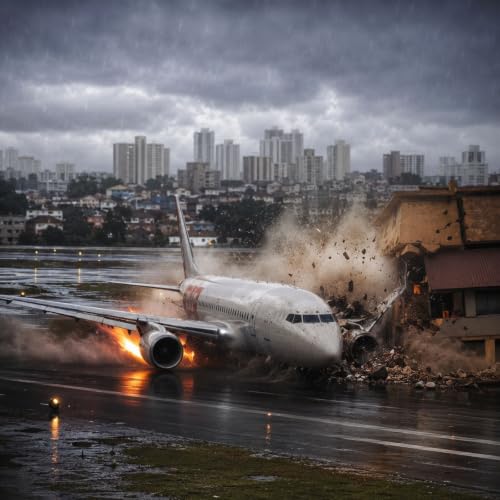
    TAM Airlines Flight 3054 ended in catastrophe in July 2007 during a rain-soaked landing at Congonhas Airport, one of the most challenging airports in the world. Facing a short, slippery runway and a disabled thrust reverser, the crew attempted to land under intense pressure and difficult conditions.
    In the critical moments after touchdown, a fatal mistake occurred—one engine was inadvertently left at full climb power while the other was set to idle. This imbalance prevented the aircraft from slowing down, causing it to accelerate uncontrollably, veer off the runway, and crash into a nearby building.
    The impact killed 199 people, marking the deadliest aviation disaster in South American history. The tragedy exposed serious concerns about runway safety, airport limitations, and cockpit procedures under stress. In its aftermath, safety measures such as improved runway surfacing were introduced, but the airport’s risks continue to raise concern among pilots to this day.


    You can listen and download our episodes for free on more than 10 different platforms:
    https://linktr.ee/Air_Crash_Chronicles

    Produced by Podcai Studio:
    https://www.podcaistudio.com/
    Show More Show Less
    21 mins
  • The Gander Crash and the Bomb Mystery
    Jul 2 2026
    Arrow Air Flight 1285 crashed in 1985 shortly after takeoff from Gander, Newfoundland, killing 248 U.S. soldiers and 8 crew members. The tragedy quickly turned into a major controversy, as investigators were divided over its cause.
    The majority concluded that the aircraft stalled due to ice accumulation on the wings combined with excessive weight, which reduced lift at a critical moment. However, a dissenting group strongly rejected this explanation, arguing that the evidence suggested a possible onboard explosion or sabotage linked to geopolitical tensions at the time.
    This sharp disagreement created a rare internal conflict within the investigation, eventually leading to the dissolution of the board and the formation of a new investigative body. Amid the dispute, crucial safety concerns about the dangers of ice buildup were overshadowed—an issue that later contributed to another fatal crash just a few years afterward.


    You can listen and download our episodes for free on more than 10 different platforms:
    https://linktr.ee/Air_Crash_Chronicles

    Produced by Podcai Studio:
    https://www.podcaistudio.com/
    Show More Show Less
    23 mins
  • The Gimli Glider: A High-Stakes Descent Without Fuel
    Jul 1 2026
    This episode explores three aviation disasters where small errors and technical failures escalated into life-threatening emergencies.
    The first case revisits the “Gimli Glider,” where an Air Canada flight exhausted its fuel mid-air due to a metric conversion mistake. Despite the complete loss of engine power, the pilot managed an extraordinary unpowered landing, saving everyone on board.
    The second incident covers a midair collision over the Amazon involving a Boeing 737 and a business jet. A combination of communication failures and a disabled transponder led to a breakdown in situational awareness, resulting in a fatal crash.
    The final case examines Helios Airways Flight 522, where an incorrect pressurization setting caused gradual cabin hypoxia, incapacitating the crew and passengers until the aircraft eventually ran out of fuel and crashed.
    Together, these events highlight how seemingly minor oversights in procedures, communication, and system configuration can compound into catastrophic outcomes in aviation.


    You can listen and download our episodes for free on more than 10 different platforms:
    https://linktr.ee/Air_Crash_Chronicles

    Produced by Podcai Studio:
    https://www.podcaistudio.com/
    Show More Show Less
    22 mins
  • Tragedy in the Fog: The Linate Airport Collision
    Jun 30 2026
    A major runway collision in 2001 occurred at a major international airport under extremely low-visibility conditions caused by thick fog, resulting in a fatal crash during takeoff operations.
    A passenger jet accelerating for departure collided with a smaller aircraft that had mistakenly entered an active runway. The smaller aircraft had been navigating the taxiways incorrectly and ended up in a restricted area, directly in the path of the departing jet. The impact led to a devastating fire and significant loss of life.
    Investigators found that while pilot and taxiing errors contributed to the sequence of events, the deeper causes were systemic failures at the airport. Critical ground safety systems were either unavailable or not functioning, including surface movement radar and other detection tools that could have alerted controllers to the runway incursion. In addition, confusing signage and poorly maintained taxiway markings increased the likelihood of navigation mistakes in low visibility.
    The investigation concluded that a combination of human error, inadequate infrastructure, and insufficient safety oversight allowed the accident to occur. In response, major reforms were introduced, including upgraded ground radar systems, improved airport lighting and signage standards, and stricter runway incursion prevention procedures, significantly enhancing safety in low-visibility operations.


    You can listen and download our episodes for free on more than 10 different platforms:
    https://linktr.ee/Air_Crash_Chronicles

    Produced by Podcai Studio:
    https://www.podcaistudio.com/
    Show More Show Less
    22 mins
  • The Jet That Fought its Pilot
    Jun 29 2026
    A promotional demonstration flight for a new-generation passenger aircraft ended in tragedy when the aircraft failed to gain sufficient altitude during a low-level flyover and crashed into a forested area, resulting in multiple fatalities.
    The aircraft was operating under advanced computer-assisted flight control systems, designed to enhance stability and prevent unsafe maneuvers. However, during the maneuver, the aircraft descended too low and too slowly to recover power and lift in time, leading to a controlled but unrecoverable impact with terrain.
    Investigators concluded that pilot decision-making and inadequate preparation for the flight profile played a central role in the accident. They determined that the crew’s handling of altitude and speed during the demonstration did not leave enough margin for recovery in a critical phase of flight.
    The pilot involved disputed parts of the findings, suggesting that automated flight control systems may have limited manual inputs during the maneuver and raising concerns about data interpretation from onboard recorders. These claims contributed to ongoing debate about the balance between human control and automation in modern aircraft.
    Despite the controversy, the accident did not halt the adoption of the aircraft type, but it did lead to increased emphasis on pilot training for fly-by-wire systems and stricter safety procedures during demonstration flights and low-altitude operations.


    You can listen and download our episodes for free on more than 10 different platforms:
    https://linktr.ee/Air_Crash_Chronicles

    Produced by Podcai Studio:
    https://www.podcaistudio.com/
    Show More Show Less
    23 mins
  • The Flash Fire of Air Canada Flight 797
    Jun 28 2026
    Three major aviation disasters demonstrate how a combination of technical failures, environmental hazards, and overlooked warnings can lead to catastrophic outcomes—and how each tragedy ultimately reshaped modern aviation safety.
    In one incident, a mid-flight cabin fire breaks out in the lavatory area and spreads rapidly through toxic smoke. The situation escalates as passengers and crew struggle with limited visibility and failing onboard systems during an emergency descent. The tragedy exposes critical gaps in fire detection and evacuation procedures, leading to major improvements in smoke alarms, emergency lighting, and cabin fire response protocols.
    In another case, a passenger aircraft attempts to land during severe weather conditions when it suddenly encounters a powerful, localized downdraft. The aircraft loses lift abruptly and crashes short of the runway. Investigators later identify the danger of microburst wind shear, which leads to the development and widespread adoption of advanced weather radar systems designed to detect these invisible atmospheric threats.
    A third disaster involves a structural design flaw in an aircraft cargo door system. Despite earlier warnings from a near-identical failure, the issue remains unresolved, and the defect eventually leads to explosive decompression and loss of control in flight. The investigation highlights how ignored safety recommendations can have fatal consequences when combined with high structural stress.
    Together, these events reveal a consistent pattern: small design flaws, environmental hazards, and delayed safety action can combine with devastating effect. In response, aviation authorities introduce stronger regulations, improved detection technology, and stricter maintenance and compliance standards, forming the foundation of many modern flight safety systems.


    You can listen and download our episodes for free on more than 10 different platforms:
    https://linktr.ee/Air_Crash_Chronicles

    Produced by Podcai Studio:
    https://www.podcaistudio.com/
    Show More Show Less
    23 mins