Beyond UX Design cover art

Beyond UX Design

Beyond UX Design

By: Jeremy Miller
Listen for free

Summary

Beyond UX Design’s mission is to give you the tools you need to be a truly effective UX designer by diving into the soft skills they won’t be teaching you in school or a boot camp. These soft skills are critical for your success as a UX professional.Jeremy Miller Art
Episodes
  • Yes, And... Now What? Improv Lessons for Navigating the Actual Job with Nikki Anderson
    May 15 2026
    Your tools are solid. Your process is tight. But when a stakeholder pushes back, a workshop goes sideways, or a PM challenges your work, none of that matters. What matters is how you respond. Nikki Anderson joins me to talk about improv, structured play, and how to stay sharp when the messy stuff hits.What if the most important skill in your UX career has nothing to do with design?Nikki Anderson is a UX research consultant, founder of Drop-In Research, and one of those rare people who can draw a straight line between improv comedy and stakeholder management, and actually make it land. She started doing improv around the same time she got into UX research, originally to overcome a lifelong fear of speaking on the spot. What she found was that the principles she was learning on stage translated almost perfectly into the conference room.In this conversation, we get into the specific places where UX professionals tend to flail, and it's not where most people think. It's not the research plan or the prototype. It's the high-stakes meeting where everything's riding on one presentation. It's the design critique that spirals into defensiveness. It's the moment a stakeholder blames you for something and your fight-or-flight kicks in before your brain does. Nikki breaks down how improv—and specifically the "yes, and" mindset—isn't about blind agreement. It's about accepting reality, staying curious, and choosing to investigate rather than argue.We also get into structured play, the idea that creativity doesn't just need freedom, it needs a container. Nikki makes the case that the most productive meetings, critiques, and workshops aren't the loose, open-ended ones. They're the ones with clear intention, playground rules, and maybe a little "draw a duck" warm-up before anyone starts giving feedback. If you've ever felt like the soft skills side of this job was something you were just supposed to figure out on your own, this one's for you. Listen in.Topics:• 04:00 - Nikki's improv origin story.• 07:12 - Where UX professionals flail: the high-stakes meeting trap.• 10:30 - The skepticism around "yes, and" — and what it actually means.• 13:50 - Structured play and why it matters at work.• 16:20 - Ambiguity and mismatched expectations: improv as a tool for dealing with them on the fly.• 17:21 - Live stakeholder blame scenario: the "yes, and + investigate" approach in action.• 22:45 - Applying improv to design critiques.• 23:31 - Renaming critiques, setting playground rules, and warm-up exercises.• 30:45 - Using improv to handle unexpected process changes.• 31:30 - Accepting reality: the "yes" before the question.• 35:55 - The control/no-control exercise for individual contributors.• 38:10 - Creativity needs structure, not just freedom.• 44:05 - Closing thoughts: take an improv class; nothing is an emergency.Helpful Links:• Connect with Nikki on LinkedIn• Subscribe to the User Research Strategist—Thanks for listening! We hope you dug today’s episode. If you liked what you heard, be sure to like and subscribe wherever you listen to podcasts! And if you really enjoyed today’s episode, why don’t you leave a five-star review? Or tell some friends! It will help us out a ton.If you haven’t already, sign up for our email list. We won’t spam you. Pinky swear.• ⁠⁠⁠Get a FREE audiobook AND support the show⁠⁠⁠• ⁠⁠⁠Support the show on Patreon⁠⁠⁠⁠⁠⁠⁠• ⁠⁠⁠Check out show transcripts⁠⁠⁠• ⁠⁠⁠Check out our website⁠⁠⁠• ⁠⁠⁠Subscribe on Apple Podcasts⁠⁠⁠• ⁠⁠⁠Subscribe on Spotify⁠⁠⁠⁠⁠⁠⁠• ⁠⁠⁠Subscribe on YouTube⁠⁠⁠• ⁠⁠⁠Subscribe on Stitcher⁠
    Show More Show Less
    55 mins
  • The Frequency Illusion: You Just Noticed It, but it Was Always There
    May 8 2026

    Your brain doesn't show you everything around you — it shows you what it's been told to look for. In this episode of the Cognition Catalog, we break down the frequency illusion and how this quirk of attention can quietly warp how product teams spot trends, prioritize problems, and build roadmaps.What if the trend your team keeps talking about isn't actually a trend — and your brain has been quietly manufacturing evidence for it this whole time?

    The frequency illusion is one of those cognitive biases that feels like insight right up until it isn't. You learn a new term, you spot a new pattern, and suddenly it seems like it's everywhere — in your product, in your competitors' apps, in research you've been staring at for weeks. The information was always there. Your attention just finally got the memo.In this episode of the Cognition Catalog, I break down how the frequency illusion works, where it came from (including the surprisingly colorful backstory behind the Baader-Meinhof phenomenon), and why it doesn't stop at UI patterns. The same mechanism that makes you see skeleton loaders everywhere after one design review is the same one that inflates a single customer complaint into what feels like a five-alarm fire on your roadmap.The tricky part? It feels exactly like professional growth. And when an entire team gets primed on the same idea at the same time, that individual bias can scale into something much harder to catch. If you want to get better at separating what you're noticing from what's actually happening, this episode is for you.Topics:• 03:00 - The Inter story: how a LinkedIn post changed everything I saw.• 04:00 - What the frequency illusion actually is.• 04:30 - The Baader-Meinhof phenomenon and how it got its name.• 05:00 - Arnold Zwicky coins "the frequency illusion" in 2005.• 05:30 - Selective attention and confirmation bias: the two engines behind it.• 06:30 - The recency illusion and how it compounds the problem.• 07:00 - How the frequency illusion shows up in design critiques.• 08:30 - What to actually do about it: attention is not neutral.• 08:50 - Watch for shared attention bias on your team.• 09:20 - Don't let air time substitute for evidence.• 09:45 - Create deliberate distance between discovery and decision.• 10:15 - Surface what you're not seeing.• 11:00 - Closing thoughts and listener question.


    Thanks for listening!

    We hope you dug today’s episode. If you liked what you heard, be sure to like and subscribe wherever you listen to podcasts! And if you really enjoyed today’s episode, why don’t you leave a five-star review? Or tell some friends! It will help us out a ton.

    If you haven’t already, sign up for our email list. We won’t spam you. Pinky swear.

    • ⁠⁠Get a FREE audiobook AND support the show⁠⁠

    • ⁠⁠Support the show on Patreon⁠

    ⁠⁠⁠• ⁠⁠Check out show transcripts⁠⁠

    • ⁠⁠Check out our website⁠⁠

    • ⁠⁠Subscribe on Apple Podcasts⁠⁠

    • ⁠⁠Subscribe on Spotify⁠

    ⁠⁠⁠• ⁠⁠Subscribe on YouTube⁠⁠

    • ⁠⁠Subscribe on Stitcher

    Show More Show Less
    13 mins
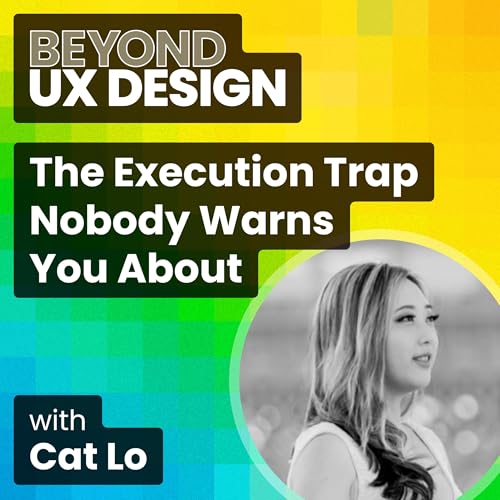
  • The Execution Trap Nobody Warns You About with Cat Lo
    May 1 2026
    Cat Lo spent 20 years learning that execution excellence can actually hold you back. After burning out at Amazon doing beautiful work that nobody noticed, she distilled her hard-won lessons into five tenets, a framework that helped her shape billion-dollar opportunities and drive $218 million in impact.What if the very thing that made you a great designer is the reason you’re being left out of the decisions that matter most?Cat Lo’s career has taken a path most designers don’t follow, starting with a bus ticket to New York City and no job waiting, through agency work, entrepreneurship, and eventually to Amazon, where she designs how millions of new products find their first customers. She didn’t take the traditional route from corporate to “I need freedom.” She went the other direction, deliberately. And that choice gave her a perspective on craft, scale, and influence that’s pretty hard to find in most design conversations.In this episode, Cat breaks down why execution excellence, the thing that gets you hired and earns you trust, can quietly become a trap. The better you get at delivering, the more delivery lands on your plate. And the more delivery on your plate, the less you’re involved in deciding what gets built in the first place. The result is a framework of five tenets she uses every day: find the smallest testable truth, let customer data be the tiebreaker, ship to learn rather than waiting for perfection, align on the problem, not the solution, and look for the invisible problems nobody else is paying attention to.Cat also walks us through a real example from her work at Amazon — a $7.8 billion market opportunity hiding in plain sight that most people had written off as not important enough to solve. It’s a masterclass in how individual contributors without direct authority can still shape strategy, build conviction, and make work impossible to ignore. If you’ve ever felt like you’re doing great work that just isn’t landing, this one is for you. Go give it a listen.Topics:• 03:27 - Cat’s Origin story: a bus ticket, $20, and no job waiting in New York City.• 05:08 - Career arc: fine arts → art director → entrepreneurship → Amazon.• 07:41 - Your skills are knobs, not switches. Learn when to turn each one up or down. • 10:07 - Every company speaks a different design language; you have to learn to speak theirs.• 14:17 - How to handle vague direction: match your response to the altitude of the ask.• 18:00 - Tenet 1: find the smallest testable truth before going wide.• 25:52 - Tenet 2: customer truth is the only real tiebreaker when opinions are flying. • 30:36 -Tenet 3: achievable now beats perfect later. Ship to learn, not to finish.• 37:33 - Tenet 4: alignment means agreeing on the problem, not the solution.• 41:00 - The brand name generator story and the $7.8B opportunity nobody was solving.• 48:00 - Tenet 5: look around the corner for the invisible problems no one’s been assigned.• 53:15 - How to build influence without authority: state your opinion clearly and stay flexible.• 01:04:05 - Where to find Cat: faangforcorporate.com.Helpful Links:• Connect with Cat on LinkedIn• Subscribe to FAANG Boss—Thanks for listening! We hope you dug today’s episode. If you liked what you heard, be sure to like and subscribe wherever you listen to podcasts! And if you really enjoyed today’s episode, why don’t you leave a five-star review? Or tell some friends! It will help us out a ton.If you haven’t already, sign up for our email list. We won’t spam you. Pinky swear.• ⁠⁠Get a FREE audiobook AND support the show⁠⁠• ⁠⁠Support the show on Patreon⁠⁠⁠⁠• ⁠⁠Check out show transcripts⁠⁠• ⁠⁠Check out our website⁠⁠• ⁠⁠Subscribe on Apple Podcasts⁠⁠• ⁠⁠Subscribe on Spotify⁠⁠⁠⁠• ⁠⁠Subscribe on YouTube⁠⁠• ⁠⁠Subscribe on Stitcher
    Show More Show Less
    1 hr and 9 mins
adbl_web_anon_alc_button_suppression_c
No reviews yet