Candid Conversations on Leadership cover art

Candid Conversations on Leadership

Candid Conversations on Leadership

By: Candice Solomon-Strutz and Chris Tidrick
Listen for free

About this listen

Candice Solomon-Strutz and Chris Tidrick have in-depth conversations about what it means to be a leader today. Candice and Chris are IT leaders at the University of Illinois at Urbana-Champaign and collectively have more than 50 years of experience working in higher education. You can find Candice at @caniso13 on Instagram, Twitter, Threads, and TikTok and @candicesolomonstrutz on LinkedIn. You can find Chris at @think.feel.lead on Instagram, Threads, and TikTok, and @christophertidrick on LinkedIn.Candice Solomon-Strutz and Chris Tidrick Personal Development Personal Success
Episodes
  • Episode 2.04 A Journey to Inclusive Leadership with Dean Venetria K. Patton
    Mar 24 2026

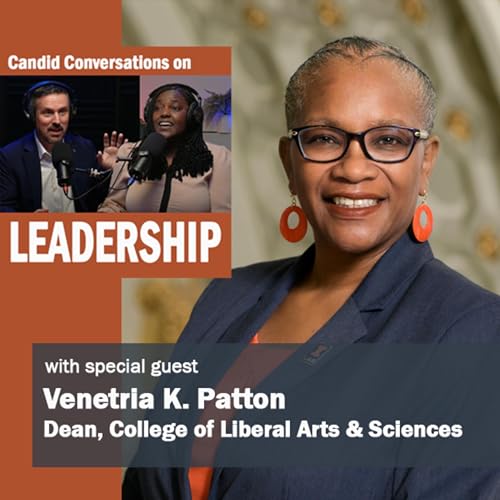
    In this episode of Candid Conversations, Chris and Candice welcome Venetria K. Patton, the Harry E. Preble Dean of the College of Liberal Arts and Sciences. Dean Patton reflects on the leadership journey that brought her from faculty roles in English and African American studies to major administrative positions at Purdue University and the University of Illinois. She opens up about the early experiences that shaped her understanding of leadership, including serving on a graduate advisory committee and learning the value of having a seat at the table where decisions are made.

    Patton also shares the influence of mentors and role models who modeled strong leadership through listening, thoughtfulness, and the ability to navigate conflict. Just as important, she explains how she learned from less effective leaders by observing what not to do. That perspective helped her develop a leadership philosophy centered on integrity, collaboration, and inclusive decision-making, with a focus on creating environments where people feel heard, valued, and empowered to contribute.

    The conversation turns to her academic work and the challenge of balancing scholarship with the demands of being dean of the largest college on campus. Patton discusses her research on Black women writers and the Harlem Renaissance, along with the ongoing projects she continues to pursue while managing a packed administrative schedule. She also speaks about the college’s future, including online degree completion, AI, academic freedom, personalized education, and the need to help LAS stand out as a place of broad expertise and impact across many disciplines.

    Later in the episode, Patton reflects on the habits that sustain her, from intentional work-life integration to protecting time for family, rest, and even a relaxing hair appointment. She also shares a surprising personal side: her background as a dancer, soccer player, coach, and referee, and how those experiences still shape her leadership today. The conversation closes with a thoughtful reminder that people should not postpone their lives in pursuit of work alone, and that balance, joy, and purpose matter now.

    Candice and Chris are IT leaders at the University of Illinois at Urbana-Champaign and collectively have more than 50 years of experience working in higher education. Candice is currently the Senior Director of IT Partners at the College of Applied Health Sciences and Chris is the Chief Information Officer and Senior Director of IT Partners at the Gies College of Business.

    Show More Show Less
    29 mins
  • Episode 2.03 Leading Through Our Fractures
    Feb 22 2026

    In this episode, Chris and Candice go one-on-one for a candid conversation sparked by Chris’s recent Substack post, “Leading Through Our Fractures.” They open by grounding the moment in Black History Month, with Candice noting its significance and encouraging listeners to keep learning because Black history is American history. From there, the episode settles into a reflective, personal discussion about leadership, identity, and the real stories that shape how we show up at work.


    Chris introduces the core idea behind “leading through our fractures”: the belief that leaders don’t become credible by appearing flawless—they become relatable by acknowledging what’s real. He connects this to the Japanese art of kintsugi, where broken pottery is repaired with gold, making the cracks part of the beauty rather than something to hide. Candice shares why this resonated so deeply: our flaws and missteps aren’t just baggage, they’re often the very things that make us uniquely grounded, empathetic, and effective—if we learn how to carry them with intention.


    Together, they explore the tricky middle ground between being an authentic, vulnerable leader and oversharing in a way that becomes unsteady or inappropriate. Candice talks about learning where that line is by watching examples of what not to do, and by paying attention to feedback when she shares something personal in a way that helps others grow. They dig into empathy too—how it’s less about claiming you “know exactly how someone feels” and more about listening, asking questions, and letting your own experiences with challenge make you more compassionate without turning it into a comparison game.


    The conversation gets personal as both reflect on how childhood experiences echo into adulthood leadership. Chris names the lingering impact of not being “picked” growing up, and how that quietly fueled a need for approval and expertise—until he learned to notice it and choose differently. He also brings in ideas from Positive Intelligence (and the notion of internal “saboteurs”), sharing how his own restlessness can push unnecessary change unless he checks his motives. They wrap on a lyrical note, referencing a line Candice highlighted—about broken pieces, scars, and harmony—underscoring the episode’s theme: when leaders embrace the cracks with honesty and boundaries, they don’t look weaker… they look more whole.


    To read the article that inspired this epiosde, please visit https://thinkfeellead.substack.com/p/leading-through-our-fractures

    Show More Show Less
    32 mins
  • Episode 2.02 Servant Leadership with James Quisenberry
    Nov 9 2025

    In this episode of Candid Conversations on Leadership, Chris and Candice welcome guest James Quisenberry, who leads IT for Student Affairs at the University of Illinois Urbana-Champaign and co-founded the campus IT Leadership Workshop. Together they unpack servant leadership—rooted in Robert Greenleaf’s 1970 essay “The Servant as Leader”—as a philosophy where a leader’s primary goal is to serve the people and the organization. Candice walks through hallmark traits like empathy, deep listening, community-building, self- and organizational awareness, stewardship, commitment to growth, and humility—framing how these build trust, morale, innovation, retention, and ethical cultures.


    The trio contrasts servant leadership with more traditional, hierarchical models, noting how generational shifts changed how people want to be led. They surface a core tension leaders must navigate: balancing autonomy and agency with organizational clarity and speed. Chris shares how his team uses “disagree and commit” to invite inclusive debate before moving decisively—and how accountability is not at odds with compassion. James pushes back on the misconception that servant leadership is “soft,” arguing it often means serving people best by holding them to clear standards, and by prioritizing the whole organization over a one-to-one dynamic.


    Personal origin stories come through: Candice’s grounding in Alpha Phi Omega’s service ethos; James’ upbringing with educator parents and long-time involvement in Rotary and Scouting; and Chris recognizing service in his own leadership through feedback from his team. They explore how to cultivate the “heart” of a servant leader—through active listening reps, identity-based habits, and service outside of work. Mentorship and coaching emerge as essential—trusted partners who “won’t let you believe your own BS” and help you check ego, motivation, and perception.


    Finally, they get candid about the hard parts: resisting the urge to rush to solutions, getting out of your own head, and truly listening (especially when you love to talk). They offer practical moves: ask “What serves the organization?” on big calls; celebrate team contributions so success is shared; treat ego as a potential tailwind—not a headwind; and use accountability to remove barriers to others’ growth. Chris closes with a story where stepping back let the team find a better answer—proof that servant leadership can drive both stronger culture and stronger results.

    Show More Show Less
    32 mins
No reviews yet