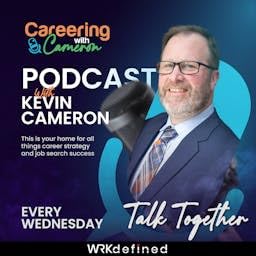
Careering with Cameron cover art

Careering with Cameron

Careering with Cameron

By: WRKdefined Podcast Network
Listen for free

Welcome to the Careering with Cameron podcast, your home for all things career strategy and job search success! Hosted by Kevin Cameron, this is the safe place for you to ask all the "dumb questions" about finding a job. What to Expect: Are you finishing college or graduate school and just starting your career? Are you a bright, data-driven individual in a STEM field (Science, Tech, Engineering, or Math) who may struggle with people skills? If you're wondering "what's next," you are in the right place. Kevin's goal is to give you a clear, step-by-step roadmap for your career journey. We'll walk through the often-confusing process of finding a job so you can feel ready and empowered. The ultimate goal is not just to apply for positions, but to find meaningful work that aligns with your passion. Meet Your Host: Kevin Cameron brings over 20 years of experience as a recruiter and is an ICF-certified professional coach. Having been "on the other side of the desk" for two decades, he's bringing the inside scoop to help you: Think like a recruiter so you can land the job you want. Get actionable advice and best practices for resume writing, interview questions, negotiating offers, and more. You don't have to navigate this career search alone! New episodes drop every Wednesday. Be sure to subscribe and follow us on social media @careeringwithcameron_ on Instagram!All rights reserved by WRKdefined Career Success Economics
Episodes
  • The Reverse Application: How to Get Hired Without a Job Posting
    Jul 1 2026
    In this solo episode, Kevin Cameron breaks down a concept that's not new, but rarely named: the reverse application. If you're tired of applying into a black hole and hearing nothing back, this episode flips the entire process upside down - starting with who you want to talk to, not what job is posted. Kevin Cameron explains how the informational interview works, why C-suite leaders are often more open to a conversation than you'd expect, and how to build a network you can return to throughout your career, not just when you're desperate for a job. Key Takeaways The reverse application starts with the skills you enjoy using, then finds where those skills are needed - not the other way around. Informational interviews are about understanding culture and fit, not pitching yourself for a role. Reach out using common ground: shared schools, employers, or events you both attend. Senior leaders are often more receptive to a conversation than junior staff. Track every conversation in a spreadsheet or CRM — it becomes one of your most valuable career assets. Follow up no more than once every three to four days if there's been no response, weekly once a conversation is ongoing. Episode Highlights Why this strategy has always existed under a different name: networking. The difference between an informational interview and a sales pitch. How to identify which companies might have an opening before a job is ever posted. Why people don't respond right away — and why that has nothing to do with you. How to keep the door open after a great conversation that didn't lead anywhere yet. Timestamps 00:00 — Introduction: what is the reverse application 01:56 — What an informational interview really is 04:00 — Preparing questions and doing your research 05:55 — Finding common ground to start a conversation 07:58 — Why C-suite leaders are often the most open to chatting 10:03 — Working backwards: skills, organisations, and your network 12:28 — Taking job search out of luck and into language 14:18 — Preparing your "elevator" direction 16:26 — Following up without overdoing it 19:59 — Why people don't respond right away 21:26 — Tracking your network like a career-long asset 23:40 — Final thoughts If you found this advice valuable, please hit subscribe, leave us a review. Visit Talent Connect: Website: www.talent-connect.net LinkedIn: Talent-Connect Kevin's LinkedIn: Kevin Cameron PCC Production Credit: Edited and produced by @the32collective_ / https://www.the32collective.co/
    Show More Show Less
    25 mins
  • The One Word Costing You the Job | with Lili Foggle
    Jun 24 2026
    Getting to the interview is hard enough right now but what happens when you get there and still don't get the job? In this episode, Kevin Cameron sits down with Lili Foggle of Impressive Interviewing, a communication coach with 10 years of experience, to talk about what actually separates the number one candidate from everyone else. Lili breaks down why skills alone won't get you the offer in the final round, how to use AI smartly without sabotaging yourself, and the one language mistake quietly costing candidates — especially women — jobs they're more than qualified for. Key Takeaways In the final round, everyone can do the job — the decision shifts to trust, likability, and fit. Research the company's real values by looking at what leadership is actually saying, not just the website. Never ask AI to write your interview answers. Use it for research and gap analysis. Stop using "we" for your achievements — own your contribution with "I." Your closing questions should be so specific they couldn't be asked anywhere else. Chaos in the hiring process usually means chaos in the culture. Episode Highlights Why only 3% of applicants land an interview and what that means for your prep. The shift that happens in the final round and why likability outweighs skills. Lili's five-list method for breaking down any job description. The study of 25,000 interview answers that proved "I" language predicts hiring decisions. The ping pong rule for small talk that makes you instantly more memorable. Timestamps 00:00 — Introduction 01:03 — Lili's background and Impressive Interviewing 03:18 — The 3% interview rate and the AI recruiting doom loop 06:02 — True or false: skills are what get you hired 07:10 — What actually decides the final round 08:10 — Fit for the team vs fit for the role 10:34 — The cheat code: deep research 13:50 — Questions that show interest vs questions that show doubt 16:32 — How to use AI in interview prep — and how not to 19:44 — The five-list method for job description analysis 23:22 — How to handle panel interviews 27:41 — How to close the final round 29:44 — The question that couldn't be asked anywhere else 32:41 — Why "we" is erasing you from your own success stories 38:35 — Lili's why Connect With Lili Prepare for your next interview: https://impressiveinterviewing.com Become an interview coach: https://parwcc.com/interview-institute/ TikTok: https://www.tiktok.com/@yourinterviewcoach LinkedIn: https://www.linkedin.com/in/lilifoggle/ If you found this advice valuable, please hit subscribe, leave us a review. Visit Talent Connect: Website: www.talent-connect.net LinkedIn: Talent-Connect Kevin's LinkedIn: Kevin Cameron PCC Production Credit: Edited and produced by @the32collective_ / https://www.the32collective.co/
    Show More Show Less
    43 mins
  • Why Your Workplace Is Failing Neurodivergent Employees | with Shea Belsky
    Jun 17 2026
    What does it actually take to create a fair hiring process for neurodivergent candidates and why does it matter for everyone, not just a few? In this episode, Kevin Cameron sits down with Shea Belsky, an autistic software engineer and neurodiversity advocate, to talk about the parts of hiring and onboarding that most companies are quietly getting wrong. Shea brings a direct, no-fluff perspective on when and how to disclose a diagnosis, why accommodations are an investment not an expense, and what onboarding looks like when it actually works. If you manage people, hire people, or are neurodivergent yourself — this conversation will shift how you think. Key Takeaways When disclosing a neurodivergent diagnosis, always frame it around a specific need — not just the label. The return on investment is a more capable, more confident employee. One in seven people worldwide are neurodivergent — far more than most workplaces acknowledge. Dropping someone into a new role with no ramp-up hurts everybody, but hits neurodivergent employees hardest. Workplace tools like AI note-taking and quiet rooms benefit the whole team — not just one person. Framing your needs to a hiring manager is not a warning. It is a map to your best work. Episode Highlights Why disclosing a diagnosis without context can backfire — and how to frame it effectively. The honest case for why accommodations pay for themselves. How one in seven people around you may be neurodivergent without either of you knowing it. The onboarding mistake that sets people up to fail from day one. Shea's vision for a tool that helps every employee cut through the masking and communicate what they actually need. Timestamps 00:00 — Introduction 02:28 — What neurodivergent candidates face in interviews 04:39 — When and how to disclose: framing it as a need 06:00 — What to tell a hiring manager vs a recruiter 07:21 — Why hiring managers fear getting it wrong 09:28 — Accommodations as investment, not expense 13:27 — Most common accommodations in interviews and on the job 15:11 — AI tools and cultural shifts that benefit everyone 17:29 — How many people around you are neurodivergent 23:43 — The onboarding mistakes companies keep making 29:08 — What Shea wishes existed for every employee 33:35 — Framing your needs as your superpower 35:12 — Shea's why Connect With Shea LinkedIn: linkedin.com/in/sheabelskyWebsite: https://www.sheabelsky.com/ If you found this advice valuable, please hit subscribe, leave us a review. Visit Talent Connect: Website: www.talent-connect.net LinkedIn: Talent-Connect Kevin's LinkedIn: Kevin Cameron PCC Production Credit: Edited and produced by @the32collective_ / https://www.the32collective.co/
    Show More Show Less
    37 mins
adbl_web_anon_alc_button_suppression_t1
No reviews yet