Episodes

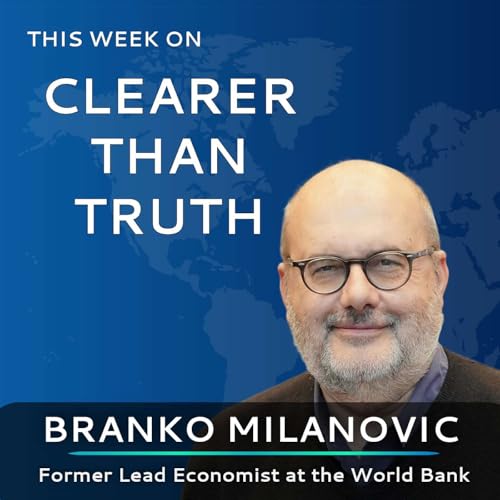
  • Branko Milanović
    Apr 8 2026

    Branko Milanović is one of the world’s leading economists and a former lead economist at the World Bank. Known for his groundbreaking work on global inequality, Milanović has spent decades analyzing how wealth and power shift across countries and individuals.

    In this episode, Milanović argues that the era of neoliberal globalization is over—and is being replaced by what he calls “national liberalism.” He explains how countries are abandoning free trade and global integration while continuing pro-market policies at home, creating a new and more fragmented economic system.

    The conversation explores the rise of Asia, the decline of Western economic dominance, and how global income is being reshuffled across both nations and individuals. Milanović also breaks down why some economic policies can be “lose-lose” in absolute terms but still make sense geopolitically, and how inequality—both within and between countries—continues to shape global stability.

    Support the show

    Show More Show Less
    32 mins
  • Charles Kupchan
    Apr 6 2026

    Charles Kupchan is a professor of international affairs at Georgetown University and a senior fellow at the Council on Foreign Relations. He previously served on the National Security Council under Presidents Bill Clinton and Barack Obama, helping shape U.S. policy toward Europe.

    In this episode, Kupchan explains his concept of “liberal realism” and why he believes the world is entering a new geopolitical era—one defined not by a single dominant power, but by a fragmented, “de-centered” global order. He discusses the decline of multilateral institutions, the uncertain future of NATO, and the growing shift of power from West to East and North to South.

    The conversation also explores whether the liberal international order is truly collapsing, what a multipolar world means for global stability, and why democracies must adapt to survive in the digital age. Kupchan offers a sobering look at the future of global cooperation, warning that demand for coordination is rising just as the ability to achieve it is declining.

    Support the show

    Show More Show Less
    27 mins
  • Ram Charan
    Mar 25 2026

    Ram Charan is a world-renowned business advisor, speaker, and author who has spent decades coaching top CEOs and boards across the globe. He is the author of more than 30 books, including the bestseller Execution, and his latest, China’s 90% Model, argues that Beijing is pursuing a strategy of total industrial dominance.

    In this episode, Charan outlines his controversial thesis that China’s goal is not just to compete globally—but to eliminate the industrial capacity of rival nations through what he calls the “90% model.” He explains how China uses scale, subsidies, and pricing power to dominate entire industries, from solar to electric vehicles, and warns that this strategy could reshape the global economic order.

    The conversation explores whether this represents a new kind of economic warfare, why tariffs may not be effective, and what a realistic U.S. response could look like—from industry-by-industry negotiation to deeper coordination with allies. Charan also discusses the geopolitical implications of China’s rise, the risks to Western manufacturing, and what the next decade could mean for global power.

    Support the show

    Show More Show Less
    40 mins
  • Mohammed Soliman
    Mar 15 2026

    Mohammed Soliman is a senior fellow at the Middle East Institute, director at McLarty Associates, and a nonresident senior fellow at the Foreign Policy Research Institute. He is also the author of West Asia: A New Grand Strategy for the Middle East.

    In this episode, Soliman argues that policymakers should stop thinking about the region as the “Middle East” and instead understand it as West Asia—a strategic crossroads increasingly shaped by the rise of Asia, shifting trade routes, and emerging technology infrastructure. Drawing on themes from his new book, he explains how energy flows, migration, supply chains, and capital investment are linking the Gulf, South Asia, Europe, and Africa into a single geopolitical system.

    The conversation explores the growing role of India and the Gulf states in global trade, the strategic implications of the India–Middle East–Europe Economic Corridor, and how artificial intelligence infrastructure and data centers are becoming new strategic targets in modern warfare. Soliman also discusses how conflicts in the region could reshape Asian geopolitics and why U.S. strategy should focus less on military dominance and more on flexible coalitions and economic integration across West Asia.

    Support the show

    Show More Show Less
    39 mins
  • Ravi Agrawal
    Mar 10 2026

    Ravi Agrawal is the Editor-in-Chief of Foreign Policy and the host of FP Live. In this conversation, he discusses the implications of a new Middle East conflict and what it reveals about America’s evolving role in the global order.

    Agrawal explains the concept of a “world minus one”—a moment of transition where the United States appears to be stepping back from the international system it helped build. He examines the risks of military action taken without clear objectives, the precedent set by targeting foreign leaders, and how such actions may reshape global norms around power and sovereignty. The discussion also explores the potential ripple effects for Russia, China, and global energy markets, as well as the long-term consequences for nuclear proliferation and international institutions.

    Support the show

    Show More Show Less
    39 mins
  • Benjamin Nathans
    Mar 9 2026

    Benjamin Nathans is a Pulitzer Prize–winning historian and professor at the University of Pennsylvania. He is the author of To the Success of Our Hopeless Cause: The Many Lives of the Soviet Dissident Movement, an acclaimed work that explores the individuals and ideas behind resistance to Soviet authoritarianism. Nathans’s research focuses on Russian and Soviet history, political dissent, and the struggle for human rights under authoritarian regimes.

    Support the show

    Show More Show Less
    45 mins
  • Yukon Huang
    Feb 26 2026

    Yukon Huang is a senior fellow at the Carnegie Endowment for International Peace and a leading authority on China’s economy and global financial relations. He previously served as the World Bank’s Country Director for China and Russia, giving him firsthand insight into the economic transformations of two major global powers. Huang’s work focuses on China’s growth model, U.S.–China tensions, and the evolving role of emerging markets in the global economy, making him a key voice in debates over trade, development, and geopolitics.

    Support the show

    Show More Show Less
    41 mins
  • Edward Luce
    Feb 9 2026

    Edward Luce is the chief U.S. commentator and columnist for the Financial Times, where he covers American politics, foreign policy, and global power shifts. He is the author of several acclaimed books, including Zbig: The Life of Zbigniew Brzezinski, America’s Great Power Prophet, a definitive biography of one of the most influential strategic thinkers of the Cold War era. Luce is widely respected for his sharp analysis of U.S. leadership, geopolitics, and the future of the liberal international order.

    Support the show

    Show More Show Less
    31 mins