

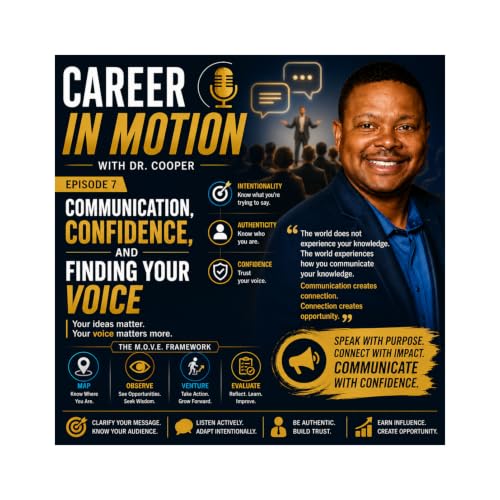
Communication, Confidence, and Finding Your Voice | Careers in Motion with Dr. Cooper
Failed to add items
Add to basket failed.
Add to wishlist failed.
Remove from wishlist failed.
Adding to library failed
Follow podcast failed
Unfollow podcast failed

Communication, Confidence, and Finding Your Voice | Careers in Motion with Dr. Cooper
-
Narrated by:
-
By:
Episode 7 – RSS Show Notes
Dr. Cooper explores one of the most important professional skills:
Communication
Not simply public speaking.
Not simply presentations.
Not simply email.
Communication is how your experiences, knowledge, skills, and ideas come alive in other people's minds.
You can have tremendous expertise, experience, and credentials. But if you cannot communicate, the world may never fully understand the value you bring.
As Dr. Cooper explains:
Communication is not simply talking. Communication is translation.
It is the ability to take what is in your mind and intentionally help another person understand it.
Every interaction involves:
- a sender
- a message
- an audience
- context
- perceptions
- noise
- interpretation
- feedback
Communication is wonderfully messy.
Within the M.O.V.E. framework, communication falls under:
E = Evaluate
Great communicators are constantly evaluating.
They ask:
- Am I being understood?
- Does this message fit my audience?
- What feedback am I receiving?
- Should I pivot?
- Is my message landing?
Communication, like career movement, requires adaptation.
The episode also explores three essential ingredients of effective communication:
- Intentionality
- Authenticity
- Confidence
Listeners are reminded that communication is about connecting.
Dr. Cooper also challenges the idea that communication is a natural talent, but a developmental skill that can be practiced and improved through:
- message organization
- tone
- delivery
- listening
- presence
- persuasiveness
- feedback
- reflection
At the center of the episode is an important realization:
The world does not experience your knowledge. The world experiences how you communicate your knowledge.
Listeners become more intentional, authentic, and confident communicators in their everyday interactions.
Key Topics Discussed
- Why communication is a critical career skill
- Communication as translation and connection
- The communication process and its complexities
- Intentionality, authenticity, and confidence
- Communication as a developmental skill
- The importance of feedback and adaptation
- Presence, delivery, and persuasiveness
- Communication and career movement
Listener Takeaways
- Communication is much more than speaking.
- Great communicators continuously evaluate and adapt.
- Confidence in communication is built, not inherited.
- Communication improves through practice and reflection.
- Intentionality and authenticity matter more than perfection.
- Listening is just as important as speaking.
- Strong communication creates connection, trust, and opportunity.
Career in Motion Challenge
Choose one communication interaction this week.
After it is over, spend five minutes reflecting:
- What was my intended message?
- Was I understood?
- Did I adapt to my audience?
- What feedback did I observe?
- What would I do differently next time?
Repeat this process for one week.
Then ask yourself:
“Am I becoming more intentional, authentic, and confident in my communication?”