• Ep. 15: Industrial AI’s reality check, with Josh Peeno of JPeeno Innovation Group
    May 4 2026

    In this episode of Ctrl+Alt+Mfg, Josh Peeno, P.E., joins the conversation to explore why so many digital transformation and AI initiatives in manufacturing fall short. It’s not because the technology isn’t powerful; it’s because it often isn’t built for the realities of the plant floor. Drawing on his experience in heavy manufacturing and industrial AI, Peeno explains why successful transformation requires operator trust, practical deployment strategies and a deep understanding of how factories actually run.

    Peeno also discusses the concept of “machine teaching,” using human expertise to train autonomous AI systems in a way that supports operators rather than replaces them. He shares lessons from applying AI in glass manufacturing, talks about the value of fractional technical leadership for mid-sized manufacturers and explains why the industry’s looming skills gap may be one of the biggest drivers for smarter automation.

    Chapters
    • (00:00:00) - The Reality of AI in Manufacturing
    • (00:04:55) - Understanding Digital Transformation Challenges
    • (00:09:05) - Bridging the Gap in Manufacturing
    • (00:14:36) - The Human Element in Digital Transformation
    • (00:18:34) - AI: Fear and Resistance on the Plant Floor
    • (00:21:23) - AI as the Apprentice in Manufacturing
    • (00:30:43) - Fractional Leadership: A New Approach
    • (00:33:35) - Teaching the Next Generation of Engineers
    • (00:35:50) - Global Competitiveness in Manufacturing
    Show More Show Less
    44 mins
  • Ep. 14: From data silos to smart factories, with John Dyck of CESMII and John Harrington of HighByte
    Apr 21 2026

    In this episode of Ctrl+Alt+Mfg, Gary Cohen and Stephanie Neal sit down with John Dyck, CEO of CESMII, and John Harrington, chief product officer at HighByte, to talk about why interoperability is one of the biggest barriers to smart manufacturing.

    As manufacturers invest in connected systems, cloud platforms, analytics and AI, many are still struggling to turn that technology into real business value because their data remains trapped in silos. Dyck and Harrington explain why interoperability has become more than just a technical challenge, how legacy systems and one-off integrations have slowed progress and why a more open, standardized approach is critical for scaling digital transformation across the enterprise.

    The conversation also dives into CESMII’s Industrial Information Interoperability Exchange (i3X), the role of collaboration between manufacturers and software providers and why interoperability could be the foundation for the next generation of industrial AI.

    Chapters
    • (00:00:00) - The Importance of Interoperability in Manufacturing
    • (00:04:20) - Introduction to Smart Manufacturing Institute
    • (00:10:55) - Understanding Smart Manufacturing vs Digital Transformation
    • (00:12:33) - High Byte's Role in Data Integration
    • (00:18:01) - Challenges of Data Silos in Manufacturing
    • (00:20:03) - Industrial Information Interoperability Exchange Initiative
    • (00:21:24) - Collaboration Among Competitors
    • (00:23:11) - Integrating Industrial Data
    • (00:24:59) - Advancements in Specification Implementation
    • (00:26:47) - The Importance of Abstraction in Technology
    • (00:29:09) - Shifting Mindsets in Technology Providers
    • (00:30:37) - Ecosystem of Specialists in Manufacturing
    • (00:33:09) - AI's Role in Scaling Manufacturing Operations
    • (00:34:35) - An Inflection Point in Manufacturing Innovation
    • (00:36:27) - Interoperability as an Accelerator
    • (00:38:47) - The Future of Smart Factories
    • (00:45:00) - The Human Element
    Show More Show Less
    46 mins
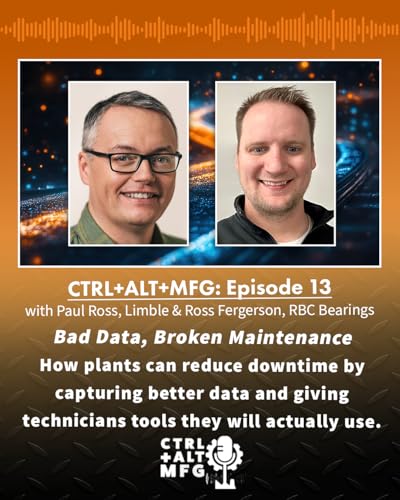
  • Ep. 13: Bad data, broken maintenance with Paul Ross of Limble and Ross Fergerson of RBC Bearings
    Apr 7 2026

    What’s really holding manufacturers back from smarter maintenance? While many point the finger at AI or automation, bad data might be the real culprit.

    In this episode of Ctrl+Alt+Mfg, Gary Cohen and Stephanie Neil talk with Paul Ross of Limble and Ross Fergerson of RBC Bearings about why so many plants are still stuck in reactive maintenance mode and what it takes to move toward more proactive, data-driven operations.

    They explore the maintenance maturity curve, the role of modern CMMS platforms and why technician-friendly tools are essential for adoption. Fergerson also shares how RBC Bearings replaced a legacy system and rolled out a new CMMS in just eight months, improving visibility, reducing paperwork and building trust across the organization.

    The conversation looks at how better maintenance data can preserve tribal knowledge, improve planning and make AI more practical on the plant floor.

    Chapters
    • (00:00:00) - Introduction to Smarter Manufacturing
    • (00:03:44) - The Importance of Maintenance Data
    • (00:07:32) - Understanding CMMS and Its Role
    • (00:11:41) - Transitioning from Legacy Systems
    • (00:18:12) - Accelerating Adoption of New Technologies
    • (00:20:23) - The Role of AI in Maintenance
    • (00:23:00) - Addressing Common Maintenance Challenges
    • (00:27:04) - Transforming Maintenance from Cost Center to Profit Center
    • (00:28:52) - Operational Changes Post-Implementation
    • (00:31:59) - Advice for Modernizing Maintenance
    Show More Show Less
    38 mins
  • Ep. 12: Why system integrators matter more than ever in the age of AI, with Adrienne Meyer of CSIA
    Mar 24 2026

    In this episode of Ctrl+Alt+Mfg, Gary Cohen and Stephanie Neil talk with Adrienne Meyer, CEO of the Control System Integrators Association (CSIA), about why system integrators are becoming more essential than ever in modern manufacturing. As companies push ahead with AI, digital transformation, robotics and smarter automation, integrators are the ones connecting systems, software and operations to make those investments actually work.

    Meyer shares how the role of the system integrator is evolving beyond traditional controls work into data-centric, networked and AI-aligned solutions. She also discusses the biggest trends shaping the market right now, including workforce shortages, brownfield upgrades, cybersecurity demands and the growing opportunities in data centers, semiconductors and defense.

    The conversation also looks at the value CSIA brings to the integration community, why collaboration remains so important in a competitive market and what attendees can expect from the 2026 CSIA Conference in Baltimore.

    Chapters
    • (00:00:00) - System Integrators: Driving the Future of Manufacturing
    • (00:07:01) - Meet Adrienne Meyer: New CEO of CSIA
    • (00:09:50) - The Role of CSIA and System Integrators
    • (00:17:47) - Current Trends and Opportunities in System Integration
    • (00:22:34) - Upcoming CSIA Conference Highlights
    • (00:25:41) - Navigating Change in System Integration
    • (00:30:02) - Addressing Workforce Shortages and AI Adoption
    • (00:31:49) - Technological Opportunities and Disruptions
    • (00:35:58) - Closing Thoughts and Future Directions
    Show More Show Less
    39 mins
  • Ep. 11: What plant engineers really want, with Amara Rozgus of Plant Engineering
    Mar 3 2026

    Manufacturing may be stabilizing but its workforce is at a turning point.

    In this episode of Ctrl+Alt+Mfg, Amara Rozgus, editor-in-chief of Plant Engineering, breaks down insights from the 2026 Plant Engineering Salary Survey. The data shows a highly experienced, well-paid and satisfied workforce, but one that’s rapidly nearing retirement, with too few junior engineers coming up behind them.

    We discuss the growing skills gap, declining entry-level salaries, the risk of institutional knowledge loss and how AI is being viewed on the plant floor. Is it a helpful tool or a potential threat?

    If you’re thinking about workforce strategy, digital transformation or the future of manufacturing talent, this episode is for you.

    Chapters
    • (00:00:00) - Introduction to Manufacturing Challenges
    • (00:01:29) - Stephanie Gets Catfished Over a Dog
    • (00:05:12) - The State of the Plant Engineering Workforce
    • (00:07:12) - Insights from the 2026 Salary Survey
    • (00:10:25) - The State of Manufacturing Engineering
    • (00:15:15) - The Aging Workforce and Skills Gap
    • (00:23:13) - The Role of AI in Manufacturing
    • (00:27:08) - Conclusion and Future Outlook
    Show More Show Less
    29 mins
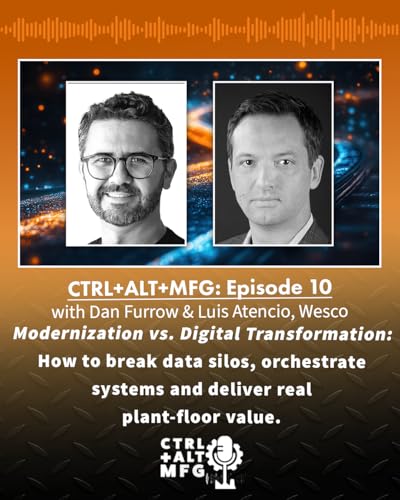
  • Ep. 10: Modernization vs. digital transformation, with Dan Furrow and Luis Atencio of Wesco
    Feb 17 2026

    Digital transformation remains a top priority for manufacturers, but many initiatives still stall between strategy and execution.

    In this episode of Ctrl+Alt+Mfg, Dan Furrow, senior vice president and general manager, U.S. industrial, global accounts and international markets, at Wesco, and Luis Atencio, solutions architect for Wesco’s smart manufacturing team, join the podcast to explore what separates modernization from true digital transformation.

    They discuss:

    • Why modernization is only the foundation
    • How data silos undermine enterprise-wide visibility
    • The importance of orchestration when integrating hardware, software and systems
    • How AI can support workforce continuity and reduce unplanned downtime
    • Why successful initiatives begin with business outcomes, not technology trends

    With real-world examples and practical best practices, this episode provides a grounded look at how manufacturers can unlock value from the data they already have.

    Chapters
    • (00:00:00) - Introduction to Digital Transformation in Manufacturing
    • (00:05:37) - Understanding Modernization vs. Digital Transformation
    • (00:10:12) - The Role of Friction in Transformation
    • (00:14:57) - Breaking Down Silos in Manufacturing
    • (00:18:30) - The Importance of Orchestration
    • (00:20:44) - Data as a Critical Asset
    • (00:25:07) - Real-World Applications of Data Integration
    • (00:29:21) - Common Themes in Successful Projects
    • (00:32:31) - Best Practices for Manufacturers
    • (00:34:55) - Conclusion and Key Takeaways
    Show More Show Less
    37 mins
  • Ep. 9: When cyberattacks go physical, with Ian Bramson of Black & Veatch
    Feb 3 2026

    Cybersecurity threats are no longer confined to IT systems. They’re now crossing into the physical world, with real consequences for manufacturing, supply chains and critical infrastructure. In this episode of Ctrl+Alt+Mfg, hosts Gary Cohen and Stephanie Neil are joined by Ian Bramson, vice president of global industrial cybersecurity at Black & Veatch, to unpack what this shift means for industrial organizations.

    The conversation explores why the industrial attack surface is expanding, how supply chains and legacy systems create hidden vulnerabilities and why cybersecurity needs to be built in early through concepts like clean build, not bolted on after startup. Bramson also dives into how attackers are using AI, what “AI vs. AI” means for defenders and the unique challenges of securing OT environments as operations move to the cloud. HIs takeaway is to keep it simple, start early and focus on building a resilient cybersecurity foundation that can adapt as technology — and threats — continue to evolve.

    Chapters
    • (00:00:00) - Introduction to Cybersecurity in Manufacturing
    • (00:05:47) - The Growing Threat of Cyberattacks
    • (00:09:25) - Evolving Cybersecurity Landscape
    • (00:13:34) - The Concept of Clean Build
    • (00:17:43) - Supply Chain Vulnerabilities
    • (00:23:06) - AI in Cybersecurity: Opportunities and Threats
    • (00:27:04) - Cloud Security Challenges
    • (00:29:47) - Final Thoughts and Key Takeaways
    Show More Show Less
    34 mins
  • Ctrl+Alt+Mfg Ep. 8: Inside the 2026 State of Automation Report, with Mark Hoske, Control Engineering
    Jan 20 2026

    Automation is no longer optional, but where should manufacturers invest to see real returns?

    In this episode of Ctrl+Alt+Mfg, we’re joined by Mark Hoske, editor-in-chief of Control Engineering, to break down the findings of the 2026 State of Industrial Automation Report. We discuss where automation is delivering measurable ROI, why advanced process controls continue to lead, how manufacturers are balancing efficiency with risk and what year-over-year data reveals about changing adoption trends.

    The conversation also explores workforce challenges, skills gaps and how automation is being used to create higher-skill roles rather than replace workers. If you’re specifying, implementing or justifying automation investments, this data-driven episode cuts through the hype to focus on what’s actually happening on today’s plant floors.

    Chapters

    00:00 Introduction to Automation and Manufacturing Trends

    08:58 Insights from the 2026 State of Automation Report

    18:19 Key Findings and Surprises in Automation Investments

    21:42 Emerging Technologies in Automation

    23:41 Insights from the 2025 State of Automation Report

    24:52 Looking Ahead: The 2026 Automation Report

    27:25 The Importance of Community in Automation Research

    28:53 Future Trends and Research in Automation

    31:03 Connecting the Dots: Automation and Community Engagement

    Chapters
    • (00:00:00) - Introduction to Automation and Manufacturing Trends
    • (00:08:58) - Insights from the 2026 State of Automation Report
    • (00:18:19) - Key Findings and Surprises in Automation Investments
    • (00:21:42) - Emerging Technologies in Automation
    • (00:23:41) - Insights from the 2025 State of Automation Report
    • (00:24:52) - Looking Ahead: The 2026 Automation Report
    • (00:27:25) - The Importance of Community in Automation Research
    • (00:28:53) - Future Trends and Research in Automation
    • (00:31:03) - Connecting the Dots: Automation and Community Engagement
    Show More Show Less
    32 mins