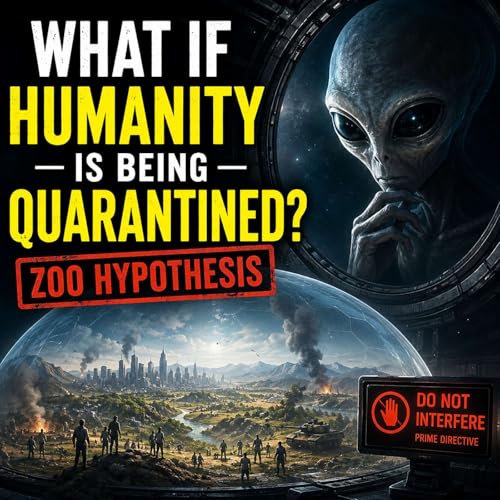
• What If Humanity Is Being Quarantined? The Zoo Hypothesis
    Jun 1 2026

    Are we alone in the universe… or are we being intentionally isolated from it?

    In this episode of Entropy Rising, we dive into one of the most unsettling solutions to the Fermi Paradox: the Zoo Hypothesis. The idea is simple but disturbing. Advanced alien civilizations may already know humanity exists and are deliberately avoiding contact.

    But why?

    We explore the different versions of the theory, from civilizations observing us like animals in a cosmic nature documentary to galactic “prime directives” that prevent interference with developing species. We also discuss whether humanity is actually too dangerous, too primitive, or simply not advanced enough yet to join a larger galactic community.

    Along the way we tackle:
    • The Fermi Paradox and why the universe seems silent
    • Whether humanity is unusually violent or just average
    • If advanced civilizations could realistically hide from us
    • Why a galactic quarantine might exist
    • The connection between the Zoo Hypothesis and simulation theory
    • Whether curiosity alone would eventually break the quarantine
    • The terrifying possibility that aliens may already be watching humanity

    Could Earth be an uncontacted tribe on a galactic scale? Or are we simply early in the history of intelligent life?

    Support the show

    Website: https://www.entropy-rising.com/

    Show More Show Less
    28 mins
  • Grabby Aliens: If We Weren’t Early, We Wouldn’t Exist
    May 18 2026

    Humanity might not just be early to the universe… we may have to be early.

    In this episode of Entropy Rising, we dive into the Grabby Aliens theory, one of the most fascinating solutions to the Fermi Paradox. The idea is simple but unsettling: if intelligent civilizations tend to expand across the stars, then any civilization born too late would never get the chance to exist at all.

    We explore:
    • Why expansion may be a natural outcome of evolution
    • How civilizations could spread across the galaxy in only a few million years
    • Whether Dyson swarms and megastructures should already be visible
    • The link between Grabby Aliens and the anthropic principle
    • Whether advanced civilizations would preserve primitive life or consume all available resources
    • How this theory compares to ideas like the Zoo Hypothesis and rare life scenarios

    If the universe is full of expansionist civilizations, then humanity may not just be one of the first civilizations.

    We may be forced to be.

    Support the show

    Website: https://www.entropy-rising.com/

    Show More Show Less
    25 mins
  • How a Civilization Survives the End of Everything
    May 4 2026

    What happens when surviving your planet isn’t enough… and even your star starts to die?

    In this episode of Entropy Rising, we explore what it would actually take for a civilization to survive for billions, trillions, and even longer. Not just avoiding extinction, but pushing all the way to the edge of the universe itself.

    We break down real, physics-based ideas like restarting a planet’s core, shielding worlds from solar death, harvesting and extending the life of stars, and eventually moving beyond planets entirely. From Dyson swarms to artificial black holes, this is the long-term survival strategy of a civilization that refuses to die.

    At some point, the stars go out. After that, things get weird.

    Support the show

    Website: https://www.entropy-rising.com/

    Show More Show Less
    35 mins
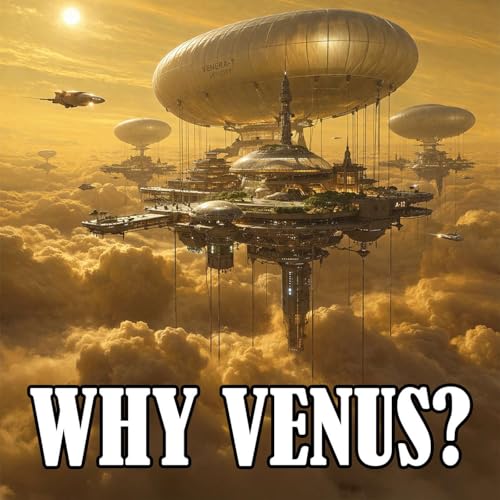
  • Colonizing Venus Is Crazy… Or Is It?
    Apr 20 2026

    Venus isn’t just a dead planet. It might actually be one of the most overlooked places humans could live.

    In this episode of Entropy Rising, we break down the reality of colonizing and terraforming Venus. From floating cloud cities in the upper atmosphere to the insane engineering required to strip away its crushing carbon dioxide atmosphere, this is what it would actually take to turn Earth’s hottest neighbor into a second home.

    A lot of people assume Mars is the obvious choice. The reality is more complicated.

    Venus has Earth-like gravity, a thick atmosphere, and regions where humans could survive with minimal protection. But it also comes with surface temperatures hot enough to melt lead and pressures that crush spacecraft in minutes.

    So which wins out?

    We explore:

    • Why Venus might be more viable than people think
    • The science behind floating cities in the clouds
    • How you could remove or freeze an entire atmosphere
    • The biggest challenges standing in the way
    • And whether terraforming a planet is even worth it

    The reality is, colonizing Venus sounds insane at first. But once you break it down, it starts to look less like science fiction and more like a long-term engineering problem.

    Would you live there?

    Support the show

    Website: https://www.entropy-rising.com/

    Show More Show Less
    33 mins
  • Are Humans Actually Special in the Universe?
    Apr 6 2026

    Humanity, at the center of the galaxy… or just another average species?

    In this episode of Entropy Rising, we break down the popular sci-fi idea behind “Humanity, F*** Yeah” (HFY)—the belief that humans would dominate any galactic civilization through sheer willpower, creativity, or grit. It’s a fun concept. It makes for great stories. But how well does it actually hold up when you look at it through the lens of real science?

    We explore the assumptions these stories rely on: Are humans uniquely violent? Is our intelligence fundamentally different? Could a younger civilization realistically challenge one that’s had thousands—or even millions—of years to advance? And what happens when you factor in scale, evolution, and the limits of physics?

    Instead of just dismissing the idea, we dig into what traits might matter—adaptability, cooperation, innovation—and whether those are actually unique to us, or simply the baseline for any species that makes it to space.

    The result is a more grounded look at humanity’s place in the universe—one that challenges the idea that we’re destined to be exceptional, while still leaving room for what makes us… us.

    If aliens are out there, the real question isn’t whether we’d win.

    It’s whether we’re anything special at all.

    Support the show

    Website: https://www.entropy-rising.com/

    Show More Show Less
    32 mins
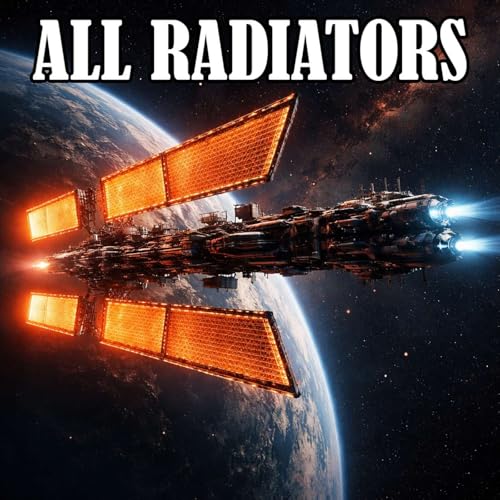
  • The Ugly Truth About Realistic Spaceship Design
    Mar 23 2026

    Most science fiction shows sleek, elegant starships—but real spaceships would look very different. In this episode of Entropy Rising, we break down what realistic spacecraft design might actually look like using real physics and engineering constraints.

    From massive radiators needed to dump heat into the vacuum of space, to radiation shielding, propulsion limits, and the surprising advantages of long, narrow ship designs, we explore the practical challenges that would shape future spacecraft. We also look at how ships might differ depending on their role—whether they’re transporting people between space stations, hauling cargo across the solar system, or operating as military vessels.

    Along the way we discuss what sci-fi gets right, what it gets wrong, and how concepts like heat management, shielding, and orbital mechanics will influence the ships humanity may one day build.

    If humans expand into the solar system, these are the kinds of designs that could actually make it possible.

    Support the show

    Website: https://www.entropy-rising.com/

    Show More Show Less
    43 mins
  • Are Hive Minds Inevitable?
    Mar 9 2026

    Hive minds are not just a sci fi trope. They might be a natural outcome of evolution.

    In this episode of Entropy Rising, we explore whether hive minds could realistically evolve in nature and whether advanced civilizations might choose to become networked intelligences. Are the Borg pure fantasy, or is there a biologically plausible path to collective consciousness? Could something like the Conjoiners from Revelation Space represent a more realistic future?

    We break down the difference between a true hive mind and a networked intelligence. From ant colonies and pheromones to biological radios and interstellar communication limits, we examine what physics and biology actually allow. We also tackle the uncomfortable questions: Do you lose free will in a hive mind? Could a civilization scale across the galaxy if its thoughts are limited by the speed of light? And could this be part of the Fermi Paradox?

    This episode moves from evolutionary biology to spacefaring civilizations, asking whether merging minds is dystopian, utopian, or simply inevitable.

    Would you join one?

    Support the show

    Website: https://www.entropy-rising.com/

    Show More Show Less
    32 mins
  • Planetary Invasion: If They Can Reach Us, We’re Done
    Feb 23 2026

    If a civilization can cross interstellar space, the war is already decided.

    In this episode of Entropy Rising, we examine planetary invasion through the lens of real physics. No cinematic dogfights. No convenient alien weaknesses. Just propulsion energy, orbital mechanics, and strategic reality.

    Any ship capable of traveling between stars already carries extinction-level energy. Once an invading force controls orbit, they don’t need to land troops. They can freeze a planet with solar shades, redirect stellar energy to overheat it, scatter relativistic debris, or enforce a blockade. Gravity favors whoever owns space.

    We also explore the rare equal-footing scenario. What if two interstellar civilizations are technologically comparable? That leads to layered defenses, weaponized megastructures, and deeply entrenched planetary infrastructure.

    Finally, we ask the deeper question: why invade at all? With abundant resources in space, planetary conquest may be the least efficient option.

    Planetary invasion sounds dramatic. Under real physics, it becomes colder, faster, and far more decisive.

    Support the show

    Website: https://www.entropy-rising.com/

    Show More Show Less
    38 mins