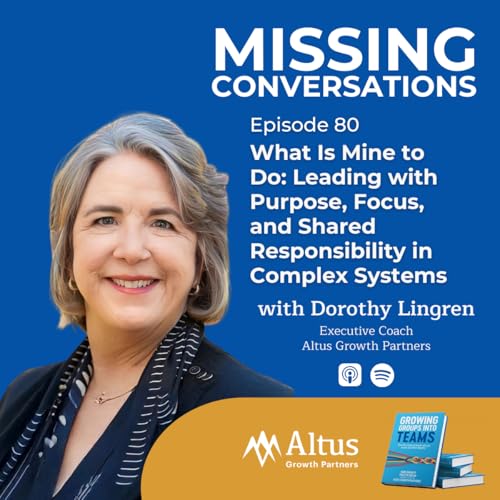
Episode #80: What Is Mine to Do: Leading with Purpose, Focus, and Shared Responsibility in Complex Systems cover art

Episode #80: What Is Mine to Do: Leading with Purpose, Focus, and Shared Responsibility in Complex Systems

Episode #80: What Is Mine to Do: Leading with Purpose, Focus, and Shared Responsibility in Complex Systems

Listen for free

View show details
One of ten children, Altus executive coach Dorothy Lingren grew up inside a large and complex family system. Her early lived experience of figuring out how to find her place, build relationships, and understand what made the whole thing work became the foundation for a career spent partnering with high-potential leaders and organizations navigating some of the most demanding environments in healthcare, government, and beyond. In this episode of Missing Conversations, fellow Altus executive coaches and hosts Amy Vodarek and Dan Winter sit down with Dorothy to explore why successfully navigating systems starts with the leader understanding who they are, how simulations like Breakthrough Learnings, Friday Night in the ER (https://www.blearning.com/fner), reveal what leaders do under pressure versus what they think they do, and what it takes to build teams and avoid burning out. If you feel like you're managing increasing complexity, this episode gives you practical ways to lead with greater purpose, sharper focus, and the one practice that makes both possible. Key Moments You'll Want to Hear 01:49: What growing up in a family of ten taught Dorothy about leading complex systems. 03:33: Three questions that reveal what every leader needs to see in themselves and others. 05:23: Why every systems change initiative has to start with who the leader is. 07:24: The one question that replaces overwhelm with purposeful, focused action. 12:01: What a healthcare simulation reveals about what leaders actually do under real pressure. 16:34: The moment leaders stop blaming the system and start seeing their own role in it. 20:11: What the most impactful leaders do when they stop trying to fix the people around them. 22:52: How to build leadership capacity when in complex environments. 26:41: Culture lives in the stories we tell. Here's how leaders begin writing new ones. 30:47: What it takes to lead teams through complexity. 35:40: The one practice Dorothy recommends for every individual, team, and organization to accept and work within the chaos. By the end of this conversation, you'll hear answers to: How do I lead effectively when my organization feels too complex to manage? Start with yourself before you try to change anything around you. Altus executive coach Dorothy Lingren, shares that the most clarifying question a leader in a complex system can ask is simply: what is mine to do here? Not everything. Not the whole system. Just what belongs to you right now. From there, Dorothy advocates for one meaningful action, not a sweeping initiative, but a single move you can try, learn from, and build on together with your team. Complexity doesn't shrink by pushing harder. It becomes navigable when leaders get honest about where their attention and energy actually belong. Timestamps: 07:24 How do I build a high-performing team that doesn't burn out under pressure? High-performing teams thrive when leaders stop measuring their team's success by individual accountability and start asking a different question altogether: what are we learning together, and how are we building something we all feel responsible for? Dorothy shares the story of a government client who stopped tracking individual deliverables and started asking what each person was learning from their partners. That one change, from accountability to curiosity, transformed how the whole team worked. High-performing teams aren't built by pushing people harder. They're built by creating conditions where people feel genuinely connected to a shared purpose and trusted to contribute their best. Timestamps: 22:52 How do leaders shift organizational culture when it feels stuck or misaligned? Altus executive coach Dorothy Lingren shares that culture lives in the everyday narratives leaders and teams carry about what's allowed, what's rewarded, and what's real. Her approach is to start small and stay curious. Pause a meeting, try a standing check-in, ask a question nobody's been asking. Each small experiment chips away at the old story and begins to write a new one. The leaders who change the culture most effectively are the ones willing to try something different, notice what happens, and invite their teams into that learning alongside them. Timestamps: 26:47 Resources Mentioned in This Episode Friday Night in the ER is a systems thinking simulation created and distributed by Breakthrough Learning — one of the tools Dorothy uses to help leadership teams see how complex systems actually behave under pressure, and where the real opportunities to lead differently live. Learn more at blearning.com/fner. Experiential and simulation-based learning is a thread that runs through much of the work Altus brings to leadership teams. If this conversation sparked your thinking, you'll also want to hear how Altus colleague Ryan Soares approaches adventure and experiential learning as a leadership development tool — and what happens when leaders are taken entirely out of their ...
adbl_web_anon_alc_button_suppression_c
No reviews yet