• "The Wrap Sheet: The Brinks Diamond Heist - Nap Time, Snacks, and $100 Million Gone"
    Mar 24 2026

    In this Wrap Sheet episode of Heists, Hustles, and Homicide, Steve breaks down one of the most unbelievable heists in modern history - the Brinks Truck Jewelry Heist, where tens of millions of dollars in diamonds and luxury jewelry were stolen… because security quite literally fell asleep on the job.

    This wasn’t Ocean’s Eleven.

    This wasn’t a high-tech operation.

    This was a perfect storm of lazy decisions, bad timing, and unbelievable luck.

    In this episode, Steve dives into:

    1. The infamous gas station stop that changed everything
    2. The moment a Brinks guard decided nap time > security
    3. The criminals who basically walked into the easiest heist of their lives
    4. The shady possibility that jewelry companies may have undervalued the shipment to save money (and paid the ultimate price)
    5. Where the stolen diamonds likely ended up - and why they’re almost impossible to recover
    6. And the most unbelievable twist of all…
    7. How one of the suspects in the largest jewelry heist in U.S. history somehow left the country due to a breakdown in coordination between agencies

    This episode is equal parts true crime breakdown, dark humor, and “you can’t make this up” insanity.

    Because sometimes the biggest crimes don’t happen because criminals are brilliant…

    They happen because everyone else dropped the ball.

    Show More Show Less
    17 mins
  • "The Brinks Diamond Heist: The Largest Jewelry Theft in U.S. History"
    Mar 13 2026

    In July of 2022, a Brinks armored truck left a high-profile international jewelry exhibition in San Mateo, California carrying 73 bags filled with diamonds, luxury watches, gold, emeralds, and rare gemstones.

    By sunrise the next morning…24 of those bags were gone.

    No shootout.

    No alarms.

    No dramatic Hollywood getaway.

    Just a quiet rest stop in Lebec, California…and over $100 million in jewelry disappearing into the night.

    What followed was one of the most fascinating cargo theft investigations in modern American history.

    Federal prosecutors would later reveal a 300-mile shadow pursuit, burner phones used during the operation, and a suspected cargo theft ring that had already been targeting high-value shipments across California.

    But the twists didn’t stop there.

    One suspect was mysteriously allowed to leave the United States before trial, stunning prosecutors and leaving victims demanding answers. Meanwhile, a legal war erupted between Brinks and the jewelers themselves over the true value of the stolen cargo.

    Was it really a $100 million heist…

    or something far bigger?

    And perhaps the biggest question of all:

    Where are the diamonds now?

    In this episode of Heists, Hustles, and Homicide, we dive deep into:

    1. The 300-mile surveillance operation that led to the heist
    2. The moment thieves struck at a quiet highway rest stop
    3. The cargo theft ring investigators say was behind it
    4. The shocking self-deportation twist that stunned prosecutors
    5. The legal battle between Brinks and the jewelers over the missing fortune
    6. And why much of the jewelry may never be recovered

    This is the story of the largest jewelry heist in U.S. history - and the stunning vulnerabilities it exposed in one of the world’s most trusted armored transport systems.

    Because sometimes the biggest heists don’t happen in vaults.

    They happen on the side of a highway.

    Next week on Heists, Hustles, and Homicide:

    Pan Am Flight 103 - the bombing that changed aviation security forever.

    Show More Show Less
    24 mins
  • "The Olympic Park Bombing (Part Three): The Real Bomber"
    Feb 23 2026

    For months, the world focused on the wrong man.

    In Part 1 and Part 2 of our series on the bombing at Centennial Olympic Park during the 1996 Summer Olympics, we followed the rise and collapse of suspicion around Richard Jewell.

    But while Jewell endured 88 days under investigation, the real bomber was still free.

    In Part 3, we follow the trail that law enforcement eventually uncovered...a pattern of ideology, extremism, and calculated terror that led to one name:

    Eric Rudolph.

    This episode explores:

    1. How the investigation pivoted away from Jewell
    2. The series of bombings that followed Olympic Park
    3. The extremist beliefs that motivated the attacks
    4. The years-long manhunt
    5. The unlikely moment that finally ended it
    6. The lasting impact on Richard Jewell’s legacy

    The Man Behind the Bomb

    Eric Rudolph was not seeking fame as a hero.

    He was seeking impact.

    His bombing at Centennial Olympic Park was the first in a series of attacks that would stretch across multiple states and claim additional lives. His ideology was rooted in anti-government extremism and hatred...and he was willing to kill to broadcast it.

    This episode examines how he evaded capture for years and how his arrest finally brought answers to a case that had already done irreversible damage.

    The Aftermath

    Richard Jewell was eventually cleared.

    But clearing a name is not the same as restoring a life.

    In this final chapter, we examine the emotional toll, the cultural debates, and the complicated legacy left behind...for law enforcement, for media, and for a man who did the right thing and paid for it anyway.

    This Series Explores
    1. Investigative pressure and tunnel vision
    2. Media ethics in high-profile cases
    3. Domestic extremism in the 1990s
    4. The fragility of reputation
    5. And the human cost of being wrongfully accused

    Show More Show Less
    24 mins
  • "The Olympic Park Bombing (Part Two): 88 Days of Hell"
    Feb 20 2026

    Three days after the bombing at Centennial Olympic Park during the 1996 Summer Olympics, the man once praised as a hero became the focus of a national investigation.

    His name was Richard Jewell.

    In Part 1, we followed the explosion, the discovery of the backpack, and the stunning shift from applause to accusation.

    In Part 2, the story turns darker.

    For 88 days, Richard Jewell lived under relentless scrutiny as the FBI zeroed in on him as their primary suspect. Cameras camped outside his home. Headlines painted him as a wannabe cop desperate for recognition. The narrative hardened before evidence did.

    This episode takes you inside the psychological and institutional storm that nearly destroyed an innocent man.

    In This Episode
    1. How investigative tunnel vision took hold
    2. The FBI’s behavioral profile and the “hero bomber” theory
    3. The leak that changed everything
    4. Media saturation and public judgment
    5. Bobi Jewell’s emotional plea to the President
    6. What it feels like to be hunted in your own home

    This is not just the story of an investigation.

    It’s the story of what happens when institutions need an answer...and choose the wrong one.

    The Human Toll

    Richard Jewell would later call this period “88 days of hell.”

    He was never arrested.

    He was never charged.

    But for nearly three months, the world treated him as guilty.

    Part 2 explores the emotional damage, the social isolation, and the cost of being labeled a suspect in front of the entire world.

    Why This Matters

    High-profile cases don’t just test law enforcement.

    They test the media.

    They test public patience.

    They test the presumption of innocence.

    And when pressure builds, truth can get lost.

    Coming in Part 3

    The real bomber was still out there.

    While Richard Jewell endured suspicion, the man responsible for the attack remained free...and would strike again.

    In Part 3, we follow the trail that leads to Eric Rudolph and the long manhunt that finally brought answers.

    Show More Show Less
    25 mins
  • "The Olympic Park Bombing (Part One): From Hero to Suspect"
    Feb 17 2026

    In the summer of 1996, the world gathered in Atlanta for the 1996 Summer Olympics...a celebration of unity, competition, and global pride.

    And then a bomb exploded in Centennial Olympic Park.

    In the first installment of this three-part series, Steve takes you inside the night that changed everything...the music, the crowds, the green backpack beneath a bench…and the security guard who noticed something wasn’t right.

    His name was Richard Jewell.

    At first, he was hailed as a hero...the man who spotted the bomb and helped clear the area before it detonated, likely saving countless lives.

    But within days, that hero narrative collapsed.

    What happens when the man praised on national television becomes the FBI’s primary suspect?

    In Part 1, we'll walk through:

    1. The electric atmosphere of Olympic Atlanta
    2. The discovery of the backpack
    3. The chilling 911 warning call
    4. The explosion that killed two and injured more than 100
    5. The media spotlight that turned applause into suspicion

    This is the beginning of one of the most controversial investigative shifts in modern American history.

    And it’s only the beginning.

    This episode sets the stage for the 88 days that followed...days that would nearly destroy an innocent man.

    This episode contains discussion of terrorism, death, and traumatic events.

    Up next

    Part 2: 88 Days of Hell

    The cameras close in.

    The FBI doubles down.

    A mother pleads on national television.

    And Richard Jewell’s world collapses under the weight of suspicion.

    Show More Show Less
    27 mins
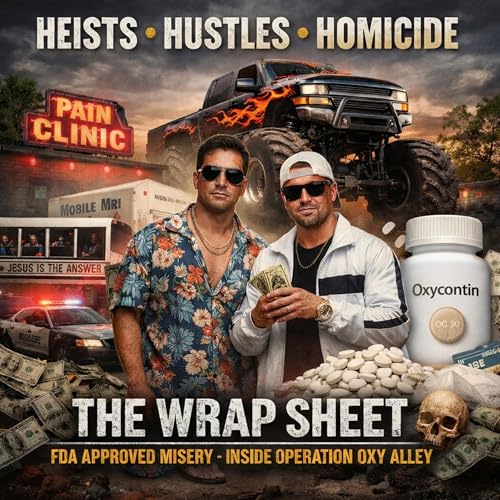
  • "The Wrap Sheet: FDA Approved Misery - Inside Operation Oxy Alley"
    Feb 5 2026

    Welcome back to Heists, Hustles, and Homicide, my little crime crew. This is The Wrap Sheet!

    In this solo deep dive, Steve unpacks Operation Oxy Alley - the wildly absurd, deeply disturbing Florida pill-mill scandal where addiction became a tourism industry and pain clinics operated like fast-casual restaurants.

    We’re talking about the George brothers, two Florida men who looked more suited selling cocaine in nightclubs than working in healthcare, yet somehow built a multi-million-dollar opioid empire using real doctors, real prescriptions, and shockingly fake ethics.

    From out-of-state caravans and church buses full of addicts…to MRI trailers parked behind strip clubs…to monster trucks fueled by pill-mill profits - this episode breaks down the insanity most people never stop to think about.

    We also explore the uncomfortable question the George brothers left behind: were pharmaceutical-grade opioids actually safer than today’s fentanyl-laced street pills - and what happens when supply is shut down but demand never goes away?

    This isn’t just a crime story.

    It’s a warning about greed, broken systems, and what happens when pain becomes a business model.

    Plus, a teaser for next week’s episode on the Atlanta Olympic bombing.

    Show More Show Less
    17 mins
  • "Operation Oxy Alley: How Pain Became a Business"
    Jan 29 2026

    In the late 2000s, South Florida became ground zero for a quiet catastrophe hiding in plain sight. Strip malls turned into distribution hubs. Doctors became volume machines. And thousands of people across the country died with legal prescriptions in their pockets.

    In this episode of Heists, Hustles, and Homicide, host Steve takes you inside Operation Oxy Alley - the federal investigation that exposed one of the largest pill mill operations in U.S. history. What began as “legitimate” pain clinics evolved into an industrial pipeline of addiction, fueled by money, indifference, and a system that rewarded volume over care.

    You’ll hear how the George brothers built an empire by exploiting loopholes, how excess and arrogance replaced caution, and how one grieving father helped crack the illusion wide open. This isn’t a story about back-alley drug deals - it’s about how devastation can wear a lab coat, operate during business hours, and call itself a business.

    Because when legality replaces morality, the damage doesn’t end when the doors close.

    #OperationOxyAlley #OpioidCrisis #TrueCrimePodcast #PillMill #BigPharma #MedicalCorruption #TrueCrimeStory #HeistsHustlesAndHomicide #CrimeDocumentary #InvestigativePodcast #AmericanCrime

    Show More Show Less
    36 mins
  • "The Wrap Sheet: FIFA Scandal - Cats, Cash, and Corruption"
    Jan 23 2026

    Welcome back to Heists, Hustles, and Homicide, my little crime crew...it’s your favorite host, Steve, and this week’s Wrap Sheet is going fully unhinged.

    We’re breaking down the FIFA scandal, and not the polite, press-conference version. This is the loud, sarcastic, laugh-through-the-pain deep dive into how soccer’s governing body turned the world’s most popular sport into a global crime syndicate.

    We start in the early days of soccer - low scores, chaotic rules, questionable officiating, and fans who treated ties like moral victories. From there, we dig into how FIFA began as a small good-ol’-boys club before João Havelange flipped the table, bribed ignored countries for votes, and turned FIFA into a global juggernaut with unlimited power and very limited oversight.

    That power quickly became money - a lot of it - thanks to sponsorships, TV rights, and corporate partnerships that funneled billions through Swiss banks, shell companies, and “development programs” that somehow turned into beach houses.

    We unpack the role of Adidas power broker Horst Dassler and the creation of ISL - the marketing company that doubled as FIFA’s kickback vending machine - and how corruption went from accidental to industrial.

    Then comes Sepp Blatter, the ultimate bureaucratic survivor, who didn’t invent the corruption but perfected it. Under his watch, bribery became institutionalized, scandals were quietly settled, and FIFA learned it didn’t need to change - it just needed better lawyers.

    We break down the absurd decisions to award World Cups to Russia and Qatar, the mysteriously “destroyed” computers, and why playing soccer in desert-oven temperatures was somehow less important than who was wiring money to whom.

    Things escalate when Ireland gets robbed in one of the worst officiating disasters in World Cup history - and FIFA responds by paying $7.1 million in what can only be described as international hush money.

    That’s when the FBI enters the story - treating FIFA not like a sports organization, but like organized crime with shin guards. RICO charges, wire fraud, money laundering - the kind of legal heat you don’t attract unless you’re running an actual criminal enterprise.

    And finally, we meet Chuck Blazer - the man, the myth, the walking deli counter - who lived large, flipped fast, wore a wire disguised as a keychain, and famously rented a $6,000-a-month Trump Tower apartment… for his cats.

    The arrests that followed were surreal: FIFA executives dragged out of luxury hotels wrapped in white sheets like confused bathrobe fugitives - and FIFA pretending the whole thing came as a complete shock.

    This isn’t just a scandal.

    It’s a case study in how corruption works when everyone at the top benefits.

    And as always, we end with a teaser for next week’s episode - Operation Oxy Alley, where Florida Man energy meets prescription-pill chaos.

    Show More Show Less
    18 mins