

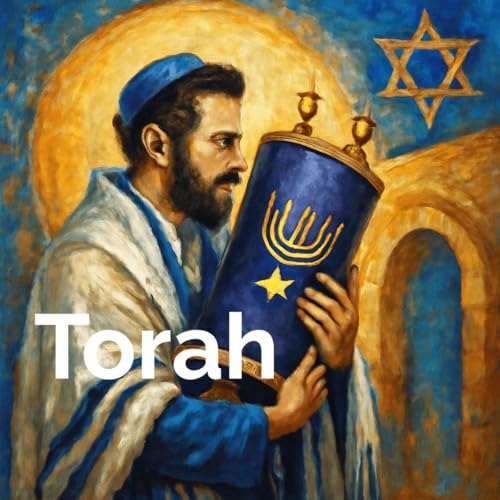
Islamic Tawrat.
Failed to add items
Sorry, we are unable to add the item because your shopping cart is already at capacity.
Add to basket failed.
Please try again later
Add to wishlist failed.
Please try again later
Remove from wishlist failed.
Please try again later
Adding to library failed
Please try again
Follow podcast failed
Unfollow podcast failed

Islamic Tawrat.
-
Narrated by:
-
By:
Summary
In Islamic theology, the Tawrat denotes the divine revelation bestowed upon the prophet Musa (Moses) to serve as guidance for the Banu Isra'il (Children of Israel). The Quran references the Tawrat eighteen times, portraying it as a source of huda (guidance) and nur (light) through which earlier prophets rendered judgments among their communities. Specifically, Quran 5:44 states: "Indeed, We sent down the Torah, in which was guidance and light. The prophets who submitted [to Allah] judged by it for the Jews, as did the rabbis and scholars by that with which they were entrusted of the Scripture of Allah." This positions the Tawrat as one of four major scriptures in the Islamic chain of revelation, preceding the Zabur (Psalms) given to Dawud (David), the Injil (Gospel) to Isa (Jesus), and culminating in the Quran itself.
Muslim doctrine holds that the original Tawrat comprised Mosaic laws (shari'ah), moral commandments, and historical narratives concerning creation, prophets, and divine covenants, aligning in broad outline with the Pentateuch's content but originating directly from Allah's speech to Musa on Mount Sinai. Unlike the Quran, which Muslims regard as verbatim preserved since its revelation in 610–632 CE, the Tawrat is believed to have undergone tahrif—distortion—effected by Jewish scribes and leaders through textual alterations (tahrif al-lafz) or deliberate misinterpretations (tahrif al-ma'na). Quranic verses cite instances of such changes, including twisting words from their contexts or concealing truths for worldly gain, as in 4:46: "Among the Jews are those who distort words from their [proper] usages," and 5:13: "They distort words from their [proper] places." This view, elaborated in post-Quranic exegeses like those of al-Tabari (d. 923 CE), reconciles doctrinal divergences between the Quran and Jewish texts by attributing inconsistencies to human intervention rather than divine error.
Notwithstanding the doctrine of tahrif, the Quran validates the Tawrat extant during the Prophet Muhammad's era (circa 610–632 CE), urging Jews to adjudicate by it: "And let the People of the Gospel judge by what Allah has revealed therein" parallels instructions for the Torah in 5:43, implying residual authenticity amid corruptions. Classical scholars such as Ibn Hazm (d. 1064 CE) argued for wholesale textual corruption post-Musa, while others like al-Razi (d. 1209 CE) emphasized interpretive distortion, allowing selective affirmation of Pentateuchal elements compatible with Islamic monotheism, such as monotheistic declarations and ethical prohibitions. No physical copy of the pristine Tawrat survives in Islamic tradition; hadiths occasionally reference its lost contents, like prohibitions on usury or Sabbath observances, but Muslims rely solely on the Quran for authoritative guidance.
The Tawrat's legal prescriptions, including rituals like circumcision and dietary laws, are seen as abrogated (mansukh) by subsequent revelations, particularly the Quran, which supersedes prior scriptures in universality and finality. This abrogation underscores Islam's self-conception as the corrective culmination of Abrahamic faiths, with the Tawrat's role confined to its historical context among the Israelites. Empirical scrutiny of manuscript traditions, such as Dead Sea Scrolls dating to 250 BCE–68 CE, reveals textual stability predating Islam, challenging claims of post-Mosaic wholesale alteration, though Islamic apologetics maintain that corruptions occurred incrementally, including during the Babylonian exile (586–539 BCE). Mainstream Sunni and Shia sources uniformly uphold the Tawrat's revelatory origin while subordinating it to Quranic primacy, cautioning against uncritical reliance on extant versions due to suspected interpolations favoring anthropomorphic depictions of God or prophetic flaws absent in Islamic narratives.
This episode includes AI-generated content.
adbl_web_anon_alc_button_suppression_c
No reviews yet