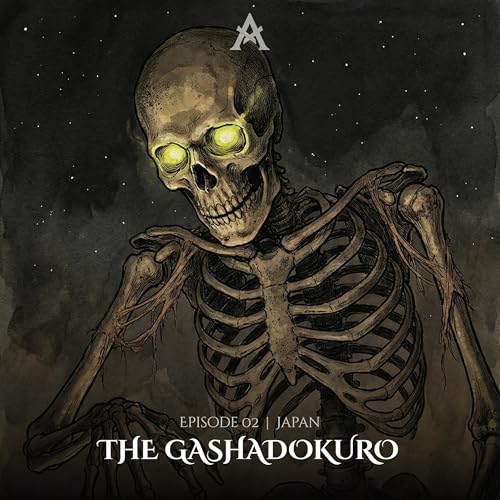
In Japanese folklore, when too many people die and no one buries them, the bones accumulate. Individual identities dissolve. What remains is a collective fury that merges into something fifteen meters tall, with eyes that glow like foxfire and teeth that grind in the dark.
The Gashadokuro, the rattling skull, is a skeleton taller than the trees, assembled from the bones of hundreds of forgotten dead. It hunts at night during the hour of the ox, between one and three in the morning, when the boundary between the living and the dead is thinnest. It cannot be killed with swords. It persists until the accumulated rage of the dead burns itself out. That can take decades.
In this episode, we trace the creature from the ninth-century Nihon Ryoiki, a Buddhist text where a skull in a field speaks the story of its own murder, through the rebellion of Taira no Masakado in 939 CE, one of the Three Great Vengeful Spirits of Japan whose head mound still stands in a Tokyo business district. We follow his daughter Takiyasha-hime, who learned forbidden sorcery and raised the bones of her father's fallen soldiers to continue his war. Then we arrive at an extraordinary woodblock print by Utagawa Kuniyoshi from 1844, now in the Victoria and Albert Museum, where a single artistic choice transformed an army of small skeletons into one colossal giant and created the image that defines the Gashadokuro today.
But the creature was not formally named until 1966. A writer called Morihiro Saito gave it its name, and the manga artist Shigeru Mizuki illustrated it the following year. A modern monster, built on ancient foundations.
Behind the rattling bones lies a real historical horror: the Great Tenmei Famine of 1782 to 1788, which killed over a hundred and thirty thousand people. Corpses lay in the streets while the living were too few to bury them. Buddhist monks tried mass sutra recitations. It was not enough. The Gashadokuro is what happens when death overwhelms every institution designed to manage its spiritual consequences.
The horror is not the skeleton. The horror is the society that produced the skeleton.
Folklore Reborn turns real legends from around the world into stories worth hearing and tabletop adventures worth playing. Follow us wherever you get your podcasts.
The old stories were warnings.
LINKS
Patreon: https://www.patreon.com/Artaxios
Our Website: https://artaxios.com


 Mar 26 202613 mins
 Mar 24 202616 mins