Episodes

  • The Great Drought
    Jul 13 2022

    This story tells how there was a terrible drought followed by a lethal flood.

    There's a terrible drought and all the animals get together and realise that all water is being held inside a giant frog called Tidilick, the only way to get the water out is to make the frog laugh. They decide to hold a talent contest 'Get Out of Drought'. The Kookaburra tries and fails, the Frill Lizard tries and fails, the Crane tries and fails and finally the Short Finned Eel succeeds and Tidilick the frog laughs so much that the earth is flooded.

    This story is from Australia where the First Nations (Aboriginal) people have lived for over 65 thousand years. This dreaming story from the Gurnaikurnai people, 'Tidilick The Frog' that tells of the natural history of the area and the flood records the period of natural change. The Lurtbit Yauung Brataualung clan group recorded this story which depicts the natural history of the country going through a turbulent time of great natural change, which shaped the landscape as we know it today.

    See omnystudio.com/listener for privacy information.

    Join Fun Kids Podcasts+: https://funkidslive.com/plus

    See omnystudio.com/listener for privacy information.

    Show More Show Less
    14 mins
  • Hainuwele the Coconut Girl
    Jul 20 2022

    In this story we hear where root vegetables (tubars) and root spices came from and how people with good and evil hearts are separated.

    The god Ameta finds a coconut one day, he plants it and a lovely girl Hainuwele (coconut girl) grows from the ground. She has the amazing gift of being able to poo precious items. This instills jealousy amongst the villagers who decide to get rid of Hainuwele. She becomes the root of all root plants and spices and her leaves are made into a guilt gate and with the help of the goddess Satene anyone with a dark heart is turned into an animal and if they are particularly evil they are turned into goblins.

    This story is from the Alifuru, Wemale and Alune people on the island of Ceram, located in the centre of the Muluka islands that are now part of Indonesia. They worship many gods, spirits and divine creatures.

    Ameta who appears in this story, is the god who fathered Hainuwele (which means coconut girl) goddess of fertility. The other goddess who appears in this story is Satene - a goddess who became queen of the dead on the mountain of Salahua where people's souls went once they died.

    See omnystudio.com/listener for privacy information.

    Join Fun Kids Podcasts+: https://funkidslive.com/plus

    See omnystudio.com/listener for privacy information.

    Show More Show Less
    14 mins
  • Coyote and Silver Fox
    Jul 27 2022

    In this story we learn how the earth is created and how domestic relationships sometimes have to be managed.

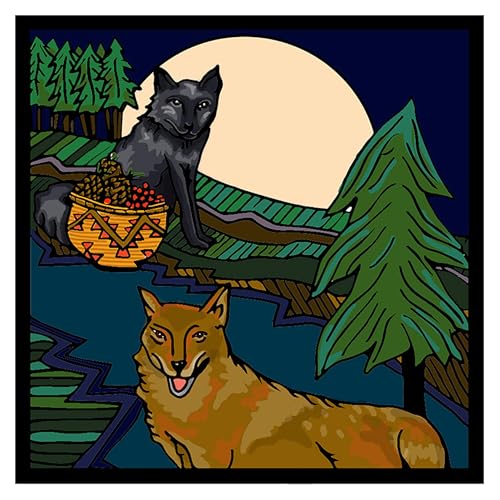
    In the beginning there is nothing but water. Silver Fox is lonely and thinks Coyote into being. Together they sing the world into existence and go down to live on it. They live in harmony together except for the fact that Coyote is always hungry and Silver Fox keeps going out to get things to eat but he gobbles everything up and never shares or saves food. She eventually gets fed up of his antics and sets a trap. She's a crafty fox and teaches Coyote her worth and they live in harmony after that.

    This story is from the Miwok tribe of indigenous people (also known as Native Americans or American Indians) who have lived in North America (Turtle Island) for at least 15,000 years. Coyote and Silver Fox represent the first people and even though they are animals they behave just the way people would. Coyote, who features in many stories, is often represented as a trickster and makes frivolous decisions and as you can hear in this story he is always hungry. Silver Fox is more serious and wise.

    See omnystudio.com/listener for privacy information.

    Join Fun Kids Podcasts+: https://funkidslive.com/plus

    See omnystudio.com/listener for privacy information.

    Show More Show Less
    14 mins
  • Pangu Creates the Earth and Nuwa Creates Humans
    Aug 3 2022

    These are two stories form ancient China describing how the world was created and how humans were made.

    In the beginning there is nothing but a cosmic egg. Pangu emerges from this egg and the upper part becomes Yin the sky and lower part becomes Yang the earth. He begins to form the earth with the help of Phoenix, Dragon and Tortoise but becomes exhausted and his body becomes the earth itself. Later, Nuwa a goddess with a fish tail comes down to earth but is lonely as she has no one to talk to. She decides to make humans out of mud and clay. She finds it too tiring to fashion them one at time so she finds a better way by splattering mud with a stick. This is how she populates the earth.

    The earliest human settlements in what is today called China date back 7000 years. China was ruled by a number of different dynasties and has a very old and rich tradition of legends and mythology. The main characters of these stories are gods, goddesses, ghosts and demons. The main themes reflect various aspects of human nature, human relations and social life.

    Pangu is accompanied by three animals that feature in many ancient Chinese stories; Dragon who represents wisdom and power, Tortoise a symbol of strength and immortality and there are stories where the history of the world is written on its shell, and Phoenix, a symbol of rebirth. In the second part of the story we hear about how humans were created by Nuwa also known as Nu-Kua, Nu-Kwa, Nü-Wa a Chinese Creator Goddess and mother of all humans.

    See omnystudio.com/listener for privacy information.

    Join Fun Kids Podcasts+: https://funkidslive.com/plus

    See omnystudio.com/listener for privacy information.

    Show More Show Less
    14 mins
  • The Cosmic Hug
    Aug 10 2022

    This story is from the Māori people explaining how the earth and the sky were separated so that light could enable forests and plants to grow, followed by animals and humans.

    In the beginning there is nothing but the cosmos. Rangi (Ranginui) the sky father and Papatua (Papatūānuku) the earth mother hold each other in a tight embrace. Papatua gives birth to 70 sons who are caught between their mother and father with very little space and no light. They have to find a way out. Eventually, led by Tāne , (who becomes god of the forests) they manage to prize their parents apart. (Tāwhiri) Tāwhirimātea the god of the weather or wind doesn't agree with his brothers separating their mother and father. The other brothers featured are Tu (Tūmātauenga - angry face) God of war, Whiro, god of darkness and Uru, the first born and god of light. As they prize their parents apart light shines through and the forests begins to grow and the earth becomes populated by plants and animals.

    The ancestors of the Māori people arrived in Aotearoa (translated as land of the thick white cloud) from the Polynesian Islands by boat over 1000 years ago and settled in this new land. They first encountered Europeans in the 1600’s when the Dutch landed onshore and called this island Nieuw Zeeland after the Dutch province Zeeland. The next Europeans to arrive where the British in 1769 led by Captain Cook and the colonisation by the British began.In Māori society there is a long tradition of singing and storytelling. History is passed on through the many stories shared from generation to generation through song, dance and chants.

    See omnystudio.com/listener for privacy information.

    Join Fun Kids Podcasts+: https://funkidslive.com/plus

    See omnystudio.com/listener for privacy information.

    Show More Show Less
    14 mins
  • Legend of the Milkyway
    Aug 17 2022

    This story from Estonia describes how the amazing milky white group of stars we call the Milky Way (or bird path in Estonian) came from the adventurous goddess Lindu's wedding veil, carried by birds

    The goddess Lindu lives in the sky with her father Uru. She loves adventure and can't stay still for long. Uru sends her down to earth to look after the birds. The North Star, Moon and Sun propose to her but she thinks they’re all too boring as they stay in one place and she needs more. Northern Lights feels like a more exciting prospect. He also proposes but then stands her up and she is left with her shimmering bridal veil but no marriage. She goes back up to live in the sky with her father and her bridal veil becomes the Milky way.

    Estonia is in Northern Europe and is bordered to the North with Finland and to the west by the Baltic Sea across from Sweden to the South by Latvia and to the East is Russia. Many of these legends have been passed down through songs featuring tales of creation of course, but also tales of battles, journeys and magic. The most striking example of the culture of ancient Estonians is the rhythmic verse, as well as the aural tradition of folk song where each line is repeated several times with thematic variations. Estonians have one of the biggest collections of folk songs in the world, with written records of about 133,000 folk songs.

    See omnystudio.com/listener for privacy information.

    Join Fun Kids Podcasts+: https://funkidslive.com/plus

    See omnystudio.com/listener for privacy information.

    Show More Show Less
    14 mins
  • The Council of the Orishas
    Aug 24 2022

    These two stories from the Yoruba people describe how humans were created, the coming of a great flood and how Oshun, the goddess of fertility made sure women have a voice.

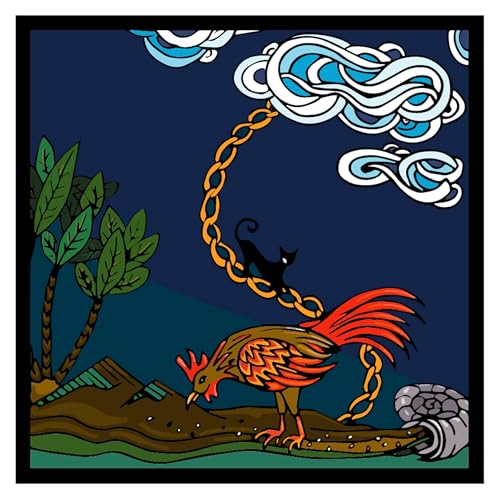
    The Orishas are the gods who live in the sky. Obatala (creator of mankind) decides to go down to create the earth - he is given a gold chain, a shell, a hen and a black cat. He then attempts to makes humans but gets drunk on palm wine and makes them all wonky. He has to start again. Once the earth is populated, Olukun, god of the seas is annoyed that the other gods didn’t consult him, so he creates a flood and drowns the earth. A few people survive. Oshun, the goddess of fertility is annoyed because the other gods keep ignoring her and she isn't heard. She persuades all the women to go on strike. Things become unbearable for the men and no babies are born, so women are promptly given a seat at the table both in the skies and on earth.

    The Yoruba are an ancient people with roots that date back over 2000 years and were the rulers of the Oyo Kingdom, a West African Empire covering what is now West Nigeria to Zaire and Sudan. The main city of Ile-Ife cultivated a great cultural tradition. Traditional Yoruba religion has a pantheon of deities (gods) called the Orisha with hundreds of different gods representing natural elements and human emotions and worshipped for many different purposes. Ife is the Yoruba word for Earth and was named by the creator Obatala who also created mankind.

    See omnystudio.com/listener for privacy information.

    Join Fun Kids Podcasts+: https://funkidslive.com/plus

    See omnystudio.com/listener for privacy information.

    Show More Show Less
    14 mins
  • Where the Sun and the Moon Came From
    Aug 31 2022

    This story from the Taíno people begins with a great flood forcing everyone to hide in caves, even the Sun and the Moon. This story explains why the Sun and the Moon rise and set at different times.

    In the beginning there is a great flood. Many people hide in caves to escape the flood and so do the Sun and the Moon. The Sun kicks the Moon out as there isn’t enough space in the cave they are sharing. The moon goes up to the sky and find that it's much more spacious. The Sun misses the moon so goes up to the sky to find her and realises that’s it’s much better than his cave. He tries to reconnect with the moon but she is not willing to reconcile, so they are always set to be apart forever.

    The Taíno are an Arawak people who were the indigenous people of the Caribbean and Florida. At the time of European contact in the late 15th century, they were the principal inhabitants of most of Cuba, Jamaica, Hispaniola (the Dominican Republic and Haiti), and Puerto Rico. Once thought to have completely disappeared there is now "Taíno restoration", a revival movement for Taíno culture that seeks official recognition of the survival of the Taíno people. In Puerto Rico, the history of the Taíno is being taught in schools and children are encouraged to celebrate the culture and identity of Taíno through dance, costumes and crafts.

    See omnystudio.com/listener for privacy information.

    Join Fun Kids Podcasts+: https://funkidslive.com/plus

    See omnystudio.com/listener for privacy information.

    Show More Show Less
    14 mins