Episodes

  • EP 39: AI Chatbots: 95% of Interactions by 2025
    Feb 25 2026

    Servian Global Solutions projects that 95% of customer interactions will be AI-powered by 2025. We're in 2026 now-that's not a future prediction anymore, it's the present reality. The chatbot market is growing by $11.45 billion through 2026, fueled by major advances in natural language processing and machine learning making chatbots intuitive, context-aware, and capable of handling genuinely complex conversations.

    Modern AI chatbots differ dramatically from frustrating automated systems of years ago. These systems now understand context, handle follow-up questions, detect sentiment, and maintain conversation flow naturally. They're not doing keyword matching scripts anymore—they're using transformer models similar to ChatGPT, trained specifically for customer service scenarios with reinforcement learning for real-time contextual awareness.

    However, limitations exist. Chatbots struggle with truly novel situations they haven't been trained on, can't make judgment calls requiring human empathy, and occasionally hallucinate confidently incorrect information—which is why accuracy checking and clear escalation paths matter. Some customers simply prefer human interaction regardless of AI capability, which businesses must respect.

    Cost savings are substantial but shouldn't be the only driver. NIB Health Insurance saved $22 million through AI-driven digital assistance, reducing customer service costs by 60%. The strategic value extends beyond cost reduction: 24/7 availability supports customers globally, instant response times improve satisfaction, and consistent answer quality eliminates variance in agent knowledge.

    Show More Show Less
    14 mins
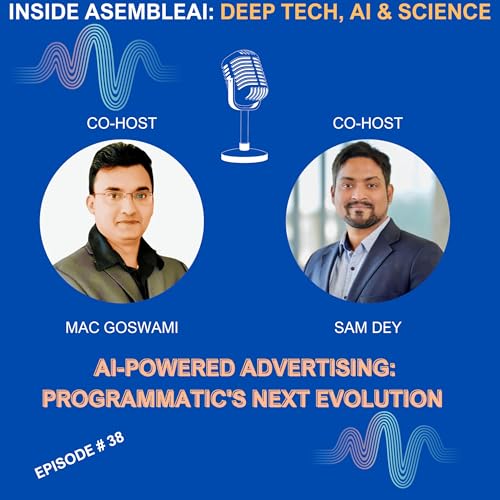
  • EP 38: AI-Powered Advertising: Programmatic’s Next Evolution
    Feb 25 2026

    Traditional ad buying involved manual targeting, static audiences, and fixed bids. AI advertising uses machine learning to optimize targeting, bidding, and creative selection in real time across millions of data points. Performance Max and Meta Advantage+ campaigns represent this evolution - algorithms handling what used to require entire teams of media buyers.

    Smart bidding algorithms adjust bids based on conversion likelihood, time of day, device type, user behavior history, competitor activity, and dozens more variables simultaneously. This dynamic approach consistently outperforms manual bid management, especially for campaigns with large audiences and multiple ad variations. However, human strategy and oversight remain necessary—marketers must set clear goals, supply quality creative assets, and analyze performance to ensure AI automation aligns with business objectives.

    Critical risks include over-optimization—AI might optimize for metrics that don't actually align with business goals. Optimizing for clicks gets clicks but might not deliver quality traffic. Optimizing for conversions without considering lifetime value might acquire expensive customers who churn quickly. The human role is defining success properly so AI optimizes toward meaningful outcomes.

    Looking at 2026, programmatic advertising moves toward full automation. For small businesses without media buying expertise, this democratizes access to sophisticated advertising. For agencies and specialists, it forces evolution toward strategic consulting rather than tactical execution.

    Show More Show Less
    13 mins
  • EP 37: AI Content Creation: 3x Output, Half the Cost
    Feb 25 2026

    The numbers are staggering: 96% of companies now use generative AI for content production. Companies report 3-5x more content output, 30-50% cost savings, and 50% reductions in creation time. This isn't incremental improvement—it's transformational change in how marketing teams operate.

    AI content creation in 2025 encompasses far more than ChatGPT writing blog posts. We're talking about integrated workflows governing ideation, creation, distribution, and analytics. Tools like Jasper, Copy.ai, and ContentBot handle everything from drafting to scheduling and multi-platform distribution. The sophistication has moved far beyond simple text generation.

    Limitations remain clear: AI struggles with truly original creative thinking—breakthrough ideas that redefine categories. It excels at recombining existing concepts but genuine innovation requires human creativity. AI lacks emotional intelligence and cultural nuance, can mimic empathy but doesn't actually understand context the way humans do, and generates confidently wrong information (hallucinations), which is why human fact-checking remains non-negotiable.

    Looking ahead, the strategic implication is marketing teams shifting focus from production to strategy. When AI handles volume, humans focus on insight, positioning, and differentiation. Small teams can now compete with large enterprises because production bottlenecks disappear.

    Show More Show Less
    19 mins
  • EP 34: AI in Credit and Lending: Democratizing Access or Amplifying Bias?
    Feb 22 2026

    AI in credit decisions is genuinely controversial because it could either democratize lending and expand access to underserved populations or take historical discrimination and amplify it at scale. The reality is both are happening simultaneously in different institutions—it all depends on how intentionally the AI is designed and monitored for fairness.

    Sam and Mac examine how AI is disrupting traditional credit scoring. FICO scores have dominated for decades using limited data: payment history, credit utilization, length of credit history, types of credit, and recent inquiries. This approach systematically excludes millions who don't have traditional credit histories, even if they're perfectly responsible with money and would be excellent borrowers.

    The technical models include XGBoost as the industry standard and neural networks for processing more data with hidden layers. Traditional logistic regression is often a poor fit for real-world credit behavior. Banks need model governance with clear ownership, regular bias testing, robust explainability, and human oversight for complex cases. AI handles straightforward approvals and denials; humans handle the middle—complex situations requiring judgment and contextual understanding.

    Show More Show Less
    15 mins
  • EP 32: AI Fraud Detection - Fighting Fire with Fire
    Feb 22 2026

    Over 50% of fraud now involves AI. FIDZY surveyed 562 fraud professionals globally and found AI-powered fraud has become the norm, not the exception. We're talking about deepfakes, synthetic identities, and AI-powered phishing so sophisticated it's basically indistinguishable from legitimate communications. The counter punch? 90% of banks are now using AI to fight back—fighting fire with fire.

    Sam and Mac paint the threat landscape: deepfake calls that sound exactly like your bank's fraud department, using your bank's actual spoofed phone number, with perfect voice and professional script asking for your PIN. California bank customers received dozens of these calls and many fell for it because the technology is that convincing.

    This is an arms race. Fraudsters use AI, banks use AI—there's no final victory. As bank AI gets smarter at detection, fraud AI evolves to evade those systems. It's like computer viruses and antivirus software—never-ending evolution and counter-evolution. The economic stakes are enormous: Deloitte estimates US banking losses from fraud could increase from $12.3 billion in 2023 to $40 billion by 2027, more than tripling in four years due to generative AI sophistication.

    Human oversight remains essential. 88% of banking professionals say human oversight is non-negotiable. AI identifies potential issues and surfaces them to analysts, but humans make final calls on complex cases. The benefit: 43% of institutions report increased efficiency because AI handles high-volume straightforward cases, freeing human experts for complex nuanced cases requiring judgment.

    Show More Show Less
    17 mins