• The New Stone Age
    Mar 26 2026
    Imagine furniture, cities and buildings that tell stories rooted in local geology, where the materials and forms echo the unique landscapes of their region. Imagine a design language spoken with local stones and traditions, elevating cultural identity. Beyond its primal beauty and ancient aura, STONE is a material that embodies sustainability, resilience, and storytelling. If you’ve ever danced barefoot on marble floors or admired the stone facades adorning historic cities, you’ve felt that deep, almost breathing connection to the earth’s history. But how often do we truly understand this miracle of nature and see its potential to transform our built environment? Today, we dive into the heart of biophilic design and explore how embracing natural stone could upscale our approach to architecture, sustainability, and beauty with Matt Robb, Marketing and Media Manager for the Stone Federation of Great Britain. I think you’ll enjoy this interview where we celebrate our relationship with one of the earth’s oldest, most remarkable gifts. Matt shares with us how the story starts deep beneath our feet, formed over millions of years by geological forces, sedimentary layers, thermal metamorphosis, and the slow crystallization of minerals. From limestone and marble to granite and sandstone, each type tells a story of time, place, and process. There's no such thing as a bad stone, only badly used stone. When we understand the qualities of each material we can allow them to inform your design, not constrain it. Think Right Stone, Right Place. Architects like Amin Taha are leading this movement utilising full-range stone blocks, drastically reducing carbon footprints, and proving that sustainability and innovative design are not mutually exclusive. The key? Embrace the narrative of each stone, respect its natural essence, and allow it to shape your architecture—timeless, responsible, and inherently beautiful. When you learn how stone is formed which Matt shares brilliantly where it comes from, and what it can do, your designs become richer, more authentic, and more sustainable. Also there is the sustainability aspect of Stone. Imagine a world where buildings are seen as part of a living, breathing ecosystem, where materials cycle and recycle with grace. That’s the promise of stone. Its longevity is legendary think of Edinburgh’s historic streets or the enduring facades of ancient temples. Stone can be carefully dismantled, catalogued, and reimagined in future projects. The challenge? Building the infrastructure to support this reuse. But progress is happening. Architect-led networks and heritage specialists are leading the charge, turning old buildings into treasure troves of reconditioned stone. Consider this: If the entire 8 billion-strong human population built with stone, the required quarry would be just a tiny pinprick in the Earth’s crust no scars, only stories. Yes, quarrying involves extracting from the earth, but the narrative isn’t black and white. Modern practices focus on minimising impact, returning sites to nature, and enhancing biodiversity. UK quarries, for instance, often serve as reclaimed habitats and even public spaces. Stone has a 74% lower global warming potential than ceramics, and UK-produced bricks made from quarry offcuts boast 75% lower embodied carbon than traditional clay. Plus, with proper design, stone’s durability means it outlives many materials—cutting long-term waste and carbon footprints. While high-tech CNC machinery and ultra-slim stone cladding grab headlines, the most exciting innovation comes from returning to the roots of stone’s purpose. Think: robust, honest, and unpretentious. Using the full range of a stone block, giving it room to breathe, to express its natural beauty is a boundary-pushing act that challenges the wastefulness of modern architecture. Think beyond the CAD drawings with the perfect seam running through the centre of the wall panel, and instead embrace the randomness of nature’s beauty and maybe even let the stone dictate the design not the other way around. Building with the natural grain, textures, and colours celebrates its integrity while reducing waste and costs. Inside and out, designers are reimagining what’s possible when they listen to stone. From structural uses that cut entire carbon footprints to creative installations that tell stories of time and place, the future is rooted in natural materials. How to Integrate Stone into Your PracticeAre you new to specifying stone? Here’s the essential first step:Visit a quarry or large slab yard (which we are going to organise, so make sure you sign up to our Journal newsletter or become a member).See the full range of colours, textures, and sizes.Connect with a stone specialist.Understand how each material is formed and suited to different applications.Challenge misconceptions about cost.Remember: the true cost is what you reject. Use the raw ...
    Show More Show Less
    41 mins
  • Interview Special - Workspace Design Show 2026 London
    Mar 25 2026
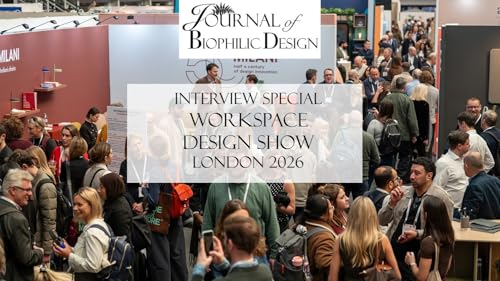
    At The Workspace Design Show at the Business Design Centre in London this year, I had the privilege of chairing a dynamic panel featuring industry leaders Nicola Tomkins Head of Design for Major Projects at Overbury, Lidia Johansen Associate Environmental Consultant at chapmanbdsp and Paulo Ribeiro Head of Interior Design at Aecom. It was a lively and dynamic discussion to a full house at the show. We looked at how we could reframe Biophilia, moving from Aesthetic to a Performance System. We explored how through collaboration, sourcing and configuring the brief early we can accelerate biophilic design specification. After the panel I took my camera and mic and interviews other biophilic design experts visiting the show to ask them to share their insights on the show and biophilic design, emphasising its critical role in modern architecture and interior spaces. Biophilic Design reconnects us back to nature, to our roots, to what makes us truly human. If you've ever wondered why natural elements in our spaces feel so vital, or how design can heal and inspire us, here’s what you’ll discover: how biophilic design transforms spaces, the science proving its benefits, and the urgent need to rethink our environments for mental, physical, and planetary health. Biophilic Design transforms spaces from mere workplaces into living ecosystems.As Katrina Dalley from Plant Designs puts it, “bringing nature inside makes a massive difference. It’s not just visual—it's psychological, emotional, and physiological.” Emi Melin of Plus Creatives, has been spending a lot of time researching about the impact of Biophilic and multi-sensory design as a layer over conventional interior design, looking at intangible elements like light, smell, humidity or human emotions. Plants, water features, natural textures—they all trigger our senses, grounding us, reducing stress, and boosting creativity. Moreover, as Nicola Tomkins, Head of Design for Major Projects atOverbury notes, “there’s a growing awareness of sensory elements, not just greenery, but all the layers of nature that help us feel more connected and well.” When we surround ourselves with the natural, we foster a sense of belonging that’s essential for mental health and resilience. Visitors like architect, biophilic designer and environmental psychology consultant Lucilla Malara who was visiting from Italy, emphasise the importance of how biophilic elements impact our physiology. Light, especially circadian lighting, influences our body clocks, improving sleep and alertness. Infrared light, with its deep cellular reach, even supports mitochondrial energy production, our cellular powerhouses. Diving deeper, Ulysse Dormoy CEO of Atrium, explains that “light enters our bodies beyond just vision, influencing every cell.” Our planet’s energy, derived from sun, light energy, sustains all life. Modern design must tap into this natural energy flow, not block or distort it. On a personal note, Nicola reflects, “I’m an advocate of evidence-based solutions. When you can prove that biophilic design improves wellbeing and productivity, it’s impossible to ignore.” From reduced stress and better focus to even improving conditions for those with dementia or mental health challenges, the data is compelling. The future is clearly calling for spaces that harmonise with nature, not oppose it. Think: facades punctured with green patches, windows that mimic daylight rhythms, water features inside and out, and materials that echo organic textures. More trees as Loulou Elliott of Plant Designs also advocates. Ulysse’s vision: “We need to design environments that entice people outdoors, spaces that make stepping outside the conscious choice, not a necessity.” We have the power to reimagine cities and workplaces that invite nature in, rather than keep it out. Take it from Nicola: “We’re shifting toward products that integrate greenery and biomaterials, aligning with our modern need for sustainability and wellbeing.” It’s a transformation led by awareness, innovation, and a sense of responsibility. But it’s not just aesthetics. It’s about creating spaces that support human health, emotional balance, and even planetary recovery. As Katrina states, “Biophilic design makes spaces more restorative, not just functional. It’s a holistic approach to wellbeing.” As Ulysse warns, “We are increasingly disconnected from nature, and that’s dangerous. We need to act now — for our health, our planet, and future generations.” A vision of 2100 could show a world where cities are alive with plants, and indoor-outdoor boundaries blur, enabling us to be outside more often and reconnect deeply. In the words of Lucilla: "Nature isn't just plants; it’s sounds, smells, materials, the mystery of complexity. We need to harness all of this to heal and inspire." So, do we continue down a path of disconnection or embrace a ...
    Show More Show Less
    17 mins
  • How to Fast-track a Regenerative Future
    Mar 8 2026
    Efforts to tackle the climate and nature crisis often focus on policy, science and activism. But according to Will Hayler, founder and CEO of The Blue Earth Summit, real transformation will only happen when entrepreneurs and investors are fully part of the conversation. Speaking about the philosophy behind the Blue Earth Summit, Will argues that innovation and enterprise are essential if environmental solutions are to move beyond ideas and into the real economy. “If you're really serious about solving problems, you need entrepreneurs in the room,” he says. Scaling solutions requires capital, markets and commercial incentives. While science and policy define the problem, entrepreneurs are often the ones who turn ideas into practical products and services. For architects, planners and designers, this represents an opportunity. Across the UK alone, plans to build 1.5 million homes in the coming years will shape the nation’s landscape for decades. Decisions made today about materials, planning and urban design will define the health and sustainability of future communities. Will believes the design industry should see this not as a burden, but as a privilege.“People working in climate and sustainability sometimes expect sympathy,” he says. “But I see it differently. It’s lucky you. You’re working at the cutting edge of what the world needs.” Designers, he argues, have the chance to rethink how humanity lives — creating cities that are cleaner, healthier and more connected to nature. Will is also clear-eyed about the motivations that drive the private sector. “Businesses will only do the right thing if it benefits them,” he says, pointing to the reality that return on investment and competitive advantage ultimately shape corporate decisions. Rather than criticise that system, the summit aims to work within it. One of its core goals has been to bring together groups that have historically operated in separate spheres. “We wanted to create that connection between third sector and private sector,” Will explains, arguing that NGOs, scientists and businesses must collaborate if environmental progress is to accelerate. Central to this approach is reframing the narrative around sustainability. Instead of presenting environmental action as a burden, Will believes it should be positioned as an opportunity. In his view, sustainability needs to be understood as a form of upgrade — delivering healthier environments, smarter materials and more resilient systems. “The sustainability movement is best framed around wellbeing for everyone, forever,” he says. This shift is particularly relevant in the built environment, where designers, architects and developers are shaping the places where people spend most of their lives. Integrating nature into buildings and cities can have profound health benefits. As Will puts it: “People that spend more time in nature are healthier than those that don't. So how can you bring that into your design and sell it as an upgrade?” At the same time, he believes the next wave of environmental innovation will focus heavily on circular systems and resource efficiency. “Waste management is a massive, massive issue at the moment,” he notes, pointing to the need for designers and entrepreneurs to rethink materials and production processes. Will is optimistic about the direction of travel. Clean energy, he argues, is abundant and increasingly affordable. “Energy is free and abundant, through the sun and through the wind,” he says, imagining a future powered by renewable systems. If innovators, investors and designers can work together, he believes the outcome could be transformative. “The future can and should be radically better than what we have today.” Chapter 1 — Opening and Guest Introduction (0:00 – 0:42)Chapter 2 — Will’s Background and the Blue Earth Summit’s Purpose (0:42 – 4:03)Chapter 3 — The Summit’s Focus, Leverage, and the Role of Entrepreneurship (4:03 – 9:32)Chapter 4 — Building a Bridge: Business, NGOs, and the “Upgrade” Narrative (9:32 – 16:38) Chapter 5 — Regenerative Design, Biophilia, and the Built Environment (16:38 – 21:33)Chapter 6 — Scaling, Investment, and Cross‑Border Opportunity (21:33 – 29:53)Chapter 7 — Nature-Based Design, Health, and the Big Vision (29:53 – 40:22). To find out more and register your interest in the Blue Earth Summit visit: www.blueearthsummit.com Have you got a copy of the Journal? You can now subscribe as a member of the Journal of Biophilic Design or purchase a gorgeous coffee table reference copy or PDF download of the Journal journalofbiophilicdesign.comor Amazon and Kindle. Credits: with thanks to George Harvey Audio Production for the calming biophilic soundscape that backs all of our podcasts. Listen to our podcast on Audible, Amazon Music, Spotify, iTunes, YouTube and all the RSS feeds.https://www.facebook.com/...
    Show More Show Less
    41 mins
  • We spend 90% of our time indoors. Here’s how Biophilic Design can make that healthier.
    Mar 3 2026
    We spend about 90% of our lives indoors, yet our cities, offices and homes are rarely designed with the biological reality of that fact in mind. That disconnect between humans and the natural systems we evolved within is becoming harder to ignore. Biophilic Design is a growing movement in architecture and planning, which argues that bringing nature back into the built environment is not a luxury or aesthetic flourish but a public-health, economic and social necessity. Alexandra Bowen, founder of the Biophilic Design Community on LinkedIn, puts it bluntly: “Our minds and bodies evolved over thousands of years to thrive in nature. If we’re indoors almost all the time, we have to be deliberate about reconnecting with it.”Her argument echoes a growing body of research suggesting that the benefits are measurable. Studies cited by designers show that access to daylight and views of nature can improve cognitive performance and memory recall by around 15%, while hospitals with natural light have reported 41% shorter patient stays. In schools, improved ventilation has been linked to 14% better maths scores and significantly reduced sickness absence. 00:00 Introduction to Biophilic Design and Community Engagement03:47 Alex's Journey into Biophilic Design06:11 The Holistic Approach to Biophilic Design12:46 Understanding the Science Behind Biophilic Design18:03 The Importance of Authentic Biophilic Design21:17 Moving Beyond Aesthetics in Biophilic Design27:31 Overcoming Barriers to Implementing Biophilic Design39:24 Biophilic Design Across Different Scales51:59 The Future of Cities and Biophilic Design Yet despite the data, the messaging around biophilic design is often muddled and sometimes even contradictory. On the one hand, the concept is gaining traction in sustainability frameworks and workplace strategies. On the other, it is frequently reduced to a checklist: a plant in the corner, a “green wall”, or a scattering of faux foliage. Alex calls out the “Frankenstein approach”, where offices and restaurants install plastic plants to simulate nature. “We’re bringing petroleum-based materials indoors to try to feel closer to nature. It misses the point,” she says. “True biophilic design is rooted in living systems and science, not just visual symbols.” The stakes go beyond aesthetics. Poor indoor environments carry enormous economic costs. In the United States alone, the annual cost of poor indoor air quality has been estimated at $75bn. Meanwhile, nature-based infrastructure such as urban green spaces, wetlands or tree canopies, can be 42% cheaper than traditional “grey” infrastructure and deliver 36% more value when broader benefits such as air quality, biodiversity and public wellbeing are taken into account. Still, many planners and developers remain wary. The first barrier is cost, or rather, the perception of it. Biophilic features are often seen as expensive add-ons, vulnerable to being “value (or rather cost)-engineered out” of projects. But advocates argue this misses the bigger picture. “People focus on the initial cost,” Alex says, “instead of the compounding returns over a building’s lifetime.” Those returns can include improved employee productivity, lower healthcare costs, reduced energy use and increased property value. Another barrier is language. As urban societies become further removed from the natural world, even the vocabulary that describes it is fading. Words such as river, moss or meadow appear less frequently in everyday discourse than they once did, while technological metaphors dominate. That loss of language reflects a deeper cultural shift and one that makes reconnecting people with nature harder. There is also a structural challenge within design professions themselves. Modern architecture has often prioritised form over ecological function, producing cities where, as critics have long noted, you can travel thousands of miles and encounter the same glass boxes, chain stores and climate-controlled interiors. The result is what urbanists call the “geography of nowhere”: places that feel interchangeable and detached from their landscapes. Biophilic design proposes a different starting point. Instead of asking what to build on a site, designers ask how nature already works there and look at its climate, ecology, history and culture. This approach, rooted in the concept of genius loci, or “spirit of place”, emphasises designing with the land rather than imposing upon it. It also extends beyond architecture into community life. When it is done well, biophilic design can strengthen social connection and a sense of belonging in cities. Public spaces that integrate natural systems, trees, water, biodiversity and seasonal change, tend to encourage interaction and stewardship. People are more likely to care for places they feel connected to. In practice, the shift can start small. Sometimes it is as simple as rearranging...
    Show More Show Less
    58 mins
  • Collect 2026: Metamorphosis and the Polish Design Connection
    Feb 19 2026
    Have you ever wondered why we feel so alive when we’re surrounded by nature? Why certain textures, materials, or natural elements spark deep emotions within us? The truth is reconnecting with nature through thoughtful design is a necessity, it is how we restore our bond with the earth and the more we do this, the more we are shaping a new way of living that sustains us all. Polish craft and innovation is going to take centre stage at Collect 2026 which opens in London on 25 February this year 2026. Nature connection, craft and design is taking centre stage. Biophilic Design helps people reconnect with nature. I am also a maker and artist (I sculpt, weave, sketch, etc), and for me, creating things with natural materials gives me a direct connection to nature and our planet. In this podcast we speak with the curator of this year’s Collect Corinne Julius and one of the Polish artists featured during the show. We explore the significance of biophilic design, the metamorphosis of Polish craft, and the role of materiality in art. The conversation also touches on the challenges of the craft industry in the context of climate change and the importance of tactile experiences in our lives. Can slow craft be the antidote to the disconnection and environmental crisis we face today? Have you noticed when you touch a rough piece of wood, a cool stone, or a warm fibre, something stirs inside? That tactile experience connects us directly to natural material grounding us amidst what can sometimes be quotidian chaos. It’s not accidental that craft practitioners, like Anna Bera, choose wood, stone, and clay to create, natural biophilic materials conduct our senses directly to our well-being and consciousness. Anna, a Polish artist from the mountains, explains it beautifully: “Working with natural materials is like engaging in a dialogue with the earth.”She crafts large-scale sculptures from wood, embracing imperfections, knots, and fungi. Her work isn’t flawless in the mass production sense; instead, it’s alive, real, and deeply connected.Contrast that with the sterile, sanitised surfaces of modern mass-produced objects. They’re designed to be invisible, to blend into the background. But Anna’s work demands you notice — it beckons tactile engagement, invites you to touch and reflect. Natural materials are imperfect, and that’s what makes them beautiful. Their flaws tell stories—of growth, decay, evolution. When we embrace this, we find healing, grounding, and a fresh perspective on our relationship with nature. Corinne Julius, the curator of the Metamorphosis exhibition, champions the idea that craftsmanship embodies deep intellectual effort and storytelling. She believes that authentic craft can challenge our fast-paced, disposable culture. “Craft is a form of soft power. It shows us that beauty can win minds and hearts, making deep environmental and social issues approachable.” Her exhibitions, like Metamorphosis showing at Collect this year at Somerset House in London, celebrate transformation of materials, of countries, of ideas. The craftspeople and artists she showcases, like Alicia Patanowska or Marcin Rusak use their work to COMMENT. Their pieces question consumption, waste, and sustainability through poetic, tactile means. A tile that’s thrown, cut, reassembled; a flower encased in resin—each reflects an urgent truth: We can transform waste into wonder, making us see the world differently, inspiring us to act consciously. So what is the biggest barrier to more craft specification? We have been disconnecting from nature more and more over the last two hundred years especially. Our built environments, homes, school, offices and hospitals, are often cold, uniform, and disconnected from the rhythms of the natural world. No wonder stress skyrockets, mental health suffers, and our environment degrades. Biophilic design flips this script. It’s about embedding natural elements, wood, plant life, water, into our daily spaces. Think of the Polish artists who create immersive installations from living plants, or designers reimagining architecture with curving, organic shapes that mirror the human body.As Anna says: "We need more biomorphic shapes, fewer harsh lines, more presence of trees and nature in our surroundings." Her work, touching even those with sight impairments, demonstrates how materiality influences well-being. Touching a rough wood sculpture can ground you, calm you, reconnect you with your roots.Corinne agrees: “In a world obsessed with speed and perfection, slow craft and natural materials are an antidote. They remind us who we are—living, breathing, interconnected.”This of course is the heart of biophilic design. The Polish crafts scene, with its optimism and innovation, exemplifies a can-do attitude. Corinne points out: “When we collaborate properly with craftspeople, we create spaces and products that are sustainable, soulful, and ...
    Show More Show Less
    52 mins
  • One minute to breathe. How images of nature can help save our A&E staff
    Jan 21 2026
    Emergency departments are some of the most punishing workplaces in healthcare. Clinicians move in seconds from breaking catastrophic news to families, to resuscitating a dying patient, to reassuring a parent whose child has a simple fever. We rightly talk a lot about patient experience. We talk far less about what these relentless environments do to the people who work in them.A pilot study published in the Journal of Biophilic Design suggests that something as simple as one minute of looking at nature-based art can measurably ease that burden.The research was led by emergency physician and US Army major Dr Anant Shukla at Dartmouth-Hitchcock Medical Center in New Hampshire, with Dr Harman Gill , an emergency and critical care physician, as senior researcher. Their lived experience in A&E (ED) is the backdrop to the work.Gill recounts a single shift that started with the emergency delivery of a baby girl in the middle of a chaotic winter flu season. Within 40 minutes, the new mother was in catastrophic postpartum haemorrhage. The same team that had just celebrated a new life found themselves fighting to save another. Then, as he points out, they must walk into the next cubicle – whether it’s a heart attack or “just the sniffles”, and deliver the same standard of calm, competent care. What happened 20 minutes earlier is invisible to the next patient, but not to the clinician’s nervous system.Shukla describes the ED as “controlled chaos”, windowless, noisy, metal and plastic surfaces, a “cave” in the hospital basement. During Covid, he noticed something striking, upstairs, patients on certain wards with views of nature or biophilic art were using less narcotic pain medication. Staff downstairs had nothing similar. “We do so much for patients and visitors,” he says. “Why not for clinicians?”From that question came a this experiment: could just one minute of viewing biophilic art shift clinicians’ emotional state in a meaningful way?The studyIn the ED’s staff “cave”, one wall was given over to large-scale photographs of local New Hampshire landscapes: a mountain stream, autumn foliage, a cluster of birch trees in winter, a calm pond. The works, by a local photographer, were intentionally familiar – the sort of scenes you could walk out and see within a few miles of the hospital.Clinicians, doctors, nurses, advanced practice providers and residents, could, when they had a moment, scan a QR code next to the artwork. They completed a brief validated survey (using the Daniels Five-Factor Measure of Affect) rating how they felt “right now” on items such as calm, at ease, anxious, tired, gloomy, annoyed. They were then instructed to look only at the art for one minute, using a timer on their phone, and repeat the survey immediately afterwards.In a level 1 trauma centre, even getting people to pause for sixty seconds is a challenge. Yet enough staff participated over time for the team to analyse pre‑ and post‑scores using standard statistical tests.Key findings of the biophilic art studyThe results were modest in scale but statistically robust, especially given the small sample and chaotic setting:- Anxiety fell from an average score of 2.6 to 2.0 , with a p‑value of 0.003 (meaning only a 0.3% likelihood this was due to chance).- Calm increased from 3.6 to 4.3 (p = 0.02 ).- Feeling “at ease” increased from 3.3 to 4.0 (p = 0.003 ).- Negative feelings such as feeling *gloomy*, *tired* and *annoyed* all showed statistically significant decreases.In plain language: after just one minute of viewing nature imagery, clinicians felt less anxious, less gloomy and calmer and at ease, in a way that is extremely unlikely to be explained by random fluctuation.The researchers are careful not to oversell this as a cure for burnout. No picture can fix under‑staffing, moral injury, or a broken healthcare system. But it can, as Gill puts it, create a “mandatory pause”, a tiny, biophilically designed, evidence‑based intervention that gives staff a momentary psychological reset.What this means for A&E designIf a single minute in front of one picture can move the needle, what might a genuinely biophilic emergency department achieve?At present, most EDs, in the US and UK alike, are buried in basements, windowless, acoustically harsh and visually sterile. Design decisions are dominated by managerial concerns, like where to put trolleys, equipment, computers. By contrast, high‑performing companies like tech firms deliberately shape workplaces to support focus, recovery and creativity.This research can help empower staff and designers to argue for change. Windows where possible, daylight‑mimicking lighting where it isn’t, local and seasonal nature imagery, quieter materials, designated biophilically designed micro‑spaces where staff can pause and look at something other than a monitor or a curtain track.Clinicians are not an endlessly ...
    Show More Show Less
    1 hr and 13 mins
  • Biophilic Design and Innovative Place Typologies for a new Generation of Developers
    Nov 13 2025
    We have a climate crisis, housing shortages, and increasing urban disconnection, we need a pioneering radical approach to development that puts nature and human flourishing at its core. Human Nature, led by Joanna Yarrow, are creating living, breathing ecosystems that challenge how we normally go about urban design."We've boxed ourselves into a corner by having the starting point that we are separate from nature," Joanna explains. Places should not just exist alongside nature, they should be fundamentally integrated with it.Human Nature has identified three critical place typologies that could transform how we live. These are urban neighbourhoods, rural clusters, and new settlements. Their flagship project, the Phoenix in Lewes, East Sussex, demonstrates what's possible when we reimagine development."Places aren't just buildings. They are infrastructure, streets, parks, alleyways, rivers – a collection of components that includes hardware like pavements and water systems, and software like community services."The Phoenix project is a testament to this holistic approach. Spanning 7.9 hectares of former industrial land, it will become the UK's largest bio-based development, featuring 685 homes constructed primarily from natural materials like timber, hemp, and lime.But this isn't just about sustainable construction. It's about redesigning entire lifestyles. "We want to create the optimal precondition for a better, healthy, and more sustainable way of life." This means designing neighbourhoods where car dependency becomes unnecessary, where food production is integrated, and where nature isn't an afterthought but the central organising principle.Her background – growing up in a 64-acre working wood in Sussex – deeply influences her approach. "Nature was my playground," she recalls. This personal connection translates into a professional mission to mainstream sustainable living.The challenge, she argues, isn't technological. "Most of this is not rocket science. Most of this has been done already. We don't need to reinvent the wheel." Instead, we need collective will and a systemic reimagining of development.We should review the concept of “developers” to be not just extractive profit-makers, but as stewards with critical societal duty. "You are shaping people's lives for decades, generations to come. What a responsibility."Everyone can contribute to change. "The power sits with all of us to weave this into our everyday life.” This might mean walking a different route to work, engaging with local green spaces, or challenging existing development models.The benefits extend far beyond environmental considerations. These nature-integrated spaces promise improved mental health, community connection, and a sense of belonging that modern developments often strip away."Wouldn't it be wonderful, if our schools had forests instead of fences? If our walk to work included fruit trees, flowers, and bird song? If our homes and offices could breathe without us needing to open a window?"Projects like the Phoenix prove such transformative development is possible. By demonstrating viable alternatives, Human Nature is creating blueprints for a regenerative future. We can redesign our built environment to enhance not compromise both human and natural systems.https://humannature-places.com/Bonus show notes: Advice for Developers to Design Better, Based on Joanna Yarrow's insights:1. Shift Your Mindset- Stop seeing development as unit production and profit extraction- Become "stewards" rather than "extractors"- Recognise that you're shaping lives for generations, not just building temporary structures 2. Embrace Holistic Design- Don't just design buildings, design entire "places" that include: * Infrastructure * Streets * Parks * Community services * Green spaces- Consider the entire ecosystem, not just the physical structure 3. Prioritise Collaboration- Practice "deep collaboration" with: * Local communities * Specialist architects and designers * Environmental experts * Interest groups- Be transparent and open-source about your learning and processes 4. Focus on Positive Impact- Design with three core considerations: * Climate positive outcomes * Nature enhancement * Human flourishing- Create places that inspire and enable sustainable living5. Think Beyond Traditional Boundaries- Consider different place typologies: * Urban neighbourhoods * Rural clusters * New settlements- Customise design to specific bioregional contexts6. Integrate Nature Seamlessly- Don't treat nature as an "other" or additional feature- Centre nature in every design decision- Create multi-sensory experiences that connect humans with natural systems7. Enable Sustainable Lifestyles- Design spaces that make sustainable living: * Easy * Attractive * Accessible- Reduce car dependency- Incorporate food production- Create green corridors and natural infrastructure8. Engage Communities- Run collaborative design ...
    Show More Show Less
    53 mins
  • Biophilic design: buzzword or big deal? A Workplace Geeks investigation™️
    Nov 6 2025
    Welcome to this special episode of the Journal of Biophilic Design podcast. We’re really excited to share this feature from our very first Biophilic Design Conference, which took place at the iconic Barbican Centre in London. It was a landmark moment — the UK’s first-ever conference dedicated entirely to biophilic design — and we were joined by an amazing lineup of experts, designers and researchers exploring how connecting people and nature through design can transform our buildings and cities. This year’s conference is back — bigger and better than ever — at Westminster Central Hall in London on Sunday, 17th November. https://journalofbiophilicdesign.com/biophilic-design-conference Join us for a day of inspiring talks, interactive sessions, and meaningful connections with the people who are shaping the future of design for wellbeing, sustainability and climate resilience.This special edition of the Journal of Biophilic Design podcast is a podcast recorded by our friends at Workplace Geeks, Ian Ellison and Chris Moriarty. Host Ian Ellison sets out to explore a big question: Is biophilic design simply good design, or something we need to intentionally spotlight because of its unique importance to people, place and planet?In this deep dive, Ian speaks with a host of experts and thought leaders — including Dr Nigel Oseland, Dr Sally Augustin, Oliver Heath, Prof Harriet Shortt, Mark Catchlove, Dr Vanessa Champion, Matthew Burgess, Chloe Bullock, and Prof Geoff Proffitt — to unpack the science, theory, and lived experience behind biophilic design.You’ll hear:The psychological and evolutionary roots of our natural affinity for nature.Insights from the UK’s first Biophilic Design Conference and what made the Barbican such a fascinating venue.Real-world examples of biophilic design in action — from workplaces and clinics to urban spaces and beyond.Tune in to reflect, challenge assumptions, and join the ongoing conversation: is biophilic design just a feel-good concept, or is it the future of how we should be designing every environment?Book tickets to the 2nd Biophilic Design Conference - join us in PERSON and ONLINE https://journalofbiophilicdesign.com/biophilic-design-conferenceSession schedule : https://journalofbiophilicdesign.com/-2025-conference-sessionsConnect with the Workplace Geeks community:Share your thoughts using #WorkplaceGeeks or email hello@workplacegeeks.org.Follow @WorkplaceGeeks on LinkedIn and subscribe for more thought-provoking insights on workplace and design. To listen to the original visit https://www.buzzsprout.com/1933353/episodes/16903582-biophilic-design-buzzword-or-big-deal-a-workplace-geeks-investigationThey also have a listener survey live at the moment, with prizes, so do the survey too, that would be superb https://www.smartsurvey.co.uk/s/WGls2025sv/Have you got a copy of the Journal? You can now subscribe as a member of the Journal of Biophilic Design or purchase a gorgeous coffee table reference copy or PDF download of the Journal journalofbiophilicdesign.comor Amazon and Kindle. Credits: with thanks to George Harvey Audio Production for the calming biophilic soundscape that backs all of our podcasts. Listen to our podcast on Audible, Amazon Music, Spotify, iTunes, YouTube and all the RSS feeds.https://www.facebook.com/journalofbiophilicdesign/https://twitter.com/JofBiophilicDsnhttps://www.linkedin.com/company/journalofbiophilicdesign/https://www.instagram.com/journalofbiophilicdesignIf you like this,please subscribe!
    Show More Show Less
    Less than 1 minute