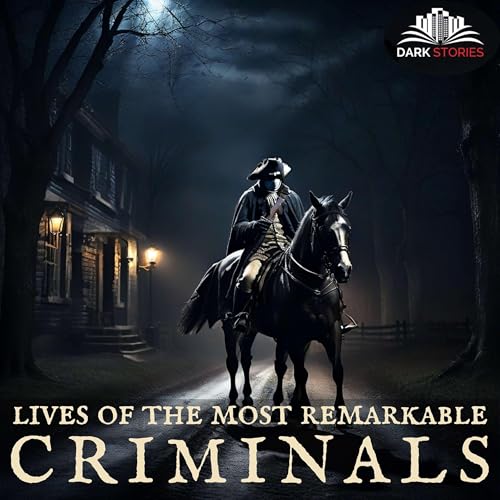
Lives Of The Most Remarkable Criminals cover art

Lives Of The Most Remarkable Criminals

Lives Of The Most Remarkable Criminals

By: Dark Stories
Listen for free

Lives of the Most Remarkable Criminals is a true crime podcast unlike any other; because every word of it was written nearly 300 years ago.


Each week, we read aloud one chapter from a remarkable book first published in London in 1735: a sprawling collection of murderers, highwaymen, coiners, housebreakers, pirates and worse, recorded in vivid and unsparing detail.


The crimes are real. The voices are authentic. And the world they reveal, brutal, strange, and surprisingly familiar, has been waiting three centuries to be heard again. True crime did not begin with podcasts. It began here by the burning light of a candle.

© 2026 Lives Of The Most Remarkable Criminals
True Crime
Episodes
  • Episode 007: Matthew Clark: The Cowardly Footpad Who Turned Killer
    Jun 29 2026
    Send us your FeedbackMatthew Clark is the kind of figure who makes true crime so unsettling: not a mastermind, not a hardened villain, but a lazy, cowardly young man whose small vices compound into something monstrous. Lives of the Most Remarkable Criminals introduces him as a creature formed entirely from the worst impulses of low life; idle, drunk, driven by lust, and too timid to commit even the crimes he plans. Born in St. Albans to parents of modest means, Clark squanders every opportunity placed before him. Dismissed from a gentleman's household for sheer incorrigibility, he drifts into roadside robbery on the heaths outside London; not from ambition, but because honest labour feels harder than the risk of the noose. The Georgian world Clark inhabits is one where cowardice and desperation make a volatile combination, and the roads between country and city are lined with gallows that watch every traveller pass. Dark Lexicon: Old words. Dark meaning.The past speaks its own dialect; here is what to listen for in this episode. Footpad: a robber who works on foot, as opposed to a highwayman who attacks from horseback. The footpad was considered the lowest and most contemptible breed of thief; lacking even the theatrical swagger of the mounted robber, he was simply a desperate figure lurking in hedgerows and waiting for someone weaker to come along. Meaner sort: nothing to do with cruelty here. In eighteenth century usage, 'mean' referred to lowly social standing or humble circumstances. The 'meaner sort' were the poor and labouring classes; the ones Georgian writers worried most about when it came to moral corruption. Passengers: today we think of someone sitting in a vehicle, but in this era a passenger was simply anyone passing along a road on foot, horseback, or in a coach. Every passenger on a lonely heath was a potential victim; every stretch of road between towns was a hunting ground. Junketting: feasting, merrymaking, carousing. The word 'junket' still survives in modern English, usually meaning a lavish trip at someone else's expense, but in Clark's day it was rawer and more physical: drinking bouts, dancing, and the reckless spending of stolen money on fleeting pleasures. The matrimonial maggot bit his brain: a wonderfully vivid eighteenth century expression. A 'maggot' in this context was a whim or a sudden foolish fancy; the image is of a parasitic idea burrowing into a person's thoughts and driving them to irrational action. When the matrimonial maggot bit Clark, it meant the notion of marriage seized hold of him like a fever. Timorous: fearful, easily frightened. Still in use today but far less common, it perfectly captures Clark's defining trait: a man who plans violence but whose own cowardice keeps undoing him, at least until desperation finally overwhelms his fear. Jocose: playful, humorous, given to joking. The word carries a warmth and ease that makes its use in this story deeply chilling; Clark sits laughing and flirting with a woman he is already planning to kill. Made a shift: managed with difficulty, barely succeeded. In this account, the phrase describes a dying woman's final desperate effort; she 'made a shift to mutter his name,' meaning she barely managed to speak it through a wound that should have silenced her entirely. About This Series Lives of the Most Remarkable Criminals is one of the earliest works of true crime writing in the English language, nearly 300 years old, covering murderers, thieves, highwaymen, forgers, coiners and worse. The book is entirely in the public domain and every word of it can be read today for free. But if you would rather listen, this podcast does exactly that: one criminal at a time, every week, read aloud. True crime was not invented by podcasts or streaming services. Eighteenth century readers were just as fascinated by outlaws and killers as we are today. They just consumed their dark stories by candlelight. The voice you hear is David Dark: crime researcher, theatre script writer, producer of live immersive experiences, and audiobook narrator and voice artist. This podcast uses an AI voice model trained on David's own voice, built using the maximum available training data to faithfully represent how he actually sounds. To hear David's real voice in human generated form, visit him on Audible, Online Stage, Voices of Today, Spoken Realms, and Internet Archive.Support the show
    Show More Show Less
    7 mins
  • Episode 006: Walter Kennedy: The Aspiring Pirate of Wapping
    Jun 23 2026
    Send us your FeedbackWalter Kennedy grows up at Pelican Stairs in Wapping, the son of an anchor-smith, a boy with every reason to follow his father into honest labour. But something restless burns in him; as Lives of the Most Remarkable Criminals tells it, he possesses a 'too aspiring temper' that honest trades can never satisfy. Serving aboard a man-of-war during Queen Anne's wars against France, Kennedy absorbs every whispered tale of buccaneers and maritime desperadoes, and what begins as fascination hardens into ambition. His is a true crime story shaped not by sudden desperation but by slow, deliberate seduction; the sea offering its own dark curriculum. The silver oar of Admiralty justice waits somewhere ahead of him, gleaming on a courtroom table he cannot yet imagine. Dark Lexicon: Old words. Dark meaning.The past speaks its own dialect; here is what to listen for in this episode. Petty treason: not a lesser kind of treason in the way we might assume. In English common law, petty treason referred specifically to the killing of a superior by a subordinate: a wife killing a husband, a servant killing a master, or a clergyman killing a prelate. When piracy is described as petty treason at common law, it signals that pirates were seen not merely as thieves but as men who had betrayed the sovereign authority itself. Silver oar: a literal object, not a metaphor. The Court of Admiralty carried a silver oar into the courtroom as its emblem of jurisdiction over maritime offences. It lay on the table during trials and was carried in procession before the condemned on their way to execution. It was the last thing many pirates ever saw gleaming in the daylight. Upon the account: sailor's slang for turning pirate. To go 'upon the account' was to abandon lawful service and take up robbery at sea. The phrase carried a grim bookkeeping quality; as if plunder were simply another ledger to be managed. Ambuscade: the older form of the word ambush, borrowed from the French. It sounds grander, more deliberate; and in this episode it describes exactly that: a carefully laid trap with poisoned arrows and lethal patience. Dissembled: today we might say 'pretended' or 'concealed.' To dissemble is to hide one's true intentions behind a mask of courtesy. The Portuguese governor who discovers the pirates but invites them to an entertainment is dissembling; and the consequences are devastating. Tractable: meaning obedient, easily managed. We still use it occasionally, but in eighteenth century character sketches it appears often; a tractable child is one who gives no trouble. Kennedy is described as tractable in his youth, which makes his later transformation all the more striking. Buccaneers: not simply a romantic synonym for pirate. The buccaneers were a specific group of seventeenth century raiders, originally hunters on Hispaniola who smoked meat on wooden frames called 'boucans.' They evolved into seafaring raiders who operated under loose commissions and sometimes with the tacit approval of colonial governors. By Kennedy's time, their era was passing into legend; the kind of legend that infected young sailors with ambition. Man-of-war: a warship in the service of a national navy, armed and crewed for battle. It is not a pirate vessel; quite the opposite. That Kennedy learns his piracy while serving aboard one of the Crown's own fighting ships is one of the darker ironies of his story. About This Series Lives of the Most Remarkable Criminals is one of the earliest works of true crime writing in the English language, nearly 300 years old, covering murderers, thieves, highwaymen, forgers, coiners and worse. The book is entirely in the public domain and every word of it can be read today for free. But if you would rather listen, this podcast does exactly that: one criminal at a time, every week, read aloud. True crime was not invented by podcasts or streaming services. Eighteenth century readers were just as fascinated by outlaws and killers as we are today. They just consumed their dark stories by candlelight. The voice you hear is David Dark: crime researcher, theatre script writer, producer of live immersive experiences, and audiobook narrator and voice artist. This podcast uses an AI voice model trained on David's own voice, built using the maximum available training data to faithfully represent how he actually sounds. To hear David's real voice in human generated form, visit him on Audible, Online Stage, Voices of Today, Spoken Realms, and Internet Archive.Support the show
    Show More Show Less
    8 mins
  • Episode 005: Barbara Spencer: The Young Coiner of Cripplegate
    Jun 15 2026
    Send us your FeedbackBarbara Spencer is barely out of childhood when the world begins to shape her into something dangerous. Raised without restraint in the cramped lanes of Cripplegate, she is the kind of figure that Lives of the Most Remarkable Criminals captures with unflinching clarity: a young woman too proud for servitude, too restless to stay still, drawn by temperament toward the edges of lawful life. Her drift into counterfeiting feels almost inevitable; a single act of defiance carries her out of her mother's alehouse and into the company of coiners who see her recklessness as a useful tool. In the annals of true crime, few portraits are as vivid as this one: a girl barely twenty, pushing false money through London's streets with a freedom she mistakes for power. Georgian justice has a particular cruelty reserved for women convicted of this offence, and the machinery of that law is already turning. Dark Lexicon: Old words. Dark meaning.The past speaks its own dialect; here is what to listen for in this episode. Mean parents: today 'mean' usually suggests cruelty or stinginess, but in eighteenth century usage it simply meant humble or of low social standing. Barbara's parents were not wicked; they were poor and unremarkable, the kind of people the law barely noticed until their children crossed it. Mantua-maker: a dressmaker who specialised in the mantua, a loose flowing gown fashionable in the late seventeenth and early eighteenth centuries. It was one of the few skilled trades open to women, and an apprenticeship to one could have set Barbara on a very different path. Utter: to utter false money had nothing to do with speaking. In legal language it meant to put counterfeit coins into circulation; to pass them off as genuine in a transaction. The crime of uttering was considered a form of petty treason against the Crown, because the monarch's image and authority were stamped upon every coin. Vend: to sell or distribute. Paired with 'utter' in the text, it underlines the commercial nature of the offence; coiners operated in networks, with some people manufacturing the forgeries and others, like Barbara, sent out into the streets to move them. Petty treason: a legal category that has no modern equivalent. It covered crimes that violated a bond of allegiance or obedience: a wife killing her husband, a servant killing a master, or a subject counterfeiting the king's coin. The penalties for petty treason were deliberately more severe than those for ordinary felonies, and for women the distinction carried a uniquely horrifying consequence. Faggots and brushes: bundles of sticks and dry kindling used to build the fire at an execution by burning. The word 'faggot' today carries entirely different connotations, but in this period it referred simply to a bound bundle of firewood; the mundane fuel of an extraordinary punishment. St. Giles's Pound: a public pound near the parish of St. Giles in the Fields, used for impounding stray livestock. The area around it was notorious for poverty, gin shops and criminal networks; it was exactly the kind of place where a young runaway could vanish into a new and dangerous life overnight. Discover: in this context, to discover someone meant to reveal or expose their identity to the authorities. Barbara refused to discover those who taught her to coin; she would not name them, even under the weight of her own conviction. About This Series Lives of the Most Remarkable Criminals is one of the earliest works of true crime writing in the English language, nearly 300 years old, covering murderers, thieves, highwaymen, forgers, coiners and worse. The book is entirely in the public domain and every word of it can be read today for free. But if you would rather listen, this podcast does exactly that: one criminal at a time, every week, read aloud. True crime was not invented by podcasts or streaming services. Eighteenth century readers were just as fascinated by outlaws and killers as we are today. They just consumed their dark stories by candlelight. The voice you hear is David Dark: crime researcher, theatre script writer, producer of live immersive experiences, and audiobook narrator and voice artist. This podcast uses an AI voice model trained on David's own voice, built using the maximum available training data to faithfully represent how he actually sounds. To hear David's real voice in human generated form, visit him on Audible, Online Stage, Voices of Today, Spoken Realms, and Internet Archive.Support the show
    Show More Show Less
    5 mins
adbl_web_anon_alc_button_suppression_t1
No reviews yet