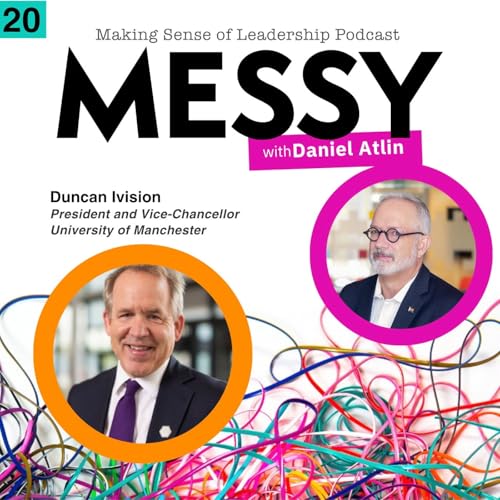
Messy with Daniel Atlin cover art

Messy with Daniel Atlin

Messy with Daniel Atlin

By: Solid Gold Podcasts #BeHeard
Listen for free

Make Sense of the Mess of Leadership. Today’s leaders are facing unprecedented challenges. It’s a messy, complex world that requires a different approach and mindset to get things done. This is where you'll find conversations on how leaders in complex organizations navigate and make sense of the mess they find themselves in.Solid Gold Podcasts #BeHeard Economics Management Management & Leadership Social Sciences
Episodes
  • What shapes the leaders we become? | Nkulu Madonko
    Jun 17 2026
    Leadership, identity, and the human need to belong.

    In this deeply personal episode of Messy, Daniel Atlin sits down with executive coach and leadership practitioner Nkulu Madonko to explore the often-overlooked relationship between identity, belonging, and leadership.

    Drawing on a remarkable life journey that spans Zambia, Zimbabwe, the United Kingdom, and South Africa, Nkulu reflects on the formative experiences that shaped him — from being sent to boarding school at age six, to navigating questions of race, culture, and belonging, to helping leaders make sense of complexity in their organizations and within themselves.

    Together, Daniel and Nkulu explore why leadership challenges are often rooted in deeper questions of identity and meaning. They discuss how many of the behaviours we describe as “leadership styles” may actually be survival strategies developed long ago in response to our need to belong, succeed, be safe, or be loved.

    The conversation examines the importance of self-awareness, curiosity, reflection, and the power of the pause in leadership. Nkulu shares insights from his coaching work with executives, arguing that leaders often lead from deeply ingrained patterns rather than consciously chosen purpose.

    Along the way, they discuss race, culture, coaching, emotional regulation, purpose, vulnerability, and why personal sensemaking is not separate from leadership — it is leadership.

    The episode concludes with a reflection on the Southern African greeting Sawubona: "I see you" and its powerful connection to leadership, identity, and the human need to be truly seen.

    Key Themes
    - Identity and leadership
    - Belonging, safety, and meaning-making
    - The hidden origins of leadership behaviour
    - Leading from purpose rather than pattern
    - Personal and organizational sensemaking
    - Race, culture, and lived experience
    - The power of reflection and self-awareness
    - Executive coaching and leadership transformation
    - Curiosity as a leadership discipline
    - Sawubona: seeing others and being seen Connect with Nkulu on LinkedIn · Quintus Wealth and Coaching · Website · Connect with Daniel on LinkedIn
    Show More Show Less
    55 mins
  • Henry Mintzberg: Rebalancing Society Before It's Too Late
    Jun 3 2026
    Rebalance the world and celebrate our interdependence.

    Henry Mintzberg, one of the world's most influential management thinkers, makes the case that society is dangerously out of balance and that every one of us has a role in fixing it.

    This episode is for anyone who feels cynical, overwhelmed, or immobilised by the state of the world but is still looking for a reason to act.

    Mintzberg, now in his mid-eighties and still publishing, argues that communism did not lose to capitalism in 1991, it simply collapsed under its own weight. The dangerous myth that capitalism triumphed has licensed a predatory form of it to tilt society off its axis. His remedy is a three-sector model of society: balancing private business, government, and what he calls the plural sector - cooperatives, NGOs, mutual organisations, and community enterprises. He uses Co-op Sapporo in Hokkaido, Japan as a living proof-of-concept: a cooperative that fills every gap left by retreating businesses and governments, from supermarkets to funeral services to mobile ATMs in depopulated villages.

    The conversation covers Mintzberg's four-stage roadmap for societal rebalancing, outlined in his pamphlet 'Balance Now for the Sake of Survival': first, reframing and committing via the Declaration of Interdependence; second, mobilising through tangible grassroots action; third, transforming institutions to make governments more respected, businesses more responsible, and communities more robust; and fourth, consolidating into comprehensive social economy models. He cites the women of Paraguay pelting a corrupt senator's house with eggs until the smell forced his resignation as the spirit of stage two.

    On organisations, Mintzberg revisits his foundational four-form framework from 'Understanding Organizations, Finally' - program, project, personal, and professional - illustrated through sports analogies from North American football to yacht racing. He champions communitieship over leadership, arguing that healthy organisations function as communities, not hierarchies, and that you cannot create a manager in a classroom any more than you can create a swimmer in a classroom.

    Mintzberg also reflects on MBA education reform, the isolating effects of every technology from the car to AI, the viral potential of the Reformation as a model for individual-led change, and why he is searching for a 'first follower' to help his rebalancing message spread.
    His inspiration: Martin Luther, an obscure monk whose one-page rant nailed to a church door changed Christianity.

    If Mintzberg at 86 is still trying to change the world, his argument is clear - so should the rest of us. Connect with Henry Mintzberg on LinkedIn · Henry Mintzberg's website and blog · Rebalancing Society - free PDF and resources · The declaration of our interdependence · Derek Sivers TED Talk - how to start a movement · Website · Connect with Daniel on LinkedIn
    Show More Show Less
    39 mins
  • Philosophy, AI and the Mess of Leading: the future of institutions in a rapidly changing world | Duncan Ivison
    May 20 2026
    President and Vice-Chancellor of the University of Manchester on AI, philosophy, and institutional change.

    This episode is for people who are struggling to see how transformative change, especially AI adoption, can be introduced without fracturing trust or triggering institutional paralysis.

    Duncan Ivison, President and Vice-Chancellor of the University of Manchester, one of the UK's largest and most comprehensive universities, in conversation with Daniel Atlin, explains how he is leading significant change: not by minimizing disruption, but by leaning into it deliberately and bringing the community along.

    Duncan describes the University of Manchester's landmark partnership with Microsoft, the first of its kind globally. It is providing free, unrestricted access to the latest version of Copilot to all 65,000 students and staff, alongside ethical frameworks, working groups on environmental impact, and structured training.

    He is frank about what he got wrong: underestimating the emotional response, the anxiety about AI's effect on organizational culture, and the importance of 'deliberated disagreement', having actual conversations rather than making assumptions about what people think. The 1,700 person town hall that followed the announcement, ranging from 'this is evil' to 'where is my licence?', became a masterclass in why dialogue and transparency matter more than consensus.

    Duncan draws directly on his background as a philosopher, trained in the limits of knowledge, first principles thinking, and asking better questions - to explain how he navigates decisions in an institution that is simultaneously a research powerhouse, a civic anchor, a global brand, and a complex adaptive system of competing disciplines and stakeholders. He argues that in an AI-mediated world, large language models don't think, rather human beings do, and that philosophy and the humanities are entering a golden era precisely because the ethical and value questions AI raises will not be answered by the tech industry.

    The conversation also covers:
    - distributed leadership and when to step in versus step back
    - strategy as narrative and why universities drift when purpose is unclear
    - reimagining university structures around real-world problems rather than academic disciplines
    - lifelong and flexible learning as the new model
    - the fragility of universities' social licence to operate
    - And the career philosophy of saying yes to opportunities before you know the outcome.

    Duncan reflects on 22 years at the University of Sydney, the 'two body problem' of a global career, and what growing up in multicultural, bilingual Montreal taught him about identity, power and ideas.

    This is a thoughtful conversation about leadership in complexity, the future of higher education, and why deeply human capacities may matter more than ever in the age of AI.

    As always, thanks for listening to Messy. Connect with Duncan Ivison on LinkedIn · University of Manchester AI and Microsoft Copilot partnership · Alan Turing at the University of Manchester · University of Manchester - From Manchester For The World strategy · Website · Connect with Daniel on LinkedIn
    Show More Show Less
    53 mins
adbl_web_anon_alc_button_suppression_t1
No reviews yet