Middle East Brief with Avi Kaner cover art

Middle East Brief with Avi Kaner

Middle East Brief with Avi Kaner

By: Avi Kaner
Listen for free

A daily 5-minute intelligence briefing on the Middle East, focusing on what actually matters. Clear analysis, no noise.Avi Kaner Daily Politics & Government
Episodes
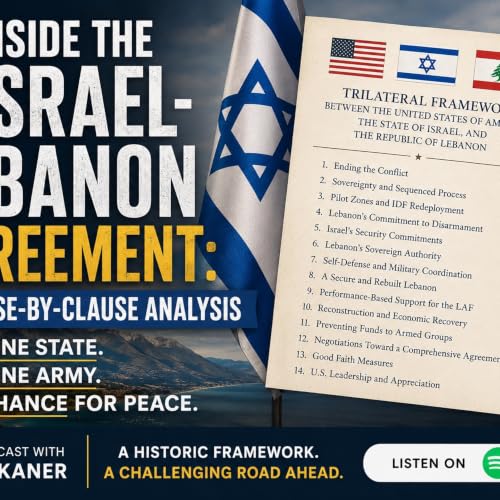
  • Inside the Israel-Lebanon Agreement: A Clause-by-Clause Analysis
    Jun 28 2026

    Israel and Lebanon have signed a historic framework agreement that could eventually end nearly eight decades of conflict.

    But what does the agreement actually say?

    In this episode of Middle East Brief with Avi Kaner, we walk through all 14 clauses of the agreement, explaining what each provision means, why it matters, and what it could mean for the future of Israel, Lebanon, and the broader Middle East.

    Topics include:

    • The declaration to end the state of war
    • Why this is more than a ceasefire
    • Lebanon's commitment to one government and one army
    • The plan to disarm Hezbollah and restore Lebanese sovereignty
    • Israel's pledge that it has no territorial ambitions in Lebanon
    • The U.S. role in verification, reconstruction, and implementation
    • Why reconstruction funding is tied to measurable progress
    • The agreement's biggest strengths - and its biggest risks
    • Whether this framework can truly bring lasting peace

    A deep dive into one of the most consequential diplomatic agreements in the Middle East in decades.

    Show More Show Less
    9 mins
  • The Armenian Genocide: Why Now?
    Jun 26 2026

    For nearly eighty years, Israel stopped short of officially recognizing the Armenian Genocide, despite broad historical consensus that approximately 1.5 million Armenians were systematically murdered by the Ottoman Empire during World War I.

    In this episode of Middle East Brief with Avi Kaner, Avi explores the history of the Armenian Genocide, why Israel delayed recognition for decades, and what has changed politically and strategically.

    He examines Israel's past relationships with Turkey and Azerbaijan, the growing deterioration in Israel-Turkey relations, and why Foreign Minister Gideon Sa'ar now calls recognition a moral and historical duty.

    The episode also explores which countries have recognized the Armenian Genocide, which have not, and how geopolitics has often influenced historical recognition.

    Finally, Avi discusses why the word "genocide" carries extraordinary legal and moral weight, why precision in its use matters, and how remembering one genocide strengthens, rather than diminishes, the universal promise of "Never Again."

    Middle East Brief with Avi Kaner provides thoughtful analysis of Israel, the Middle East, history, diplomacy, and current events.

    Show More Show Less
    8 mins
  • The UN's Latest Blood Libel Against Israel
    Jun 24 2026

    A new United Nations report accuses Israel of deliberately targeting Palestinian children and committing some of the gravest violations of international law.

    Within hours, the allegations spread across global media outlets, political circles, universities, NGOs, and social media platforms.

    But how was the report compiled?

    Who supplied the information?

    What role did Hamas-controlled institutions play?

    And why do many Israelis view reports like this with profound skepticism?

    In this episode, Avi Kaner examines the UN report's methodology, sourcing, conclusions, and broader implications for public opinion and international diplomacy.

    Topics include:

    • The UN's accusations against Israel
    • The role of the Independent International Commission of Inquiry
    • The UN Human Rights Council's unique treatment of Israel
    • The Palestinian Authority's absence from Gaza since 2007
    • Hamas control of Gaza's ministries and institutions
    • Claims regarding child casualties, hospitals, and humanitarian conditions
    • Israel's official responses and denials
    • How mainstream media often amplifies UN findings as established fact

    A discussion about evidence, bias, media amplification, and the responsibility of international institutions.

    Show More Show Less
    10 mins
adbl_web_anon_alc_button_suppression_t1
No reviews yet