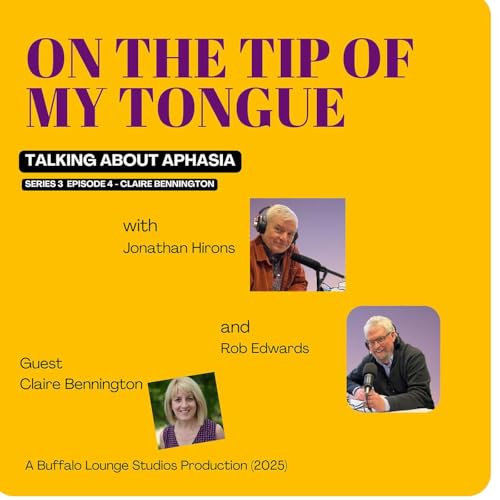
On the tip of my tongue - talking about Aphasia cover art

On the tip of my tongue - talking about Aphasia

On the tip of my tongue - talking about Aphasia

By: Jonathan Hirons and Rob Edwards
Listen for free


Jonathan Hirons's journey following his stroke and diagnosis of aphasia is both inspiring and informative. Here’s a summary of his experience and insights about aphasia:

Jonathan's Experience with Aphasia


1. Initial Incident:


In January 2019, while in a business meeting, Jonathan began to feel strange and soon realized he could not communicate effectively. His colleagues quickly called for medical help.


2. Medical Emergency:

He was rushed to University College Hospital, where scans revealed he had suffered a stroke due to a bleed on the brain. He spent five nights in the hospital and was diagnosed with aphasia.


3. Impact on Daily Life:


- Jonathan struggled with basic tasks such as speaking, reading, and writing.
- He had memory issues, recalling only his postcode but not his full address or other personal information.
- He faced challenges in understanding spoken language but could still sign his name.


4. Support from Family:

His wife, Ann, played a crucial role in his recovery:
- She encouraged him to read aloud daily and used flashcards to aid in word recognition and writing.
- This early intervention was vital for his rehabilitation.


5. Progress Through Therapy:

With the help of speech therapy, Jonathan made significant improvements:
- He regained much of his ability to read and write, although he still experiences difficulties, especially when tired.


6. Advocacy and Awareness:


- Jonathan has turned his experiences into a creative outlet by producing films, including "On the Tip of My Tongue" and "What is Aphasia?" These films aim to educate others about aphasia and its challenges.
- He actively shares his story to raise awareness about aphasia as a hidden disability and the ongoing need for support beyond initial rehabilitation.


Understanding Aphasia


Aphasia is a language disorder that affects communication abilities, including:
- Speaking: Difficulty in forming words or sentences.
- Understanding: Challenges in comprehending spoken or written language.
- Reading and Writing: Problems with reading text or writing coherently.


Key Takeaways


- Aphasia is often a result of brain damage, commonly from strokes, and can significantly impact daily life.
- Early intervention and support are crucial for recovery.
- Awareness and education about aphasia can help reduce stigma and improve support for those affected.

Jonathan's story highlights the resilience of individuals facing such challenges and the importance of community support in their recovery journey.


Copyright © 2025 Jonathan Hirons/Buffalo Lounge Studios All Rights Reserved.


This film/video/podcast is protected by copyright law. Unauthorized reproduction, distribution, or transmission of this material is prohibited.


For permissions or inquiries, please contact hello@buffalolounge.co.uk

© 2026 Jonathan Hirons/Buffalo Lounge Studios All Rights Reserved. For permissions or inquiries, please contact hello@buffalolounge.co.uk
Career Success Economics Hygiene & Healthy Living Psychology Psychology & Mental Health Social Sciences
Episodes
  • Reimagining Creativity After Stroke with Dr. Jess Johansson
    Jun 19 2026

    Send us Fan Mail

    Creativity, Hope, and Life After Stroke: Supporting People with Aphasia Beyond Rehab

    Hosts Rob Edwards and Jonathan Hirons introduce their “On the Tip of My Tongue” podcast, a follow-up to Jonathan’s film about aphasia, a brain-injury condition often caused by stroke that affects language in speaking, writing, reading, and texting; they note 350,000 people in the UK have aphasia yet public awareness is low compared with Parkinson’s. Guest Dr. Jess Johansson, a senior stroke researcher at the University of Leeds/Bradford Institute of Health Research, discusses her 13 years in stroke research and a planned NIHR fellowship application to integrate creative approaches into stroke care and extend support after services end. She describes using crafts like vision boards in stroke groups to promote relaxation, hope, and meaningful activity, emphasizing neuroplasticity and recovery beyond assumed plateaus. The conversation covers fragmented care, the value of groups and social connection, inclusion of people living alone or from deprived backgrounds, shifting away from deficit-focused models, engaging GPs, and raising aphasia awareness through public-facing art exhibitions.

    00:00 Creativity After Stroke
    00:25 Podcast Intro And Aphasia
    01:22 Meet Dr Jess Johansson
    02:00 Creative Care Fellowship Plan
    03:28 Why Creativity Helps
    05:04 Whole Person Recovery
    07:16 Research With Stroke Groups
    10:12 Access And Inequality
    12:01 Living Alone And Support
    13:28 Mental Health Adjustment
    15:50 Recovery Beyond Plateau
    19:43 GPs And Deficit Model
    23:01 Raising Aphasia Awareness
    25:47 Closing Thoughts And Thanks
    26:42 Resources And Community

    http://www.linkedin.com/in/dr-jess-johansson-091923383/


    Support the show

    Support the show: Donate Now

    This podcast is funded by https://www.bas.org.uk


    To watch Jonathan’s film: https://tipofmytonguefilm.com

    YouTube: https://www.youtube.com/@tipofmytonguefilm

    Linkedin: https://www.linkedin.com/in/jonathanhirons/

    Instagram: https://www.instagram.com/tipofmytonguepodcast/

    X: http://x.com/buffaloloungeuk

    The Tavistock Trust for Aphasia website

    http://aphasiatavistocktrust.org

    Show More Show Less
    28 mins
  • Aphasia Awareness Month Q&A: Myths, Carer Support, Recovery, and the Future
    Jun 8 2026

    Send us Fan Mail

    Aphasia Awareness Month Q&A: Myths, Carer Support, Recovery, and the Future

    During Aphasia Awareness Month, the podcast hosts a Q&A on aphasia—an often overlooked language disorder affecting speaking, understanding, reading, and writing, commonly after stroke or brain injury—with more than 350,000 people living with it in the UK. Guest Ann Hirons shares a carer’s perspective, discussing how aphasia is treated as a secondary condition, its “quiet crisis” impact on identity and family life, and the need to avoid carer burnout by creating therapy-free zones. The episode debunks the myth that impaired speech means impaired intellect, offers practical tips for everyday interactions (patience, simple questions, don’t finish sentences, use writing/pointing), and explores living with slowed communication and fatigue. It addresses the post-NHS-therapy “cliff edge,” benefits of peer groups, realistic recovery through practice and small steps, and roles for AI tools and creative outlets like film, art, and music supported by neuroplasticity.

    00:00 Aphasia Awareness Intro
    01:49 Why Aphasia Is Overlooked
    03:53 Carer Burnout Balance
    06:11 Everyday Anxiety And Support
    09:20 Myths About Intelligence
    11:36 Simple Communication Tips
    13:41 Invisible Prison Advice
    16:16 Aphasia Fatigue Reality
    17:47 After Therapy Ends
    19:08 Recovery Expectations
    21:45 AI And Future Tools
    23:10 Creativity And Neuroplasticity
    25:53 Closing And Resources

    https://www.sayaphasia.org


    Support the show

    Support the show: Donate Now

    This podcast is funded by https://www.bas.org.uk


    To watch Jonathan’s film: https://tipofmytonguefilm.com

    YouTube: https://www.youtube.com/@tipofmytonguefilm

    Linkedin: https://www.linkedin.com/in/jonathanhirons/

    Instagram: https://www.instagram.com/tipofmytonguepodcast/

    X: http://x.com/buffaloloungeuk

    The Tavistock Trust for Aphasia website

    http://aphasiatavistocktrust.org

    Show More Show Less
    26 mins
  • Speak Up for Aphasia: A Global Awareness Campaign Update
    May 22 2026

    Send us Fan Mail

    Speak Up for Aphasia: A Global Awareness Campaign Update

    Guest Claire Bennington updates on fundraising for an international aphasia awareness campaign creating a suite of animated videos in multiple languages, launched worldwide with one consistent message. The Tavistock Trust for Aphasia has pledged £35,429 if matched; the campaign is at 57% (about £22,304/42,000 AUD) and aims to raise the remainder by end of June 2026, with a global launch targeted for Aphasia Awareness Month in June 2027. Partners include the Collaboration of Aphasia Trialists for native-speaker translations, champion networks, and free hosting of assets. The message emphasizes “recognize, respond and respect” and that aphasia does not affect intelligence; listeners are asked to donate, fundraise, provide support letters, and follow “Speak Up for Aphasia” on Facebook.

    00:00 Welcome and Hosts
    00:18 What Is Aphasia
    01:24 Campaign Mission and Funding Goal
    05:16 Global Partners and Translations
    06:42 Public Message Recognize Respond Respect
    09:03 Timeline to June 2027 Launch
    11:09 How You Can Support
    13:02 Wrap Up and Resources

    Facebook: https://www.facebook.com/profile.php?id=61572140991752

    Donate to the International Aphasia Awareness campaign:

    https://justgiving.com/campaign/qarc-uq-aphasia-awareness

    Support the show

    Support the show: Donate Now

    This podcast is funded by https://www.bas.org.uk


    To watch Jonathan’s film: https://tipofmytonguefilm.com

    YouTube: https://www.youtube.com/@tipofmytonguefilm

    Linkedin: https://www.linkedin.com/in/jonathanhirons/

    Instagram: https://www.instagram.com/tipofmytonguepodcast/

    X: http://x.com/buffaloloungeuk

    The Tavistock Trust for Aphasia website

    http://aphasiatavistocktrust.org

    Show More Show Less
    14 mins
adbl_web_anon_alc_button_suppression_t1
No reviews yet