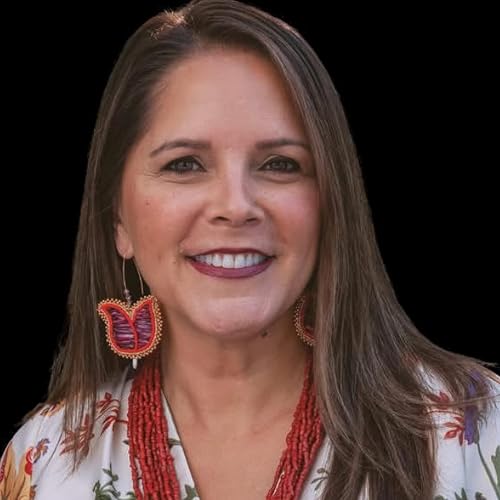
Red Hoop Talk cover art

Red Hoop Talk

Red Hoop Talk

By: Association on. American Indian Affairs
Listen for free

Native News and Talk

Red Hoop Talk is the Association on American Indian Affairs’ Native news and talk show, hosted by Jennifer Robin, a citizen of the Choctaw Nation with matrilineal connections to the Cherokee Nation. Each month, Jennifer welcomes a special Native guest for real conversations, cultural celebration, and collective healing, connecting audiences across generations and Nations. Stream live on the fourth Thursday of each month at 4 p.m. ET on YouTube, Facebook, and LinkedIn, or listen anytime on Apple Podcasts, Audible, and Spotify. It is more than a talk show; it is a movement to bring us all #CloseToCulture.

Association on. American Indian Affairs
Social Sciences
Episodes
  • EP 105 -Shonnie Bear, a citizen of the Quapaw Nation and the Cherokee Nation of Oklahoma
    Jun 30 2026

    In Episode 105 of Red Hoop Talk, host Jennifer Robin welcomes Shonnie Bear, a citizen of the Quapaw Nation and the Cherokee Nation of Oklahoma, Southern Cloth dancer, powwow tabulator, and founder of the Central Valley Women's Service Society. Through her work at powwows across Native Country, Shonnie has dedicated herself to supporting dance competitions with fairness and integrity while helping strengthen the relationships that make these gatherings possible. Grounded by her husband and twin sons, Shonnie finds joy in family, sewing, and beading, all of which deepen her connection to culture. She is also pursuing a master's degree in Early Childhood Education, reflecting her commitment to supporting Native cultures and the next generations.

    During the conversation, Shonnie discusses the history and evolution of powwows, the importance of Grand Entry, drum groups, singers, and dancers, and the responsibilities involved in judging and tabulating dance competitions. Drawing from her experience as a powwow tabulator, she shares how many powwows today utilize multiple rounds of judging to help ensure fairness and consistency in dance contests. She also speaks candidly about Native identity and the assumptions often placed on Native Peoples based on appearance, emphasizing that culture cannot be determined by skin color and that powwows should remain welcoming spaces where people can respectfully learn from one another.

    Shonnie shares that her connection to powwow culture began before she was born while her mother gourd danced, illustrating the intergenerational nature of these traditions. Today, she continues that legacy by raising her twin sons within powwow culture and helping them navigate misconceptions about Native identity. The conversation also explores the healing origins of Jingle Dress dancing among Ojibwe Peoples and the ways dance traditions continue to carry cultural knowledge forward. Through her work with the Sacramento Powwow Dance Group and the Central Valley Women's Service Society, Shonnie highlights the importance of mentorship, cultural continuity, and creating opportunities for connection beyond the dance arena.

    Each episode of Red Hoop Talk connects listeners with powerful Native voices and stories. By supporting the Association on American Indian Affairs, you help ensure these stories, traditions, and cultural teachings continue to be shared.

    Show More Show Less
    1 hr and 17 mins
  • In Episode 103 - Dr. Luhui Whitebear, a citizen of the Coastal Band of the Chumash Nation, with Huastec and Cochimi Ancestry
    Apr 25 2026

    In Episode 103 of “Red Hoop Talk,” host Jennifer welcomes Dr. Luhui Whitebear, a citizen of the Coastal Band of the Chumash Nation, with Huastec and Cochimi Ancestry, whose work is grounded in staying close to culture. Rooted in her Chumash homelands in Santa Barbara and her life in Oregon, she carries that responsibility into every space she moves through. As an Assistant Professor of Indigenous Studies at Oregon State University—where she earned all four of her degrees as a first-generation college student—she centers Native Nations, land, and lived experience in her teaching and research, with a focus on Indigenous feminisms, rhetorics, land and water rights, and Missing and Murdered Indigenous Peoples.

    Throughout the conversation, Dr. Whitebear challenges Western academic systems that separate emotion from knowledge, emphasizing that Indigenous ways of knowing require both. She speaks to reclaiming space within institutions—especially land-grant universities—as a practice of sovereignty, pushing beyond surface-level acknowledgments to address treaty violations, constitutional fragility, and resistance to movements like Land Back. She also reflects on the misappropriation of Indigenous knowledge and the responsibility to protect what is sacred while sharing knowledge appropriately within Native contexts.

    Grounded in lived experience, Dr. Whitebear shares growing up in an activist family where Native history was openly discussed, in contrast to its erasure in public education. She describes discovering Native Studies in college as transformative and reflects on navigating higher education spaces that often pressure Native scholars to conform, choosing instead to remain fully herself while creating pathways for Native students. This episode highlights what it means to stay connected to culture across systems that often attempt to create distance, and reminds listeners that advocacy is a lifelong responsibility grounded in relationship and accountability. Each episode of Red Hoop Talk connects listeners with powerful Native voices, and by supporting the Association on American Indian Affairs, you help ensure those voices continue to be heard.

    Show More Show Less
    1 hr and 7 mins
  • Ep 101 Michelle Schenandoah (Onʌyota’:aka/Oneida Nation, Wolf Clan),
    Mar 3 2026

    In Episode 101 of “Red Hoop Talk,” host Jennifer sits down with Michelle Schenandoah (Onʌyota’:aka/Oneida Nation, Wolf Clan), an inspirational speaker, filmmaker, and founder of Rematriation, to explore what it means to return the sacred to the mother. Joining from Onondaga Nation Territory, Michelle reflects on her Haudenosaunee matrilineal teachings and the responsibility she carries as a Haudenosaunee woman raised in a family of traditional leadership.

    She draws a clear distinction between repatriation and rematriation, explaining that rematriation centers women, restores balance, and renews the relationship between land, governance, and cultural continuity. From birth practices that return the placenta and umbilical cord to the earth, to the enduring teachings of the Two Row Wampum, Michelle grounds listeners in a worldview where sovereignty and ceremony are inseparable.

    The conversation also confronts the ongoing impact of the Doctrine of Discovery, not as distant history but as a legal framework that still shapes land ownership and federal Indian law today. Michelle connects these doctrines to landmark cases and to everyday land transactions, challenging listeners to understand how deeply embedded these assumptions remain. She shares a personal story about searching for Native representation in her U.S. history textbooks as a child—only to find her people’s presence reduced to a few brief pages—underscoring the urgency of truthful education. As a trained lawyer, journalist, and creator of the PBS-distributed series Rematriated Voices, Michelle continues the work of her grandmothers, who led generations of Oneida land claims, by amplifying Indigenous women’s voices and illuminating the Haudenosaunee Confederacy’s global influence on democracy and women’s rights.

    The episode also marks Teen Dating Violence Awareness Month with guest Michelle Sanchez Higginbotham of the California Consortium on Urban Indian Health (SACQUI / Rising Together). She outlines how abuse can surface in youth relationships—emotionally, physically, sexually, financially, and through technology—and reminds listeners that prevention begins earlier than many adults realize. Through practical guidance on teaching boundaries, recognizing red and green flags, and removing shame from conversations about consent, she emphasizes the importance of creating safe pathways for youth, including Two-Spirit and 2S+LGBTQ relatives, to seek support. A story shared about a young teen confidently rejecting the idea that a date entitles someone to her body offers a powerful example of boundary-setting rooted in self-worth and cultural strength.

    Together, these conversations weave law, land, governance, and youth safety into a larger call for cultural restoration and collective responsibility. Each episode of Red Hoop Talk connects listeners with powerful Native voices, and by supporting the Association on American Indian Affairs, you help keep those voices strong.

    Show More Show Less
    1 hr and 38 mins
adbl_web_anon_alc_button_suppression_t1
No reviews yet