Episodes

  • Should Pluto be a planet again?
    Apr 2 2026

    In 2006, a vote by the International Astronomical Union determined that Pluto was no longer a planet. The decision sparked a heated public debate, and many planetary scientists disagreed with kicking Pluto out of the planet club.

    Twenty years later, Pluto is back in the news: NASA administrator Jared Isaacman said he wants to make Pluto great again by declaring it… a planet again. And he’s urging President Trump to do so by executive order. Why does this Plutonian debate keep rearing its head? And does the president have the power to do that?

    To answer those questions and more, Host Ira Flatow talks with planetary scientists and Pluto champions Amanda Bosh and Alan Stern.

    Guests:

    Dr. Amanda Bosh is the executive director of the Lowell Observatory in Arizona, where Pluto was first discovered.

    Dr. Alan Stern is the vice president at the Southwest Research Institute and principal investigator of the New Horizons mission to Pluto.

    Transcripts for each episode are available within 1-3 days at sciencefriday.com.

    Subscribe to this podcast. Plus, to stay updated on all things science, sign up for Science Friday's newsletters.

    Show More Show Less
    19 mins
  • How to poop better, according to a gastroenterologist
    Apr 1 2026

    For many of us, what happens in the bathroom stays in the bathroom: According to a recent survey, 1 in 3 Americans are too embarrassed to talk about their poop or gut issues with their doctor. Gastroenterologists like Trisha Pasricha say that’s a problem, and that that stigma is getting in the way of our health and happiness.

    She joins Host Flora Lichtman to share some crucial gut knowledge, and talk about her new book, “You’ve Been Pooping All Wrong.”

    Read an excerpt from “You’ve Been Pooping All Wrong: How To Make Your Bowel Movements A Joy.”

    Guest: Dr. Trisha Pasricha is a physician-scientist at Beth Israel Deaconess Medical Center and assistant professor of medicine at Harvard Medical School in Cambridge, MA.

    Transcripts for each episode are available within 1-3 days at sciencefriday.com.

    Subscribe to this podcast. Plus, to stay updated on all things science, sign up for Science Friday's newsletters.

    Show More Show Less
    29 mins
  • Harnessing the superpowers of silk
    Mar 31 2026

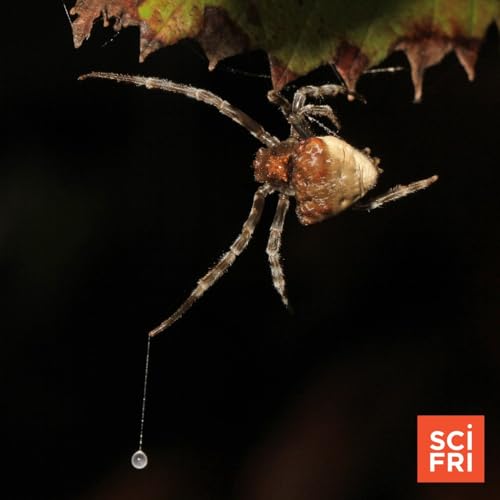
    A listener recently called in asking how they might get a pair of functioning web shooters so they could operate as a local Spider-Man. While web shooters (sadly) don’t exist, we can say that the ways real spiders use silk put Peter Parker’s powers to shame. Spiders can use their sticky threads to sail through the air, capture prey larger than them, and even live underwater. And scientists trying to harness those powers.

    Host Flora Lichtman chats with spider-silk aficionado Cheryl Hayashi about the wonders of silk, and Fiorenzo Omenetto shares how his engineering lab uses silk in the design of biomedical tools, like vaccines and sensors.

    Guests:

    Dr. Cheryl Hayashi is the senior vice president and provost of science at the American Museum of Natural History in New York City.

    Dr. Fiorenzo Omenetto is a biomedical engineer and director of the Silklab at Tufts University in Massachusetts.

    Transcripts for each episode are available within 1-3 days at sciencefriday.com.

    Subscribe to this podcast. Plus, to stay updated on all things science, sign up for Science Friday's newsletters.

    Show More Show Less
    19 mins
  • CERN finds a new particle + News alerts for the cosmos
    Mar 30 2026

    Researchers at the Large Hadron Collider in Switzerland have announced that they discovered a new subatomic particle. Roughly four times more massive than a standard proton, this short-lived piece of matter called Ξcc⁺(Xi-cc-plus) is like an extra-heavy proton, researchers say. Physicist Hassan Jawahery joins Host Flora Lichtman to unpack how the particle was found, and what its discovery means for theoretical physics.

    Then, astronomer Eric Bellm describes a new alert system that could flag potentially significant changes in the southern night sky in real time. On its first night of testing at the Rubin Observatory in Chile, the system fired off 800,000 alerts.

    Guests:

    Dr. Hassan Jawahery is a distinguished university professor at the University of Maryland and a member of the LHCb consortium.

    Dr. Eric Bellm is alert product group lead for the Rubin Observatory and a research associate professor at the University of Washington.

    Transcripts for each episode are available within 1-3 days at sciencefriday.com.

    Subscribe to this podcast. Plus, to stay updated on all things science, sign up for Science Friday's newsletters.

    Show More Show Less
    13 mins
  • Move over, vibe-coding. Vibe-proving is here for math
    Mar 27 2026

    When ChatGPT first came onto the scene, it wowed users with its writing abilities, but drew laughs for generating images of seven-fingered hands and struggling with basic math, where 2+2 didn’t always equal 4. But more recently, things have changed: Google and OpenAI’s models bagged gold medals at the International Mathematical Olympiad last year, and now some experts say AI could pose an existential threat to the field of mathematics itself.

    Mathematicians Emily Riehl and Daniel Litt join Host Flora Lichtman to explore how this technology could change the way math discoveries are made—and what could be lost if things go too far.

    Guests:

    Dr. Emily Riehl is a professor of mathematics at Johns Hopkins University in Baltimore, MD.

    Dr. Daniel Litt is an associate professor of mathematics at the University of Toronto.

    Transcripts for each episode are available within 1-3 days at sciencefriday.com.

    Subscribe to this podcast. Plus, to stay updated on all things science, sign up for Science Friday's newsletters.

    Show More Show Less
    19 mins
  • Is Punch the monkey really just like us?
    Mar 26 2026

    When Punch the monkey was abandoned by his mother, zookeepers gave him a surrogate and unexpected source of comfort: a stuffed animal. Videos of Punch snuggling the stuffie went viral, and, as his stardom rose, millions of us began wondering, “Is Punch OK? Does he have a girlfriend? Is he being bullied by the zoo's other macaques?” Primatologist Christine Webb joins Host Flora Lichtman to talk about the ways humans relate to our closest relatives, and whether we can—and should—map human feelings onto other primates.

    Guest:

    Christine Webb is an assistant professor of environmental studies at New York University. She is the author of “The Arrogant Ape: The Myth of Human Exceptionalism and Why It Matters.”

    Transcripts for each episode are available within 1-3 days at sciencefriday.com.

    Subscribe to this podcast. Plus, to stay updated on all things science, sign up for Science Friday's newsletters.

    Show More Show Less
    12 mins
  • Could bird flu still spark a pandemic?
    Mar 25 2026

    Bird flu has flown off the national news radar, with only scattered, local reports of dead birds in parks and poultry farms. Is it simply no longer a concern, or have cuts to federal science funding disrupted monitoring for this disease? Airborne pathogens expert Seema Lakdawala gives a flyover view on where bird flu stands today, and whether the government’s current monitoring efforts are enough to help prevent another pandemic.

    Guest:

    Dr. Seema Lakdawala is co-director of the Center for Transmission of Airborne Pathogens and an associate professor at Emory University in Atlanta, Georgia.

    Transcripts for each episode are available within 1-3 days at sciencefriday.com.

    Subscribe to this podcast. Plus, to stay updated on all things science, sign up for Science Friday's newsletters.

    Show More Show Less
    19 mins
  • The secret powers of flowers
    Mar 24 2026

    Flowers peeking up through the soil are a welcome sight after a long cold winter—and are one of the first markers of spring. Biologist David George Haskell argues that flowers aren’t just beautiful: They’re also critical to most ecosystems and the diversity of life as we know it. Flowering plants also make up a large part of human diets (rice, maize, and wheat are all flowers). And homing in on orchids, Haskell says, can help us understand the complex relationship between flowers and pollinators.

    Guest:

    Dr. David George Haskell is a biologist and author of: “How Flowers Made Our World: The Story of Nature’s Revolutionaries”

    Transcripts for each episode are available within 1-3 days at sciencefriday.com.

    Subscribe to this podcast. Plus, to stay updated on all things science, sign up for Science Friday's newsletters.

    Show More Show Less
    17 mins