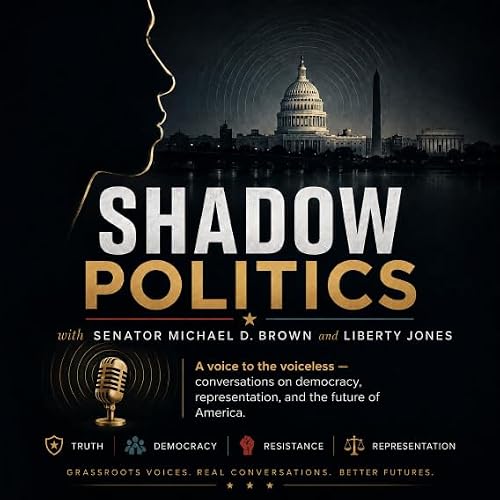
Shadow Politics with US Senator Michael D Brown cover art

Shadow Politics with US Senator Michael D Brown

Shadow Politics with US Senator Michael D Brown

By: Senator Michael D. Brown
Listen for free

Shadow Politics is a grass roots talk show giving a voice to the voiceless. For more than 200 years the people of the Nation's Capital have ironically been excluded from the national political conversation. With no voting member of either house of Congress, Washingtonians have lacked the representation they need to be equal and to have their voices heard. Shadow Politics will provide a platform for them, as well as the millions of others nationwide who feel politically disenfranchised and disconnected, to be included in a national dialog. We need to start a new conversation in America, one that is more inclusive and diverse and one that will lead our great nation forward to meet the challenges of the 21st century. At Shadow Politics, we hope to get this conversation started by bringing Americans together to talk about issues important to them. We look forward to having you be part of the discussion so call in and join the conversation. America is calling and we're listening… Shadow Politics is about America hearing what you have to say. It's your chance to talk to an elected official who has spent more than 30 years in Washington politics. We believe that if we start a dialog and others add their voices we will create a chorus. Even if those other politicians in Washington don't hear you — Senator Brown will. He's on a mission to listen to what America has to say and use it to start a productive dialog to make our democracy stronger and more inclusive. If we are all part of the solution we can solve any problem.Copyright 2026 Senator Michael Brown Political Science Politics & Government
Episodes
  • Shadow Politics, June 14, 2026
    Jun 15 2026
    Shadow Politics with Senator Michael D. Brown and Co-host Liberty Jones Across the Divide: Trump, Iran, Immigration, and the Search for Common Ground A Conversation Meant to Make America Think Again In this episode of Shadow Politics, host Former Senator Michael D. Brown opens the program with the show’s mission: to make America think again by listening to all sides before forming opinions. He introduces guest William Shelton, an arborist, small business owner in the DMV area, native Washingtonian raised in Fairfax, Virginia, political science graduate of Old Dominion University, libertarian, Christian, father, gun owner, and self-described patriot. The episode centers on why Shelton voted for Donald Trump in 2024 and how his views reflect a broader segment of American political opinion. Why William Shelton Voted for Donald Trump Michael begins by asking Shelton what leadership characteristics matter most to him and how Trump meets them. Shelton says voters often do not get to choose ideal candidates; instead, candidates are packaged and presented, leaving people to choose between the available options. He says he did not find Trump’s first presidency offensive enough to prevent him from voting for Trump again in 2024. Shelton points to Trump’s presence, his ability to speak to his base, his appeal to a certain understanding of America, and his support for lower taxes and reduced regulation as reasons Trump appealed to him as a small business owner. Iran, War, and the Question of Intervention Michael then asks about the war with Iran, arguing that Iran did not have nuclear weapons, that the United States spent heavily, and that the Strait of Hormuz was already open before the conflict began. Shelton responds by connecting the issue to broader Republican and libertarian debates about war, referencing Ron Paul and the Tea Party’s antiwar instincts. He says that if the public claims about Iran’s uranium enrichment, ballistic missile capability, and regional influence through groups such as Hamas and Hezbollah were accurate, then military action could be justified if it reduced a future threat with limited loss of life. Michael challenges that view, comparing the situation to the Bay of Pigs and arguing that the intervention may have backfired. Liberty Jones Joins the Debate Co-host Liberty Jones joins after technical issues and presses Shelton on the logic of intervention. She asks how this action would achieve its stated goals, how weapons could be kept from extremists if civilians were armed, and why critics should be dismissed as politically motivated rather than answered on the merits. Shelton answers by returning to the example of appeasement and by arguing that Iran’s leadership cannot be trusted. Liberty pushes back by questioning whether immigration, instability, and religious conflict are being oversimplified, especially when broader social, economic, colonial, and policy histories are involved. Religion, Immigration, and Western Identity The conversation broadens into religion, immigration, and national identity. Shelton argues that Muslim-majority nations such as Saudi Arabia, the United Arab Emirates, Kuwait, and Dubai should take in more Muslim refugees, asking why many migrants instead go to Western countries. Michael counters that religious nationalism is dangerous whether it comes from Islamic governments or Christian fundamentalists in the United States. Liberty adds that immigration problems cannot be reduced only to religion and must also be understood through policy, education, crime enforcement, opportunity, and historical power dynamics. Trump, Race, and Immigration Claims Michael raises questions about Donald Trump and race, saying Trump has a documented history involving racial discrimination in housing. Shelton pushes back by pointing to Trump’s support among some Black, Latino, and immigrant voters. Michael responds that most Black voters did not support Trump and that some immigrant families may oppose later immigration after becoming established themselves. Liberty asks directly whether Shelton accepts inflammatory claims made about Latino immigrants. Shelton avoids endorsing the broad claim and instead says desperate individuals may act in desperate ways, while Michael and Liberty press the point that political rhetoric can turn entire groups into targets. Crime, Protest, and Conflicting Narratives The discussion then turns to crime, protests, ICE, and public safety. Shelton argues that many people support Trump because they see Democrats as projecting chaos through protests, immigration fights, and constant social conflict. Michael responds that some violence attributed to protesters is misrepresented and argues that ICE and federal enforcement can also create violence. He cites crime statistics to argue that Republican-led or gun-friendly states often have higher violent-crime rates than cities or states frequently criticized by conservatives. Shelton counters ...
    Show More Show Less
    1 hr and 4 mins
  • Shadow Politics, June 7, 2026
    Jun 8 2026
    Shadow Politics with Senator Michael D. Brown Remembering Barney Frank: Shadow Politics Replays a Conversation on Democracy, DC Statehood, Reform, and Public Service Michael D. Brown Opens with a Tribute to Barney Frank In this episode of Shadow Politics, Former Shadow Senator Michael D. Brown opens by explaining that the program will not take live calls because it is replaying a special interview with Congressman Barney Frank. Brown says Frank had recently passed away and describes him as an important Democratic stalwart whose public service spanned decades. He frames the replay as a tribute to Frank’s life, career, intellect, humor, and long support for democratic representation, including DC statehood. Revisiting the 2022 Interview The replayed interview comes from a 2022 edition of Shadow Politics, hosted by Michael D. Brown with then co-host Marília Duffles. Brown introduces Barney Frank as a legendary former member of the U.S. House of Representatives who served from 1981 to 2013, chaired the House Financial Services Committee, and was a leading co-sponsor of the Dodd-Frank Act. Brown also notes Frank’s status as one of the most prominent openly gay politicians in the United States and thanks him for his early support of DC voting rights and statehood. DC Statehood and Representation Brown begins the interview by recalling a previous backstage encounter with Barney Frank, Tom Harkin, and Bill Clinton in Iowa, where Frank and Harkin jokingly debated who supported DC statehood first. Frank discusses his long support for giving the District of Columbia representation and notes the irony that states with smaller populations than DC can help block the District’s path to full rights. Brown connects that issue to the filibuster and the difficulty of advancing statehood legislation in the Senate. The Economy, Inflation, and the Midterms The conversation then turns to the economy and the 2022 midterm elections. Brown asks whether Democrats were doomed because of inflation and economic frustration. Frank says Democrats were in trouble politically, but argues that inflation was a worldwide issue tied to energy, the war in Ukraine, and global economic pressures rather than simply the fault of President Biden or Democrats. He also notes that despite inflation, the economy had strong areas, including low unemployment and wage growth among lower-income workers. Dodd-Frank and Financial Reform Marília Duffles asks whether the Dodd-Frank Act actually made the financial system safer or simply created more regulatory complexity. Frank defends the law, saying it worked well and helped prevent a financial crisis during the severe disruption of the pandemic. He explains that the law was broad because it combined what could have been many separate bills into one package, largely because of Senate filibuster realities. He also says major financial leaders had since acknowledged that the law was functioning effectively and did not require major changes. LGBTQ Rights, Race, and Social Progress Brown asks whether LGBTQ rights were under greater attack in the country. Frank replies that gay people have always faced attacks, but argues that conditions for LGBTQ Americans had improved dramatically over the decades, especially regarding marriage equality and general social acceptance. He says transgender rights remained more contested, but expresses optimism because younger generations are far more supportive. Frank also contrasts progress on LGBTQ issues with what he sees as more troubling regression on race, especially after the weakening of the Voting Rights Act. Democratic Politics, Young Voters, and Biden The interview also covers President Biden’s standing with voters, especially young people. Frank says Biden could do more on student loan debt and marijuana policy, both of which he believes matter to younger voters. However, he also argues that Biden and congressional Democrats accomplished a great deal despite having only 50 Democratic senators. Frank says frustration often comes from voters expecting more than the political reality allows, especially when senators such as Joe Manchin limit what can pass. Ukraine, Putin, and Global Democracy Marília raises the war in Ukraine and asks whether the United States could do more to help. Frank praises Biden’s handling of the crisis, especially his ability to build and maintain a broad coalition of European and allied nations against Russia. He compares Putin’s aggression to earlier authoritarian expansion and says Biden’s coalition-building has been a strong example of foreign policy leadership. Brown then asks whether Russia, China, India, North Korea, and other authoritarian or illiberal forces could form a dangerous bloc, and Frank says the democratic response today is stronger than the weak response to Hitler in the 1930s. Reparations, Harvard, and Institutional Responsibility Brown asks about Harvard and other universities committing money or ...
    Show More Show Less
    55 mins
  • Shadow Politics, May 31, 2026
    Jun 1 2026
    Shadow Politics with Senator Michael D. Brown and Co-host Liberty Jones Ranked Choice Voting in D.C.: the New Ballot System Guest, Monica Holman Evans, Executive Director for The District of Columbia Board of Elections Michael D. Brown Opens Shadow Politics In this episode of Shadow Politics, host Former D.C. Shadow Senator Michael D. Brown welcomes co-host Liberty Jones and guest Monica Holman Evans, executive director of the District of Columbia Board of Elections. The conversation focuses on D.C.’s newly implemented ranked choice voting system, which Brown describes as exciting, confusing, and important for voters to understand. Before turning to the mechanics of the system, Brown thanks Monica for joining the program during an already active voting period and notes her long experience in election work. Why Ranked Choice Voting Came to D.C. Monica explains that the Board of Elections did not independently decide to implement ranked choice voting. Instead, D.C. voters approved Initiative 83 in the November 2024 general election, with more than 73% voting yes. The D.C. Council then funded implementation in the FY2026 budget. Monica emphasizes that the Board’s job is now to administer the system clearly, educate voters, and make sure people are not discouraged from voting because the process feels unfamiliar. How Ranked Choice Voting Works Monica explains that ranked choice voting applies to contests with at least three qualified candidates. In those races, voters may rank up to five candidates in order of preference, but they are not required to rank more than one. A voter can still choose only a first-choice candidate if they wish. Monica stresses that ranking additional candidates does not harm a voter’s first choice because only one vote counts at a time. The purpose of the system is to ensure that the winning candidate receives more than 50% of the vote before being declared the winner. Elimination Rounds and Second Choices Brown asks how second-choice votes are counted, and Monica clarifies that second-choice votes are not automatically counted for every voter. If no candidate receives more than 50% in the first round, the candidate with the fewest first-choice votes is eliminated. Then, only the ballots from voters who chose that eliminated candidate are redistributed according to those voters’ next ranked choice. This process continues through tabulation rounds until a candidate crosses the required threshold or the contest is otherwise resolved under the rules. Why Some Support the Change Liberty asks why ranked choice voting has gained momentum and what its benefits are supposed to be. Monica explains that the main premise is that candidates should receive majority support rather than winning with a small plurality in crowded races. She says ranked choice voting has already been used in places such as Arlington County, New York, Minneapolis, and Alaska, but D.C.’s rollout is especially broad because it applies to every Board-administered primary, general, and special election contest with at least three qualified candidates, except political party offices. Voter Education and D.C.’s Unique Rollout Monica says one of the Board’s biggest challenges is voter education. Many people voted for ranked choice voting without fully understanding how large the implementation would be. She also warns voters not to rely only on outside explanations, because ranked choice voting rules differ by jurisdiction. Monica says the D.C. Board of Elections should be treated as the trusted source for how ranked choice voting works in D.C. She also notes that the Board has already had to correct outside materials that gave inaccurate information. Preparing Voters Before They Arrive Monica encourages voters to use the mailed ballot as a voting guide, even if they plan to vote in person. Because ranking candidates can take longer than simply choosing one name, she says voters should study their ballot before arriving at a vote center. The Board expects people may spend more time voting, so preparation can help reduce delays. Monica also says trained site coordinators and informational materials will be available at vote centers to help voters understand the process. At-Large Races and Candidate Strategy Brown raises a concern about D.C.’s at-large races, where voters have historically been able to choose more than one candidate. Monica explains that ranked choice voting will change how those races work in the general election, because voters will rank candidates rather than casting two equal votes. Brown says that, as a former candidate, he would likely urge voters to make him their second choice if he could not be their first. Monica notes that ranked choice voting may encourage candidates to partner, ask supporters to rank allied candidates, and avoid excessive negative campaigning because second- and third-choice support can matter. Mistakes, Overvotes, and Ballot Validity Brown asks what happens if ...
    Show More Show Less
    53 mins
adbl_web_anon_alc_button_suppression_t1
No reviews yet