Sustainable Clinical Medicine with The Charting Coach cover art

Sustainable Clinical Medicine with The Charting Coach

Sustainable Clinical Medicine with The Charting Coach

By: Dr. Sarah Smith
Listen for free

On the Sustainable Clinical Medicine Podcast we are capturing the stories of physicians who have made clinical medicine sustainable in their own lives, including their before and after stories. I will also interview coaches who are helping Physicians create sustainable clinical medicine for themselves.© 2026 2024 Career Success Economics Hygiene & Healthy Living Physical Illness & Disease Psychology Psychology & Mental Health
Episodes
  • Doctor Burnout Prevention: Energy, Boundaries, and the PACE Method With Dr. Judy Wright Episode 178
    Jun 29 2026
    Dr. Judy Wright burned out more than once before she started paying attention to what was actually driving it. As a family doctor who spent years staying two hours after her last patient to finish charting, she knows firsthand what it costs to keep grinding without ever stopping to ask what you actually need. In this episode, she talks about burnout prevention, energy management, and the quiet belief that saying yes is just part of being a good doctor and a good person. For high-achieving women in medicine who are still doing everything for everyone, her PACE method and her very honest account of learning to say no offer something more useful than another list of self-care tips. Highlights [02:00]: Her residency director told her she was slow because she cared too much about her penmanship. Dr. Wright explains what was actually going on, and why nobody gave her anything useful to work with. [06:00]: She spent years leaving clinic two hours after her last patient before a single conversation with a colleague cracked something open for her. [11:00]: The moment she came back from maternity leave, she walked into her clinic and asked for something she had never asked for before. What she asked for, and how she asked for it, is worth hearing in full. [19:00]: Dr. Wright introduces the PACE method and makes a distinction between time and energy that reframes what sustainable clinical medicine actually requires. [23:00]: She moved from clinical practice into leadership and immediately repeated every pattern she had spent years trying to break. She explains why, and what finally shifted. [40:00]: A free stress assessment she has built specifically for doctors who think they are managing fine, because that is exactly where she was every time she burned out. Three Key Takeaways 1. The problem is rarely time. It is almost always energy. Most doctors who feel overwhelmed reach immediately for a time management solution. Dr. Wright argues that time is the wrong lens. Everyone has 24 hours. What varies is energy, and energy is renewable in a way that time is not. When she started working with groups of high-achieving women, she found that underneath the complaints about not having enough time was something else entirely: exhaustion, depletion, and a capacity that had been quietly shrinking for years. Protecting your energy, she argues, is not a luxury. It is the prerequisite for everything else. 2. Saying no is a skill that has to be practiced, not a decision you make once. Dr. Wright is clear that she was not a people pleaser, but she still had work to do around saying no. For doctors who are socialized to help first and for women who are socialized to say yes, declining a request carries a weight of guilt that does not disappear just because you know it is the right call. She offers several practical ways to say no that do not require a single-word answer, and makes the case that every yes has a cost. The question is simply whether the cost is one you can afford. 3. Delegation only works when you know the people you are delegating to. Dr. Wright is not interested in getting things off her plate for the sake of it. She watched leaders hand tasks to whoever was available and then spend more energy managing the fallout than the task would have taken. What she learned, both in clinical teams and at home with her own children, is that effective delegation starts with knowing people well enough to match the right task to the right person. That takes time upfront. It also, eventually, creates something that no amount of personal effort can build alone. Guest Bio Dr. Judy Wright is a board-certified family doctor, burnout prevention strategist, and performance coach based in the United States. She works primarily with high-achieving women leaders, helping them protect their energy, set meaningful boundaries, and continue performing at a high level without burning out in the process. Her PACE method, which stands for Pause, Awareness, Calibrate, Execute and Excel, gives doctors and leaders a practical framework for sustainable performance.Connect with Dr. Wright on Linkedin. Would you like to view a transcript of this episode? Click Here Charting Champions is a premiere, lifetime access Physician only program that is helping Physicians get home with today's work done. All the proven tools, support and community you need to create time for your life outside of medicine. Learn more at https://www.chartingcoach.ca Enjoying this podcast? Please share it with someone who would benefit. Also, don’t forget to hit “follow” so you get all the new episodes as soon as they are released. Come hang out with me on Facebook or Instagram. Follow me @thechartingcoach to get more practical tools to help you create sustainable clinical medicine in your life. Questions? Comments? Want to share how this podcast has helped you? Shoot me an email at admin@reachcareercoaching.ca. I would love to hear from you...
    Show More Show Less
    46 mins
  • How to Stop Blaming Yourself as a Doctor: Pain, Guilt, and the Stories We Tell Episode 177
    Jun 22 2026
    When Dr. Maggie Kang's nine-year-old daughter was diagnosed with a rare, incurable autoimmune disease, she was the radiologist who first saw the images. What followed was not just the grief of a mother watching her child suffer. It was two years of silent, suffocating guilt built on a story that made no logical sense but felt completely true. In this episode, Dr. Kang talks about the difference between pain and suffering, why doctors are particularly vulnerable to the stories that keep them stuck, and what it actually takes to let those stories go. The insight she shares is one that applies far beyond rare disease diagnosis, and doctors who have ever blamed themselves for a bad outcome will recognize it immediately. Episode Highlights [01:00]: Dr. Kang describes the moment she first saw her daughter's images as a radiologist, and what the following five weeks in hospital looked like for their family. [06:00]: She had tried thinking her way through the guilt for two years before coaching surfaced a belief she had never once said out loud to another person. [11:00]: Dr. Kang explains why this particular belief was so hard to release, and how cultural background, professional identity, and motherhood all collided in ways she had not anticipated. [15:00]: The moment she stopped asking what had gone wrong and started asking a different kind of question entirely set off a chain of events that is still unfolding today. [25:00]: She draws a clear line between pain and suffering that reframes how doctors might think about everything from a difficult diagnosis to a bad clinical outcome. [31:00]: A lobster metaphor that her whole family now uses to talk about growth, uncertainty, and what it actually means to let go of a story that is no longer serving you. Three Key Takeaways 1. Pain is unavoidable. Suffering is the story we add to it. Dr. Kang makes a distinction that sounds simple and lands hard. Pain is the actual experience: a child who is sick, a patient outcome that did not go as hoped, a career that suddenly changes course. Suffering is the additional layer of blame and guilt that doctors quietly construct around that pain, often without ever examining it or saying it aloud. For doctors, who are trained to believe that good outcomes follow from doing everything right, this distinction is particularly important. When things go wrong despite their best efforts, the story they reach for is often the harshest one available. 2. The stories that keep doctors stuck rarely survive being questioned out loud. Dr. Kang spent two years convinced she should have caught her daughter's diagnosis earlier, even though the pediatric presentation of the disease she knew was entirely different from what she had trained on. It was not logic that kept that belief in place. It was shame. Shame keeps stories in the dark, and stories in the dark grow. What coaching gave her was not an answer, but a question: are you sure? That single question, asked with genuine curiosity by someone else, was the beginning of everything that followed. 3. Letting go of a story means tolerating not having one. Dr. Kang uses the lobster as her metaphor, and it is a good one. When a lobster grows, it has to shed its shell and endure a period of complete vulnerability before the new shell forms. The discomfort of that transition is not a sign something is wrong. It is the growth itself. For doctors, releasing a long-held belief about what they should have done or who they should be does not feel like freedom at first. It feels like losing ground. Dr. Kang describes that period honestly and what she found on the other side of it. Guest Bio Dr. Maggie Kang is a TEDx speaker and certified coach who works with mothers navigating life with a child's chronic or rare disease diagnosis. She runs the Lobster Lessons newsletter and advocates for the neuroimmune disease community alongside her daughter Nell at maggiekangmd.com. Would you like to view a transcript of this episode? Click Here Charting Champions is a premiere, lifetime access Physician only program that is helping Physicians get home with today's work done. All the proven tools, support and community you need to create time for your life outside of medicine. Learn more at https://www.chartingcoach.ca Enjoying this podcast? Please share it with someone who would benefit. Also, don’t forget to hit “follow” so you get all the new episodes as soon as they are released. Come hang out with me on Facebook or Instagram. Follow me @thechartingcoach to get more practical tools to help you create sustainable clinical medicine in your life. Questions? Comments? Want to share how this podcast has helped you? Shoot me an email at admin@reachcareercoaching.ca. I would love to hear from you.
    Show More Show Less
    38 mins
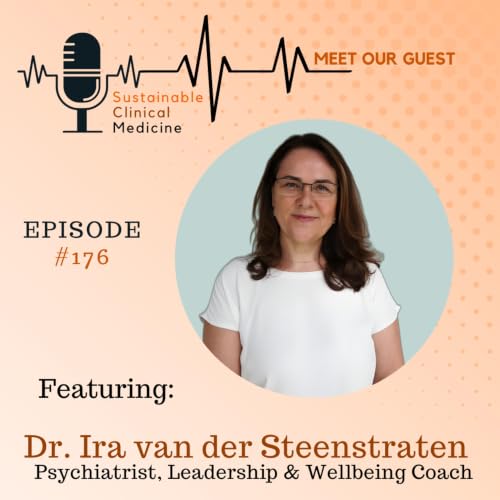
  • Self-Compassion for Doctors: The Missing Piece in Burnout Prevention Episode 176
    Jun 15 2026
    The traits that make someone a great doctor, caring deeply, holding high standards, never switching off, are the same traits quietly driving burnout in medicine. Dr. Ira van der Steenstraten has spent over a decade working with junior doctors across Queensland and now coaches doctors one-on-one, and what she keeps finding is that most are not struggling because the system is hard. They are struggling because nobody ever taught them to treat themselves with the same compassion they extend to every patient. This episode asks a confronting question: what if burnout is not a workload problem, but a self-compassion problem? And what do you actually do about a critical inner voice that has been running unchallenged for decades? Highlights [03:00]: Dr. van der Steenstraten describes what it was like to sit across the table from patients suffering deeply from the same condition she was living with herself, and what she noticed that changed how she understood the mind-body connection. [07:00]: A report landed in Australia in 2013 with numbers so alarming that a group of junior doctors decided enough was enough. What they built in response reached more than 4,500 interns across Queensland. [15:00]: Burnout gets talked about constantly in medicine, but Dr. van der Steenstraten draws a distinction between burnout and something else entirely that is far more common and far more misunderstood. [19:00]: She describes a period in her own clinical career where she showed up every day, did her job, and felt hollow doing it. The reason why will resonate with doctors across every specialty. [25:00]: Something unexpected happened when hospital leadership was invited into the wellbeing workshops. Dr. van der Steenstraten explains what it was and why it changed everything in the room. [30:00]: The very qualities that get doctors into medicine are the ones that make them most vulnerable inside it. Dr. van der Steenstraten explains why this is not a coincidence and what needs to happen next. Three Key Takeaways 1. Burnout and moral distress are not the same thing. Most doctors know what burnout feels like, but fewer have a name for the specific frustration of being unable to practice medicine the way they believe it should be practiced. Dr. van der Steenstraten describes moral distress as something distinct from burnout, with different drivers and a very different path forward. She has watched the moment doctors hear this distinction described clearly, and the response in the room is always the same. When you finally have the language for what is happening to you, something shifts. That shift is where recovery begins. 2. Self-compassion is not a soft skill. It is a clinical risk factor. The selection process for medical school tends to attract people who are caring, conscientious, and hard on themselves. Then medical training reinforces exactly those tendencies. Dr. van der Steenstraten argues that low self-compassion is one of the most underrecognized risk factors for burnout in medicine, and that the critical inner voice most doctors carry has often been running since long before they ever set foot in a hospital. The good news is that it is not fixed. The harder truth is that it takes more than awareness alone to change it. 3. Connection inside the workshop was the intervention. When Dr. van der Steenstraten asked groups of junior doctors what they found most valuable about the wellbeing program, the answer was rarely a specific strategy or framework. It was the moment they realized they were not alone. That simple recognition, that the person sitting next to them was carrying the same weight, consistently came back as the most powerful part of the experience. It raises a pointed question about what is actually lost when wellbeing programs move entirely online. Guest Bio Dr. Ira van der Steenstraten is a psychiatrist, psychotherapist, and wellbeing coach based in Brisbane, Australia. She coached more than 4,500 junior doctors through her Queensland-wide wellbeing program and now works one-on-one with doctors internationally through Vitae Wellbeing Leadership. 🌐 vitaewellbeingleadership.com💼 LinkedIn: Dr. Ira van der Steenstraten Would you like to view a transcript of this episode? Click Here Charting Champions is a premiere, lifetime access Physician only program that is helping Physicians get home with today's work done. All the proven tools, support and community you need to create time for your life outside of medicine. Learn more at https://www.chartingcoach.ca Enjoying this podcast? Please share it with someone who would benefit. Also, don’t forget to hit “follow” so you get all the new episodes as soon as they are released. Come hang out with me on Facebook or Instagram. Follow me @thechartingcoach to get more practical tools to help you create sustainable clinical medicine in your life. Questions? Comments? Want to share how this podcast has helped you? Shoot me an email at ...
    Show More Show Less
    38 mins
adbl_web_anon_alc_button_suppression_t1
No reviews yet