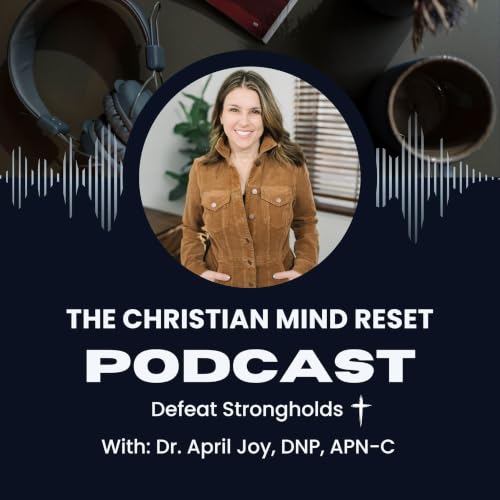
The Christian Mind Reset cover art

The Christian Mind Reset

The Christian Mind Reset

By: The Christian Mind Reset
Listen for free

The Christian Mind Reset blends Scripture, psychology, and neuroscience to help you renew your thoughts and break mental strongholds. Hosted by April Joy DNP, APN-C (@thechristianpsychnp), each episode explores real struggles, intrusive thoughts, anxiety, and how God’s Word rewires the brain. Learn how to feed truth instead of strongholds and walk in the peace Christ promises.

thechristianmindreset.substack.comThe Christian Mind Reset
Christianity Science Spirituality
Episodes
  • Waiting on God | The Neuroscience of Waiting, Biblical Hope, and Renewing Your Mind
    Jul 1 2026
    Episode 20, Season 1Show NotesWhy is waiting on God so difficult?If you’ve ever wondered why unanswered prayers feel so emotionally exhausting, why uncertainty can trigger anxiety, or why waiting can feel harder than receiving bad news, you’re not alone.In this episode of The Christian Mind Reset, we explore how neuroscience and Scripture together help us understand one of the hardest parts of the Christian life: waiting.You’ll discover why the brain naturally struggles with uncertainty, how our minds are wired to seek closure, and why seasons of waiting can leave us feeling discouraged even when our faith remains strong. We’ll also examine how God designed the brain to change through neuroplasticity and how renewing our minds with His truth can shape our experience of seasons of uncertainty.Then we’ll turn to Psalm 27, following David’s journey from the cave to the crown. Together we’ll study the beautiful Hebrew word qāvâ, often translated as “wait,” which means to bind together or become intertwined. David’s story reminds us that waiting is not passive—it is an invitation to become more deeply connected to God as He prepares us for what lies ahead.Whether you’re waiting for healing, restoration, direction, reconciliation, or an answer to prayer, this episode will encourage you to trust God’s timing, renew your mind, and remember that His silence is never His absence.In This Episode* Why uncertainty feels so stressful to the brain* The neuroscience of waiting and anxiety* Intolerance of uncertainty* Dopamine, anticipation, and delayed expectations* Neuroplasticity and renewing your mind* David’s years of waiting before becoming king* The Hebrew meaning of qāvâ* Psalm 27 and learning to wait with courage* Practical ways to renew your mind while you wait* Biblical declarations and a closing prayerKey Scriptures* Psalm 27:14* Psalm 130:5–6* Isaiah 40:31* Romans 12:2* Numbers 23:19Connect with Dr. April Joy:Connect with Dr. April Joy:Substack: The Christian Mind ResetIf you liked today’s episode, please subscribe, leave a review, follow, like, or share. You can find me on Instagram at @thechristianpsychnp and also on Instagram and Substack at The Christian Mind Reset for more Scripture, neuroscience, and practical tips for renewing your mind.Listen to The Christian Min Reset on Apple, Spotify, and Substack.My eBook, The Christian Mind Reset: A 28-Day Psalms Guide to Biblical Meditation, Neuroscience, and Renewing Your Mind, is available in my Stan Store at https://stan.store/thechristianpsychnp and on my Substack.ReferencesClark, A. (2013). Whatever next? Predictive brains, situated agents, and the future of cognitive science. Behavioral and Brain Sciences, 36(3), 181–204. https://doi.org/10.1017/S0140525X12000477PMID: 23663408. (PubMed)Draganski, B., Gaser, C., Busch, V., Schuierer, G., Bogdahn, U., & May, A. (2004). Neuroplasticity: Changes in grey matter induced by training. Nature, 427(6972), 311–312. https://doi.org/10.1038/427311aPMID: 14737157. (PubMed)Dugas, M. J., Gagnon, F., Ladouceur, R., & Freeston, M. H. (1998). Generalized anxiety disorder: A preliminary test of a conceptual model. Behaviour Research and Therapy, 36(2), 215–226.PMID: 9613027. (PubMed)Dugas, M. J., & Robichaud, M. (2007). Cognitive-behavioral treatment for generalized anxiety disorder: From science to practice. Routledge.Gross, J. J. (1998). The emerging field of emotion regulation: An integrative review. Review of General Psychology, 2(3), 271–299. https://doi.org/10.1037/1089-2680.2.3.271 (Sage Journals)Hsu, M., Bhatt, M., Adolphs, R., Tranel, D., & Camerer, C. F. (2005). Neural systems responding to degrees of uncertainty in human decision-making. Science, 310(5754), 1680–1683. https://doi.org/10.1126/science.1115327PMID: 16339445. (PubMed)Kolb, B., & Gibb, R. (2011). Brain plasticity and behaviour in the developing brain. Journal of the Canadian Academy of Child and Adolescent Psychiatry, 20(4), 265–276.PMID: 22114608. (PubMed)Masicampo, E. J., & Baumeister, R. F. (2011). Consider it done! Plan making can eliminate the cognitive effects of unfulfilled goals. Journal of Personality and Social Psychology, 101(4), 667–683. https://doi.org/10.1037/a0024192McEwen, B. S. (2007). Physiology and neurobiology of stress and adaptation: Central role of the brain. Physiological Reviews, 87(3), 873–904. https://doi.org/10.1152/physrev.00041.2006PMID: 17615391. (PubMed)Mischel, W., Shoda, Y., & Rodriguez, M. I. (1989). Delay of gratification in children. Science, 244(4907), 933–938.PMID: 2658056. (PubMed)Ochsner, K. N., & Gross, J. J. (2005). The cognitive control of emotion. Trends in Cognitive Sciences, 9(5), 242–249. https://doi.org/10.1016/j.tics.2005.03.010PMID: 15866151. (PubMed)Schultz, W., Dayan, P., & Montague, P. R. (1997). A neural substrate of prediction and reward. Science, 275(5306), 1593–1599.PMID: 9054347. (PubMed)Thomas Nelson. (2017). The NKJV Study Bible (2nd...
    Show More Show Less
    21 mins
  • The Neuroscience of Letting Go | Renewing Your Mind Through Biblical Surrender
    Jun 28 2026
    Episode 19, Season 1Show NotesWhy is letting go so difficult?If you’ve ever found yourself replaying painful memories, holding onto regret, struggling with control, or wondering why you keep returning to the same fears even after you’ve prayed about them, you’re not alone.In this episode of The Christian Mind Reset, we will examine how the biblical invitation to let go is brought into sharper focus by neuroscience and psychology, uncovering the ways God has intricately fashioned the mind to encounter freedom through the practice of surrender.We will consider how the brain encodes emotionally significant experiences, why uncertainty so often unsettles us, how cycles of rumination can entrap the mind, and how the reality of neuroplasticity echoes the biblical promise that our minds can be renewed.Yet long before neuroscience named these processes, Scripture was already inviting us to release burdens we were never created to bear in isolation.Together, we will trace the stories of Samuel, David, Paul, and ultimately Jesus, recognizing that biblical surrender is not denial or passivity, but a profound trust in the character of God—a trust that enables us to entrust what is heavy into His hands.We will also linger with Psalm 46, reflecting on what it means to hear God say, ‘Be still, and know that I am God,’ and how the Hebrew word raphah invites us to loosen our grip and cease striving.If you find yourself struggling to release the past, anxiety, grief, shame, fear, disappointment, control, or unanswered prayer, my hope is that this episode will remind you: the God who formed your mind is faithful to renew it.In This Episode• Why letting go is so difficult from a neuroscience perspective• Predictive processing and why the brain anticipates future threats• The roles of the amygdala, hippocampus, and prefrontal cortex• Emotional memory and why painful experiences are easier to remember• Memory reconsolidation and how healing changes our relationship to painful memories• Rumination, the default mode network, and repetitive thinking• Fear extinction, neuroplasticity, and renewing the mind• The psychology of control, grief, and uncertainty• Samuel mourning Saul (1 Samuel 16)• David’s response after the loss of his son (2 Samuel 12)• Paul’s encouragement to forget what lies behind (Philippians 3)• Psalm 46 and the biblical invitation to “Be still”• The Hebrew word raphah and the practice of releasing our grip• Jesus in Gethsemane as the ultimate picture of surrenderKey ScripturesPsalm 461 Samuel 16:12 Samuel 12:15–23Philippians 3:13–14Romans 12:21 Peter 5:7Matthew 11:28–30Luke 22:42Connect with Dr. April Joy:Connect with Dr. April Joy:Substack: The Christian Mind ResetIf you liked today’s episode, please subscribe, leave a review, follow, like, or share. You can find me on Instagram at @thechristianpsychnp and also on Instagram and Substack at The Christian Mind Reset for more Scripture, neuroscience, and practical tips for renewing your mind.Listen to The Christian Min Reset on Apple, Spotify, and Substack.My eBook, The Christian Mind Reset: A 28-Day Psalms Guide to Biblical Meditation, Neuroscience, and Renewing Your Mind, is available in my Stan Store at https://stan.store/thechristianpsychnp and on my Substack.ReferencesBar, M. (2009). The proactive brain: Memory for predictions. Philosophical Transactions of the Royal Society B: Biological Sciences, 364(1521), 1235–1243.Carleton, R. N. (2016). Fear of the unknown: One fear to rule them all? Journal of Anxiety Disorders, 41, 5–21.Friston, K. (2010). The free-energy principle: A unified brain theory? Nature Reviews Neuroscience, 11(2), 127–138.Fullana, M. A., Harrison, B. J., Soriano-Mas, C., et al. (2018). Neural signatures of human fear conditioning and fear extinction: A meta-analysis of fMRI studies. Biological Psychiatry, 84(8), 579–593.Hamilton, J. P., Farmer, M., Fogelman, P., & Gotlib, I. H. (2015). Depressive rumination, the default mode network, and the dark matter of clinical neuroscience. Biological Psychiatry, 78(4), 224–230.Kolb, B., & Gibb, R. (2011). Brain plasticity and behaviour in the developing brain. Journal of the Canadian Academy of Child and Adolescent Psychiatry, 20(4), 265–276.LeDoux, J. E. (2000). Emotion circuits in the brain. Annual Review of Neuroscience, 23, 155–184.McGaugh, J. L. (2004). The amygdala modulates the consolidation of memories of emotionally arousing experiences. Annual Review of Neuroscience, 27, 1–28.Nader, K., & Hardt, O. (2009). A single standard for memory: The case for reconsolidation. Nature Reviews Neuroscience, 10(3), 224–234.Pessoa, L. (2008). On the relationship between emotion and cognition. Nature Reviews Neuroscience, 9(2), 148–158.Phelps, E. A., Delgado, M. R., Nearing, K. I., & LeDoux, J. E. (2004). Extinction learning in humans: Role of the amygdala and vmPFC. Neuron, 43(6), 897–905.Thomas Nelson. (2017). The NKJV Study ...
    Show More Show Less
    41 mins
  • Why Loneliness Hurts: The Neuroscience of Social Connection and What the Bible Says About Being Alone
    Jun 24 2026
    Eisode 18, Season 1Show NotesLoneliness is more than an emotion. It affects the brain, the body, and the way we experience the world.In today’s episode of The Christian Mind Reset, Dr. April Joy explores the neuroscience, psychology, and biblical perspective on loneliness. You’ll learn why social rejection activates some of the same brain regions involved in physical pain, how chronic loneliness impacts stress hormones and overall health, and why God designed human beings for connection.Dr. Joy will discuss research on loneliness from neuroscientists such as Naomi Eisenberger and John Cacioppo, explore the surprising health benefits of strong relationships, and examine what Scripture teaches about friendship, community, and God’s presence during lonely seasons. We’ll look at Genesis 2:18, Psalm 27, Psalm 34, David and Jonathan’s friendship, and the role of the church in helping us move from isolation toward connection.Whether you’re walking through a season of loneliness, grieving a relationship, struggling to find community, or simply wanting to understand God’s design for human connection, this episode offers hope, practical encouragement, and biblical truth.In This Episode* What loneliness does to the brain* Why social rejection can feel physically painful* The role of the dorsal anterior cingulate cortex (dACC)* John Cacioppo’s research on chronic loneliness* Cortisol, inflammation, and the stress response* Loneliness in Gen Z and older adults* Why healthy relationships improve mental and physical health* Genesis 2:18 and God’s design for community* David and Jonathan’s friendship* The importance of church community and belonging* How God remains present when we feel alone* Practical steps toward building healthy relationshipsKey Scriptures* Genesis 2:18* Ecclesiastes 4:9-12* Proverbs 18:24* Proverbs 27:17* Psalm 27:10* Psalm 34:18* Hebrews 10:24-25* 1 Thessalonians 5:11* Matthew 28:20* Hebrews 13:5Key Takeaways* Loneliness is both a psychological and biological experience.* The brain processes social pain using some of the same neural networks involved in physical pain.* Chronic loneliness can increase stress, inflammation, and emotional distress.* Strong relationships are associated with better emotional health, resilience, and longevity.* God created human beings for connection and community.* Friendship is one of God’s gifts for encouragement, support, and growth.* Even when human relationships are absent, God’s presence is not.* Healing from loneliness often begins with one small step toward connection.Practical ChallengeThis week:* Spend time meditating on Psalm 27:10.* Reach out to one person through a text, phone call, or invitation.* Pray specifically for godly friendships and community.* Move beyond attending church and toward belonging by joining a group, volunteering, or introducing yourself to someone new.Connect with Dr. April Joy:Connect with Dr. April Joy:Substack: The Christian Mind ResetIf you liked today’s episode, please subscribe, leave a review, follow, like, or share. You can find me on Instagram at @thechristianpsychnp and also on Instagram and Substack at The Christian Mind Reset for more Scripture, neuroscience, and practical tips for renewing your mind.My eBook, The Christian Mind Reset: A 28-Day Psalms Guide to Biblical Meditation, Neuroscience, and Renewing Your Mind, is available in my Stan Store at https://stan.store/thechristianpsychnpReferencesBaek, E. C., Hyon, R., López, K., Du, M., Porter, M. A., & Parkinson, C. (2021). Lonely individuals process the world in idiosyncratic ways. Nature Communications, 12, 639.Cacioppo, J. T., & Cacioppo, S. (2018). The growing problem of loneliness. The Lancet, 391(10119), 426.Cigna. (2020). Loneliness and the workplace: 2020 U.S. report.Dunn, R. S. (2025). When you don’t have the words: Praying the Psalms. Lexham Press.Eisenberger, N. I., Lieberman, M. D., & Williams, K. D. (2003). Does rejection hurt? An fMRI study of social exclusion. Science, 302(5643), 290–292.Holt-Lunstad, J., Smith, T. B., & Layton, J. B. (2010). Social relationships and mortality risk: A meta-analytic review. PLoS Medicine, 7(7), e1000316.Koenig, H. G. (2012). Religion, spirituality, and health: The research and clinical implications. ISRN Psychiatry, 2012, 278730.National Institute on Aging. (2024). Loneliness and social isolation — tips for staying connected.Rote, S., & Hill, T. D. (2014). Religious attendance and loneliness in later life. The Gerontologist, 54(1), 39–50.Thomas Nelson. (2017). The NKJV Study Bible (2nd ed.). Thomas Nelson.Disclaimer: Disclaimer: This podcast/letter is for informational purposes only. It contains general information, drawn from my experience, research, and best practices. It is not health care advice, and is not intended to replace the counsel of your health care provider. Consult your provider before starting any new treatments or making changes to your health routine. This message ...
    Show More Show Less
    19 mins
adbl_web_anon_alc_button_suppression_t1
No reviews yet