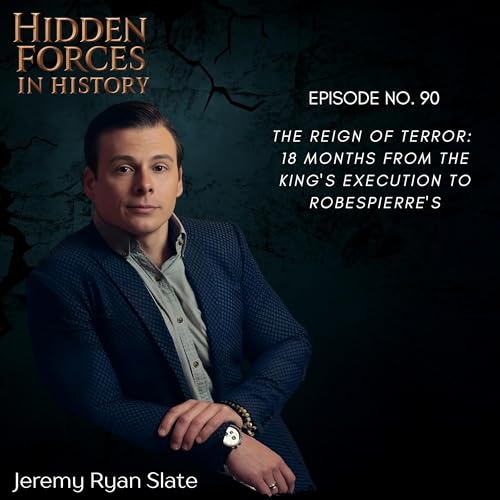
The Jeremy Ryan Slate Show cover art

The Jeremy Ryan Slate Show

The Jeremy Ryan Slate Show

By: Jeremy Ryan Slate
Listen for free

The Jeremy Ryan Slate Show is a bi-weekly investigation into how power really works—across history, empires, and the modern world.


Each episode draws on two core lenses:


Hidden forces behind history—royal murders, lost colonies, financial systems, modern elites, NGOs, propaganda, and the quiet mechanisms that shape events long before they reach the headlines.


And the Roman pattern—the idea that today’s crises aren’t new. Currency collapse, political division, border chaos, military overreach—Rome faced them all first. The Roman Empire spent centuries making every mistake a civilization can make, and left behind a playbook we’re following again, page by page.


Through expert conversations with historians, researchers, and serious thinkers—and deep dives into primary sources, documents, and records—this show connects ancient history to modern power with evidence, not opinion.


You’ll learn to:

• Recognize collapse signals before they’re obvious

• Understand modern crises through ancient parallels

• See how empires actually rise, decay, and fall

• Spot the patterns shaping what comes next


From medieval conspiracies to modern cover-ups, from Augustus to Constantine, from ancient


Rome to today’s global order—this is history as investigation.


No spin. No narratives. Just receipts.


New episodes twice a week.

Jeremy Ryan Slate
Social Sciences World
Episodes
  • The Okhrana: How Tsarist Russia Invented the Surveillance State the KGB Inherited
    May 27 2026

    They tell you the modern surveillance state began in Moscow in 1917 — that Lenin invented it, that the KGB built the entire thing from scratch. That's too small of a story.


    The real surveillance state was built thirty-six years earlier, by a Russian son who watched his father die in the snow. He created an institution called the Okhrana — the Department for the Protection of Public Safety and Order — and operated it out of an ordinary-looking building on a canal in St. Petersburg called Fontanka 16. Over the next thirty-six years, his secret police invented every technique that would later define the Cheka, the NKVD, the KGB, the Stasi, and almost every modern intelligence service. Mail interception. Agent provocateurs. Police-controlled unions. Forged documents for narrative management. Double agents inside revolutionary movements who reported back to the state.


    This isn't conspiracy. It isn't ideology. It's architecture — and the architecture survives the regime that built it.


    In this video:

    → Why Alexander III's response to his father's assassination created the prototype for every modern police state

    → How the Okhrana intercepted the entire Russian mail system before wiretaps existed

    → The agent provocateur invention — and the moment the state realized infiltration was more powerful than arrest

    → Zubatovshchina: police-run unions, the original "controlled opposition" architecture

    → The two greatest double agents in the history of political infiltration — Yevno Azef and Roman Malinovsky

    → How the Bolsheviks studied the Okhrana files and built every Soviet intelligence service on the same blueprint


    Subscribe to Hidden Forces in History for civilizational autopsies of the empires, institutions, and patterns shaping the world we live in now.


    CHAPTERS:

    00:00 The Surveillance State Begins With a Bomb

    01:21 March 1881: Alexander III's Decision

    02:43 Fontanka 16

    03:35 Perlustration: The Mail Was the First Internet

    06:08 The Invention of the Agent Provocateur

    08:36 Zubatovshchina: When the Police Built the Unions

    10:38 Bloody Sunday: The System Creates the Revolution

    11:30 The Paris Office: From Surveillance to Narrative Management

    13:12 Azef and Malinovsky: The Provocateur System at Scale

    15:22 1917: The Bolsheviks Inherit the Blueprint

    17:19 Same Playbook, Different Century

    Show More Show Less
    19 mins
  • How Rome's Last Emperor Gave Up the Border (Theodosius)
    May 25 2026

    We picture Rome falling to barbarians — warriors crashing through marble gates, fire in the streets, civilization ending in a single dramatic moment. That's the myth. The reality is quieter and worse.


    In 378 AD, an emperor named Valens rode into a valley outside Adrianople with two-thirds of the Eastern Roman army. By sunset he was dead, his army was destroyed, and Rome's ability to defend its own territory was gone.


    The man who inherited what was left — a Spanish general named Theodosius — made a decision no Roman emperor had ever made before. He didn't rebuild the border. He dissolved it.


    In 382 AD, Theodosius signed a treaty that settled the Goths inside Roman territory as a semi-autonomous, armed, self-governing nation. Not outside the empire anymore. Inside it. The Danube stopped being the hard edge of Roman civilization. It became an administrative line that people crossed under negotiated terms.


    Then in 380, the Edict of Thessalonica made Nicene Christianity the sole legal religion of the empire. Every other form of worship became illegal. The pagan temples were closed, their assets confiscated, and that wealth moved — most of it to the Christian Church, which suddenly became one of the largest institutional landowners in Rome.


    The currency kept failing. The treasury kept hemorrhaging. The army kept becoming more dependent on Gothic mercenaries. Theodosius held it together for sixteen years through personal competence — and when he died in 395, the empire split in two and never reunified.


    This is the autopsy of how Rome's last unified emperor turned military defeat into managed surrender. Theodosius didn't destroy Rome. He was probably the last person capable of slowing its collapse at all. But the choices he made guaranteed that when he was gone, the cracks he had managed would become the fault lines along which the empire permanently split apart.


    Collapse doesn't begin when systems stop functioning. Collapse begins when systems stop solving problems and start managing them instead.


    00:00 — Rome Didn't Fall to Barbarians

    02:16 — Welcome to The Roman Pattern

    02:41 — Adrianople: The Autopsy

    04:06 — The Refugee Crisis Rome Broke

    06:51 — Why Valens Couldn't Wait

    08:28 — Theodosius Takes Power

    09:57 — The Treaty That Dissolved the Border

    12:21 — The Edict of Thessalonica

    15:55 — The Monetary Spiral

    18:58 — Two Civil Wars with Gothic Armies

    21:06 — 395: The Empire Splits

    23:14 — The Pattern Closes

    25:43 — When Management Replaces Restoration

    Show More Show Less
    27 mins
  • The Reign of Terror: 18 Months From the King's Execution to Robespierre's
    May 20 2026

    They'll tell you the Terror was born from ideology, from fanaticism, from Robespierre's madness. That's too small. Much too small.


    The real engine wasn't fervor. It was a machine — a legal apparatus the Committee of Public Safety built piece by piece. The Law of Suspects in September 1793 made suspicion itself sufficient evidence. The Law of 22 Prairial in June 1794 stripped revolutionary tribunals of defense counsel, witnesses, and meaningful cross-examination. In 47 days, that machine consumed 1,376 lives in Paris alone. And in the end, it consumed the men who built it.


    This isn't conspiracy. It isn't ideology. It's architecture.


    In this video:

    → Why Louis XVI's execution detonated rather than stabilized the revolution

    → The Girondins, the Hébertistes, and the Dantonists — three factions consumed in eight months

    → 9 Thermidor: how Robespierre's own machine ended Robespierre

    → The same architecture under Stalin, Mao, and the Khmer Rouge — same playbook, different century


    CHAPTERS:

    00:00 The Machine, Not the Madness

    01:08 January 1793: Paris on the Edge

    02:08 Robespierre and the Definition of Virtue

    03:04 The Law of Suspects

    05:01 Three Factions Fall: Girondins, Hébertistes, Dantonists

    08:38 The Law of 22 Prairial

    10:36 Positional, Not Behavioral

    13:07 9 Thermidor: Robespierre Falls

    14:59 The Same Architecture: Stalin, Mao, Pol Pot

    18:01 The Architecture, Not the Ideology


    Subscribe to Hidden Forces in History for civilizational autopsies of the empires, institutions, and patterns shaping the world we live in now.

    Show More Show Less
    21 mins
adbl_web_anon_alc_button_suppression_c
No reviews yet