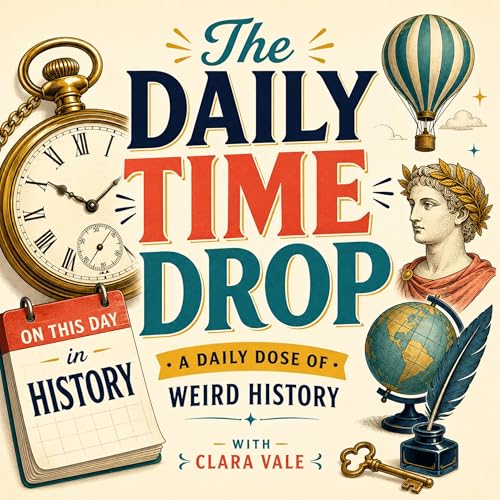
The Daily Time Drop cover art

The Daily Time Drop

The Daily Time Drop

By: Clara Vale
Listen for free

The Daily Time Drop is a daily ten minute trip through the stranger corners of history, hosted by Clara Vale.

Every episode takes one moment from this day in history and turns it into a sharp, funny, and surprising story. Expect odd inventions, bad decisions, forgotten scandals, accidental genius, royal weirdness, animal chaos, scientific breakthroughs, and the occasional reminder that humans have always been winging it with alarming confidence.

This is not a dusty history lesson. It is history with raised eyebrows, proper facts, and just enough sarcasm to keep the cobwebs off.

Perfect for your morning coffee, your commute, or that small window of time when you want to learn something without being trapped under a textbook.

Come back daily for strange events, clever context, and one excellent fact worth repeating later.

World
Episodes
  • The Tornado That Erased Mansions and the Wax Cylinder That Caught History
    Jun 29 2026
    The Tornado That Erased Mansions and the Wax Cylinder That Caught History

    On 29 June 1764, a tornado struck the small town of Woldegk in northern Germany with wind speeds estimated at over 300 miles per hour, placing it among the most violent tornadoes ever recorded. Despite levelling numerous grand mansions, only one person was killed. The event was largely forgotten, a reminder that atmospheric violence does not respect geography or cultural memory. Over a century later, on 29 June 1888, George Gouraud attended a performance of Handel’s Israel in Egypt at London’s Crystal Palace and recorded it on Thomas Edison’s newly invented phonograph. That wax cylinder became one of the earliest known recordings of a live musical performance, preserved by accident and archive care. Two moments from the same date, separated by 124 years: one a catastrophe that reshaped a landscape, the other a novelty that captured sound. Neither was recognised for its significance at the time. Both required the distance of history to reveal what they truly were.

    Chapters
    • Introduction A small German town, a violent event moving at over 300 miles per hour, and the problem of describing something in 1764 when nobody had the words for it yet.
    • The Woldegk Tornado of 1764 On 29 June 1764, one of the strongest tornadoes in recorded history struck Woldegk in northeastern Germany, with wind speeds exceeding 300 miles per hour. It levelled grand mansions across flat, open country but killed only one person. The event was largely forgotten, a reminder that tornadoes occur across Europe and that catastrophic moments do not always announce their own significance.
    • Listener Call to Action An invitation to follow the show and share it with curious friends who enjoy odd history with their morning coffee.
    • George Gouraud and the Oldest Recording of Music On 29 June 1888, George Gouraud attended a performance of Handel’s Israel in Egypt at London’s Crystal Palace and recorded it using Edison’s phonograph. That wax cylinder became one of the earliest known recordings of a live musical performance. Gouraud was demonstrating new technology, not creating a historical document, but the recording survived wars and decades to become a fragile link to a June evening over 130 years ago.
    • Closing Thoughts Two moments from 29 June, separated by 124 years. One a catastrophe, the other a novelty. Both took time to be recognised for what they were: history that did not announce itself.
    Links
    • https://en.wikipedia.org/wiki/Woldegk_tornado
    • https://en.wikipedia.org/wiki/George_Gouraud
    • https://en.wikipedia.org/wiki/Phonograph_cylinder
    • https://www.crystalpalacemuseum.org.uk/
    Show More Show Less
    10 mins
  • The Barony of Arizona: How to Steal Eleven Million Acres with Fake Documents
    Jun 28 2026
    The Barony of Arizona: How to Steal Eleven Million Acres with Fake Documents

    On 28 June 1895, a United States court delivered a verdict that ended one of the most audacious land frauds in American history. James Addison Reavis had spent over a decade claiming ownership of roughly eleven million acres of Arizona, armed with forged documents, a fabricated Spanish aristocratic title, and a wife he had specifically coached to play the role of Baroness. He had altered genuine historical archives across two continents, sold quit-claim deeds to major businesses, and convinced the world that the Barony of Arizona was real. It was not. Today, Clare Vale unpacks the spectacular rise and meticulous unravelling of the Peralta Grant, alongside the 1997 boxing match where Mike Tyson bit Evander Holyfield’s ear, the 1911 Martian meteorite that landed in Egypt, and the surprisingly modest origins of the modern dog show in Newcastle upon Tyne. History, as ever, rewards confidence, until someone checks the paperwork.

    Chapters
    • Intro Clare introduces the audacious fraud of James Addison Reavis, who claimed ownership of eleven million acres of Arizona using forged documents and a fake Spanish aristocratic title.
    • The Baron of Nowhere The complete story of Reavis’s scheme: from his early talent for forgery, to his meticulous construction of the Peralta Grant fraud, his insertion of fake documents into genuine archives, and the painstaking investigation that ultimately exposed him on 28 June 1895.
    • CTA Clare encourages listeners to follow the show and share it with others.
    • Holyfield vs Tyson II: The Ear Incident The notorious boxing match on 28 June 1997, in which Mike Tyson bit off part of Evander Holyfield’s ear during their MGM Grand rematch, leading to disqualification and a three million dollar fine.
    • The Nakhla Meteorite On 28 June 1911, fragments of a Martian meteorite fell near Alexandria, Egypt, later revealing the first evidence of liquid water on Mars.
    • The First Dog Show The world’s first conformation dog show was held in Newcastle upon Tyne on 28 June 1859, featuring only pointers and setters, and laying the foundation for institutions like Crufts.
    • Outro Clare wraps up with reflections on human overconfidence across history’s odd corners.
    Links
    • https://www.archives.gov/publications/prologue/2009/fall/peralta.html
    • https://www.smithsonianmag.com/history/the-baron-of-arizona-4686903/
    • https://www.espn.com/boxing/story/_/id/19738896/mike-tyson-bites-evander-holyfield-ear-20-years-later
    • https://www.nma.gov.au/defining-moments/resources/nakhla-meteorite
    • https://www.nhm.ac.uk/our-science/collections/mineralogy-collections/meteorite-collection/nakhla-meteorite.html
    • https://www.thekennelclub.org.uk/about-us/history-of-the-kennel-club/
    • https://www.crufts.org.uk/about-crufts/history-of-crufts/
    Show More Show Less
    12 mins
  • Sailing Solo: The Epic Journey of Joshua Slocum
    Jun 27 2026
    Sailing Solo: The Epic Journey of Joshua Slocum

    Join Clara Vale as she delves into the remarkable tale of Joshua Slocum, the first person to sail solo around the world. Setting out in 1895 from Nova Scotia with his sloop, ‘Spray’, Slocum faced challenges ranging from treacherous weather to pirates, and even the incredulity of local authorities in Buenos Aires. Despite these hurdles, his successful three-year journey not only made history but reshaped perceptions of solo exploration. Learn about his harrowing adventures, captured in his book, ‘Sailing Alone Around the World’, which continues to inspire adventurers. Clara also explores the revolutionary invention of the ATM in 1967, the signing of the Korean Armistice in 1953, and the controversial beginnings of the Eiffel Tower in 1887. Each story is a testament to human tenacity and creativity.

    Chapters
    • Intro Clara introduces the episode with a tale of daring circumnavigation.
    • Circumnavigation Joshua Slocum’s historic solo voyage around the world in ‘Spray’.
    • Call to Action Encouragement to follow the podcast and share with friends.
    • The Invention of ATM The installation of the first ATM by Barclays in 1967.
    • The Signing of the Korean Armistice The 1953 ceasefire that ended hostilities in the Korean War.
    • The Decision to Build the Eiffel Tower The start of construction on the Eiffel Tower in 1887.
    • Outro Reflections on the stories of human tenacity and creativity.
    Links
    • https://en.wikipedia.org/wiki/Joshua_Slocum
    • https://en.wikipedia.org/wiki/Automated_teller_machine
    • https://en.wikipedia.org/wiki/Korean_Armistice_Agreement
    • https://en.wikipedia.org/wiki/Eiffel_Tower
    Show More Show Less
    8 mins
adbl_web_anon_alc_button_suppression_t1
No reviews yet