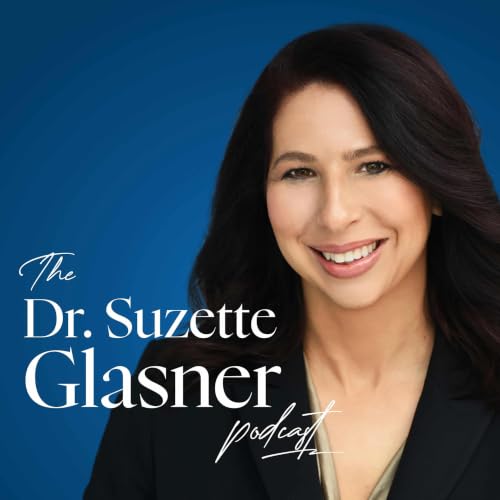
The Dr Suzette Glasner Podcast cover art

The Dr Suzette Glasner Podcast

The Dr Suzette Glasner Podcast

By: Dr. Suzette Glasner
Listen for free

Dr. Glasner is a clinical psychologist, addiction scientist, award-winning author, and Associate Professor of Psychiatry at UCLA in the David Geffen School of Medicine. The Dr. Suzette Glasner podcast discusses the latest advances in addiction science, trends in alcohol and other substance use, misuse, and addiction across the lifespan, and how to use the science underlying addictive behaviors and the effects of substance use on the brain to shape our health behaviors and every day lives.

drglasner.substack.comDr. Suzette Glasner
Hygiene & Healthy Living Physical Illness & Disease Psychology Psychology & Mental Health
Episodes
  • Ep. 60: Daveigh Chase - Lost to Fentanyl at 35
    Jun 26 2026

    In 2002, a twelve-year-old girl voiced one of the most beloved Disney characters of a generation. That same year, she terrified audiences in The Ring. Her name was Daveigh Chase, and for a moment, she was everywhere.

    Last month, she died in a Los Angeles hospital at 35 years old.

    The cause of death was sepsis — a bacterial infection that overwhelmed her body. She had been living near Skid Row, malnourished and without access to healthcare, after years of opioid dependence that began with a prescription after a back injury and eventually progressed to heroin and fentanyl. According to her family, she had been missing for nearly a decade.

    She was not a cautionary tale. She was a person with a treatable disease who didn’t receive adequate treatment.

    In Episode 60 of The Dr. Suzette Glasner Podcast, addiction scientist and clinical psychologist Dr. Suzette Glasner examines the forces that shaped Daveigh Chase’s story — and why it keeps repeating. From the specific psychological vulnerabilities that make child performers uniquely susceptible to addiction, to the way opioid dependence progresses from prescription use to fentanyl, to the homelessness-addiction spiral that claimed her life long before the infection did — Dr. Glasner walks through what the science actually tells us about how this happens and what it would take to intervene earlier. You can watch the full episode here:

    Daveigh Chase’s death wasn’t an overdose in the traditional sense. It was a body weakened by years of fentanyl use, malnutrition, and disconnection from care, exposed to an infection it couldn’t survive. That’s what dying from addiction often actually looks like — not a single moment, but a slow accumulation of harm that the healthcare system never found a way to interrupt.

    Dr. Glasner also addresses what families can do when someone they love seems unreachable — drawing on evidence-based approaches including CRAFT, harm reduction, and Housing First that don’t require waiting for rock bottom.

    Tylor Chase. Tyler Christopher. Daveigh Chase. The names change. The structure doesn’t. This episode is about why — and what we can do better.

    Resources mentioned in this episode:

    * CRAFT (Community Reinforcement and Family Training): smartrecovery.org

    * SAMHSA National Helpline: 1-800-662-4357 — free, confidential, 24/7

    * Al-Anon: al-anon.org

    * Naloxone locator: nextdistro.org

    If this episode resonated with you, please subscribe to The Dr. Suzette Glasner Podcast so you never miss a new episode — and consider leaving a review. It makes a real difference in helping others find the show.

    Have a question, a topic you’d like Dr. Glasner to cover, or a story you think deserves attention? Reach out at AskDrGlasner@gmail.com — she reads every message.

    🎧 Listen and subscribe: The Dr. Suzette Glasner Podcast / Dr. Suzette Glasner

    🧩 Learn more: drglasner.com


    This is a public episode. If you would like to discuss this with other subscribers or get access to bonus episodes, visit drglasner.substack.com
    Show More Show Less
    15 mins
  • Cannabis, Anxiety & Depression: The Science Will Surprise You
    Jun 20 2026

    Is Cannabis Good for Depression and Anxiety? What the Science Actually Says.

    Millions of Americans use cannabis to manage anxiety and depression. Perceived risk is at an all-time low. And yet — the clinical evidence tells a very different story than the cultural narrative.

    In this episode, clinical psychologist and addiction scientist Dr. Suzette Glasner breaks down three recent studies that every person using cannabis for mental health, every parent, and every clinician should know about. You can watch the full episode here:

    A 2026 study followed nearly half a million adolescents and found that individuals who used cannabis had more than double the risk of developing psychosis and bipolar disorder — with cannabis use preceding the diagnosis by almost two years. A Lancet Psychiatry review published the same year found no convincing evidence that cannabis effectively treats anxiety, depression, or PTSD — the conditions Americans most commonly say they use it for. And the potency problem: the cannabis on dispensary shelves today — flower at 15-20%+ THC, concentrates up to 90%. This matters because it directly impacts the risk of psychiatric and medical complications.

    Dr. Glasner also covers the conditions cannabis is FDA-approved to treat and why the answer surprises most people.

    In this episode:

    * Why perceived risk of cannabis has hit historic lows — and why that matters

    * What cannabis is actually FDA-approved to treat vs. what people use it for

    * The JAMA adolescent study: 463,000 teens followed over time

    * The Lancet review: examining evidence for cannabis as mental health treatment

    * Why potency matters

    🔔 Subscribe for weekly episodes on addiction science and mental health.📩 Questions or topic requests: AskDrGlasner@gmail.com🧩 drglasner.com


    This is a public episode. If you would like to discuss this with other subscribers or get access to bonus episodes, visit drglasner.substack.com
    Show More Show Less
    15 mins
  • Ep. 58 | Howie Mandel: OCD, Addiction, and the Nine-Year Gap
    Jun 14 2026

    When Howie Mandel was a guest on the Howard Stern Show, he had a panic attack triggered by a door handle. He couldn’t bring himself to touch it. He tried to get someone else to open it — and when no one would, the OCD diagnosis he’d kept secret for decades slipped out on live radio, in front of millions of listeners.

    He thought he was off the air. He wasn’t.

    What happened next surprised him. A stranger stopped him on the street and said two words: I suffer from it too. That moment — realizing he wasn’t alone — changed his life.

    In this episode, clinical psychologist and addiction scientist Dr. Suzette Glasner use Mandel’s story as a window into what OCD actually is, why it takes an average of nine years to get the right help, and a connection that rarely gets named: the overlap between OCD and addiction.

    You can watch the full episode here:

    The OCD-Addiction Connection

    Alcohol. Cannabis. Whatever creates temporary relief from a brain that won’t stop. That is self-medication — and it is one of the most underrecognized consequences of untreated OCD.

    Mandel has spoken openly about his own use of alcohol and cannabis to cope, including during the COVID pandemic, when contamination-based OCD became almost unbearable. He is not an outlier. Twenty-five to forty percent of people with OCD misuse substances at some point in their lives — three to six times the general population’s risk.

    There’s one more piece of this that rarely makes it into the conversation: the role of family. Around 90 percent of families living with OCD accommodate it daily — repeating reassurances, spraying objects before they enter the house. Every act is driven by love. The research is consistent: the more accommodation, the more severe the OCD. Mandel’s wife Terry lived this for decades before drawing a clear, firm, loving line. The parallel to addiction enabling is direct — in both cases, absorbing the consequences of the condition delays the pressure that might otherwise drive someone toward help.

    The good news is that OCD is treatable. With ERP — Exposure and Response Prevention — 60 to 80 percent of people respond. People in recovery from OCD describe it the same way people in recovery from addiction do: not the absence of the thought, but the absence of its power.

    The nine-year gap doesn’t have to be your story.

    🔍 Episode Breakdown

    00:00 – Howie Mandel’s live-radio moment — and the stranger who changed everything

    01:59 – Other public figures who’ve spoken out: Billy Bob Thornton, DiCaprio, Timberlake, Radcliffe

    03:21 – What OCD actually is (and what it isn’t)

    07:10 – The nine-year treatment gap - and why it exists

    08:49 – The OCD-addiction connection: the self-medication loop

    10:44 – Family accommodation and why love can prolong suffering

    14:54 – What actually works: ERP, medication, and NOCD

    18:10 – Three things to take with you

    🧠 Key Takeaways

    * OCD is a neurobiological condition driven by intrusive thoughts and compulsive relief behaviors.

    * On average, nine years pass between onset and appropriate treatment, due to shame, misdiagnosis, and access barriers.

    * 25–40% of people with OCD misuse or are addicted to substances — self-medication that provides brief relief and worsens the cycle long-term.

    * Both conditions can and should be treated simultaneously — addressing one without the other significantly raises the risk of relapse.

    * ERP (Exposure and Response Prevention) produces a 60–80% response rate. Combined with medication, it’s the gold standard.

    Listen to Episode 58 now to hear Howie Mandel’s story.

    📩 Questions or topic suggestions? Email AskDrGlasner@gmail.com

    🔗 Subscribe for evidence-based discussions on addiction, recovery, and mental health.


    This is a public episode. If you would like to discuss this with other subscribers or get access to bonus episodes, visit drglasner.substack.com
    Show More Show Less
    19 mins
adbl_web_anon_alc_button_suppression_t1
No reviews yet