The Information Bottleneck cover art

The Information Bottleneck

The Information Bottleneck

By: Ravid Shwartz-Ziv & Allen Roush
Listen for free

Summary

Two AI Researchers - Ravid Shwartz Ziv, and Allen Roush, discuss the latest trends, news, and research within Generative AI, LLMs, GPUs, and Cloud Systems.2025 Ravid Shwartz-Ziv & Allen Roush Science
Episodes
  • The Principles of Diffusion Models - with Jesse Lai (Sony AI)
    May 10 2026

    We host Chieh-Hsin (Jesse) Lai, Staff Research Scientist at Sony AI and visiting professor at National Yang Ming Chiao Tung University, Taiwan, for a conversation about diffusion models, the technology behind tools like Stable Diffusion, and most of the AI image and video generators you've seen in the last few years. Jesse recently co-authored The Principles of Diffusion Models with Stefano Ermon, and the book is quickly becoming a go-to reference in the field.

    We start with what a generative model actually is, and what it means to "generate" an image or a sound. Jesse explains the core idea behind diffusion in plain terms. You start with pure noise, and a neural network gradually cleans it up, step by step, until a realistic image emerges.

    From there, we talk about why diffusion has come to dominate so much of generative AI. Because the model builds an image gradually, you can guide it along the way, nudging the output toward what you actually want, refining details, or combining it with other controls. We also discuss the common critique that diffusion is slow and how the field has largely addressed it through new techniques.

    We zoom out to the bigger picture, too. Jesse shares his view on world models and whether diffusion is the right foundation for them. We talk about what makes a generative model genuinely good versus just good at gaming benchmarks, and why evaluating creativity and realism is so much harder than scoring a multiple-choice test.

    Timeline

    00:12 — Intro and welcoming Jesse

    00:47 — Why Jesse wrote the book, and who it's for

    03:29 — The three families of diffusion models, and why they're really one idea

    05:14 — What makes a good generative model

    07:39 — How do you even measure if a generated image is good

    08:59 — Why diffusion beats autoregressive models for images

    10:33 — Is diffusion still slow? How fast generation got fast

    11:12 — A simple intuition for what a "score" is

    14:12 — How the different flavors of diffusion connect under the hood

    14:42 — Diffusion for text and proteins

    17:12 — Consistency models and the push for one-step generation

    22:12 — Diffusion for world models: simulating reality in real time

    26:12 — Do world models need to understand language

    35:12 — Is diffusion the right tool, or just a convenient one

    38:12 — What benchmarks actually tell us, and what they miss

    46:12 — Closing thoughts and where to find the book

    Music:

    • "Kid Kodi" - Blue Dot Sessions - via Free Music Archive - CC BY-NC 4.0.
    • "Palms Down" - Blue Dot Sessions - via Free Music Archive - CC BY-NC 4.0.
    • Changes: trimmed

    About: The Information Bottleneck is hosted by Ravid Shwartz-Ziv and Allen Roush, featuring in-depth conversations with leading AI researchers about the ideas shaping the future of machine learning.

    Show More Show Less
    56 mins
  • Inside xAI, and the Bet on AI Math - with Christian Szegedy (Math Inc)
    May 4 2026

    We talked with Christian Szegedy, co-inventor of Inception and Batch Normalization, founding scientist at xAI, now at Math Inc, about what it takes to build a frontier lab, and why he left xAI to work on formal mathematics. Christian thinks Lean and auto-formalization are the missing piece for trustworthy AI: a machine-checkable layer underneath all reasoning, where proofs are guaranteed correct without anyone having to read them.

    We got into his bet with François Chollet that AI will hit superhuman mathematician level by 2026, and what that actually unlocks beyond math itself: verified software instead of vibe-coded apps that break when you refactor, AI systems you can actually trust because their reasoning is checkable, and a path to handling protein folding, chemistry, and parts of biology with real guarantees instead of hand-waving. Christian also walked us through how Math Inc's Gauss system pulled off a proof in two weeks that human experts had estimated would take another year.

    We also covered xAI's first 12-person year, why Christian no longer buys the original batch normalization story, why he's sure transformers won't be the dominant architecture in five years, what mathematicians do in a world of cheap proofs, and his take on whether humanity will handle AI well. He distrusts humanity more than he distrusts AI.

    Timeline

    00:12 — Intros: Christian's background (Inception, Batch Norm, xAI, Math Inc)

    01:29 — Building a frontier lab from scratch: the first 12 people at xAI

    04:15 — Hiring for proven track records when 200K GPUs are at stake

    06:07 — Elon's "dependency graph" and balancing long-term vision with investor demos

    07:28 — Gauss formalizes the strong prime number theorem in 2 weeks

    12:25 — What "formalization" actually means (and why it's not what most people think)

    14:39 — Why Lean gives 100% certainty and why that matters for RL

    15:26 — ProofBridge and joint embeddings across mathematical subfields 18:07 — Does math formalization transfer to coding and other fields?

    21:44 — Can every domain be mathematized?

    23:14 — Verified software, chip design, and why vibe-coded apps are dangerous

    26:35 — Scaling Mathlib by 100–1000x

    28:27 — Artisan formalizers vs. invisible machine-language formalists

    33:26 — Can verification generalize?

    45:19 — Revisiting Batch Norm: covariate shift, loss landscape, and what really happens

    48:22 — Is normalization even necessary?

    50:10 — What's actually fundamental in modern AI architectures

    51:41 — Why Christian thinks transformers won't last 5 years

    52:38 — The 2026 superhuman AI mathematician bet

    55:15 — What's missing: better verification + a much larger formalized math repository

    56:13 — Lean vs. Coq vs. HOL Light - does the proof assistant actually matter?

    59:26 — The role of mathematicians in 5–10 years

    1:02:00 — A human element to mathematics: Newton, Leibniz, and competitive proving

    1:03:25 — The telescope analogy: AI as the instrument that lets us see the math universe

    1:05:19 — Job apocalypse or Jevons paradox?

    1:08:41 — Advice for students

    1:09:50 — Can we formally verify AI alignment?

    1:11:52 — Closing thanks

    Music:

    • "Kid Kodi" - Blue Dot Sessions - via Free Music Archive - CC BY-NC 4.0.
    • "Palms Down" - Blue Dot Sessions - via Free Music Archive - CC BY-NC 4.0.
    • Changes: trimmed

    About: The Information Bottleneck is hosted by Ravid Shwartz-Ziv and Allen Roush, featuring in-depth conversations with leading AI researchers about the ideas shaping the future of machine learning.

    Show More Show Less
    1 hr and 13 mins
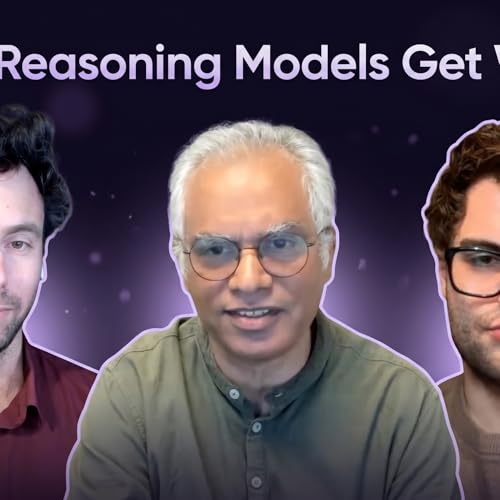
  • Reasoning Models and Planning - with Rao Kambhampati (Arizona State)
    Apr 29 2026

    We sat down with Rao Kambhampati, a Professor of CS at Arizona State University and former President of AAAI, to talk about reasoning models: what they are, when they work, and when they break.

    Rao has been working on planning and decision-making since long before deep learning, which makes him one of the most grounded voices on what today's reasoning systems actually do. We start with definitions of what reasoning is, why planning is the hard subset of it, and what changed when systems like o1 and DeepSeek R1 moved the verifier from inference into post-training. From there we get into where these models generalize, where they don't, and why benchmarks can be misleading about both.

    A big chunk of the conversation is on chain-of-thought: what intermediate tokens are actually doing, why they help the model more than they help the reader, and what outcome-based RL does to whatever semantic content was there to begin with. We also cover world models and why Rao thinks the video-only framing is the wrong bet, the difference between agentic safety and existential risk, and what the planning community figured out decades ago that the LLM community keeps rediscovering.

    Timeline
    • (00:12) Intros
    • (01:32) Defining "reasoning" and the System 1 / System 2 framing
    • (04:12) Blocksworld vs Sokoban, and non-ergodicity
    • (06:42) Pre-o1: PlanBench and "LLMs are zero-shot X" papers
    • (07:42) LLM-Modulo and moving the verifier into post-training
    • (10:12) Is RL post-training reasoning, or case-based retrieval?
    • (13:12) τ-Bench and benchmarks that avoid action interactions
    • (14:12) OOD generalization and what we don't know about post-training data
    • (19:02) Does it matter how they work if they answer the questions we care about?
    • (21:27) Architecture lotteries and why no one tries different designs
    • (23:42) Intermediate tokens and the "reduce thinking effort" cottage industry
    • (26:12) The 30×30 maze experiment
    • (27:42) Sokoban, NetHack, and Mystery Blocksworld
    • (34:58) Stop Anthropomorphizing Intermediate Tokens — the swapped-trace experiment
    • (46:12) Latent reasoning, Coconut, and why R0 beat R1
    • (50:12) How outcome-based RL erodes CoT semantics
    • (52:12) Dot-dot-dot and Anthropic's CoT monitoring paper
    • (53:42) Safety: Hinton, Bengio, LeCun
    • (57:12) Existential risk vs real safety work
    • (59:42) World models, transition models, and video-only approaches
    • (1:03:12) Why linguistic abstractions matter — pick and roll
    • (1:05:42) What the planning community knew in 2005
    • (1:08:12) Multi-agent LLMs
    • (1:09:57) Closing thoughts: the bridge analogy

    Music:

    • "Kid Kodi" - Blue Dot Sessions - via Free Music Archive - CC BY-NC 4.0.
    • "Palms Down" - Blue Dot Sessions - via Free Music Archive - CC BY-NC 4.0.
    • Changes: trimmed

    About: The Information Bottleneck is hosted by Ravid Shwartz-Ziv and Allen Roush, featuring in-depth conversations with leading AI researchers about the ideas shaping the future of machine learning.

    Show More Show Less
    1 hr and 12 mins
adbl_web_anon_alc_button_suppression_c
No reviews yet