• Iris Murdoch's World Cup Podcast
    Jun 15 2026
    In this episode Miles and his guests kick-off a fantasy world cup featuring all of Murdoch's novels. Murdoch’s novels will be separated into seven groups – we’ve added in the short story ‘Something Special’ and the recently published ‘Poems from an Attic’ to make the numbers works – and each day following the release of the podcast they’ll be a window of 24 hours for you to vote for your favourite via Facebook and X (Bluesky doesn't have a poll function, sadly) The top two works from each group go through, with two third-placed works going through as ‘lucky losers’ to the round of 16. There will then be knock-out stages ending up in the final, and even a 3rd/4th place play-off. Who will win? Who will end up missing out? And what will be over or underrated? The choice will be up to you! Joining me to discuss the groups, permutations, and the runners and riders are James Jefferies, created of irismurdoch.info and Liz Dexter, blogger extraordinaire and author of Iris Murdoch and the Common Reader.
    Show More Show Less
    56 mins
  • Undoing the Moral Empire Podcast
    Jun 11 2026
    In this episode Miles is joined by Lesley Chamberlain to discuss her newly-published monograph, 'Undoing the Moral Empire: Moral Philosophy in post-War Britain'. https://www.bloomsbury.com/uk/undoing-the-moral-empire-9781350457751/ After 1945, Britain wanted to be a new country. The authority of state and church were giving way, the Empire was dismantled, and it was no longer clear who was leading whom in matters of morals. Individuals were left to reinvent their ethical lives anew. The lives and works of the philosophers discussed in this book were caught up this sea-change. Bernard Williams, Philippa Foot, Iris Murdoch, Richard Wollheim, Charles Taylor and Alasdair MacIntyre were all characters in search of a moral England, with a particular vision of the good society. From communitarianism to swinging Sixties' individualism, and radical theories of art – which understood questions of ambiguity, error and forgiveness more than the state ever could – this is the story of their sometimes convergent but often discrepant ideas on ethical life in the second half of the twentieth century. Undoing the Moral Empire is a work of biography, social history and the history of ideas that masterfully reconstructs the shifting sentiments of the post-war era, reconfiguring enduringly relevant questions of freedom, virtue, and society. Lesley is an author, literary critics and translator whose work has focused on Rilke, Nietzsche, German philosophy, Conservative Modern Russia, Heidegger, Van Gogh, Lenin, Freud, travel writing, cuisine in Russia and Poland, journalism and fiction – twelve books in all. She’s also the author of the forthcoming chapter on Murdoch and Russian Literature in the Oxford Handbook of Iris Murdoch. This new book marks a homecoming for Lesley. You can find out much more about her work at her website: http://lesleychamberlain.co.uk/
    Show More Show Less
    56 mins
  • The Socratic Club Podcast
    Apr 16 2026
    In this episode we’re celebrating the publication of The Oxford University Socratic Club, 1942-1972: A Life, published by Bloomsbury in the UK today! https://blackwells.co.uk/bookshop/product/The-Oxford-University-Socratic-Club-1942-1972-by-Jim-Stockton/9781666932249 Jim is Lecture Emeritus in Philosophy at Boise State University, Idaho where his interests and teaching include: Medieval Philosophy, Aesthetics, Philosophy and Film, and the History of Ideas. https://www.boisestate.edu/philosophy/jstockton/
    Show More Show Less
    1 hr
  • Comyns, Murdoch, du Maurier, and the Gothic Podcast
    Apr 4 2026
    In this episode Miles discusses the mid-twentieth century gothic novel with a particular focus on Daphne du Maurier, Barbara Comyns and, of course, Iris Murdoch. An enduring subject of fascination, the gothic novel has undergone substantial change over the course of its history and the rise of the mid-century gothic – and how it interacts with other forms of fiction writing at this time – is one we know you’ll be interested in. Joining Miles to discuss the mid-century female gothic is Avril Horner. Avril is Professor Emeritus of English at Kingston University and is the author of numerous books on the Gothic – most recently Women and the Gothic – with Sue Zlosnik (2016) – and the author of Barbara Comyns: A Savage Innocence (Manchester University Press, 2024) and of the forthcoming Rebecca: Biography of a Novel (MUP: 2026). Murdoch aficionados will know her as the co-editor of Iris Murdoch and Morality and Iris Murdoch: Texts and Contexts both from Palgrave – and the co-editor of Living on Paper: Letters from Iris Murdoch 1934-1995 from Chatto and Windus (2015). Long-time listeners of the podcast will remember that Avril was one of my guests on ‘Iris Murdoch for Beginners’ so who better to be today’s guest as we discuss mid-twentieth century Gothic fiction and put Murdoch into conversation with both Daphne du Maurier and Barbara Comyns.
    Show More Show Less
    53 mins
  • Iris Murdoch and the Transcendent Podcast
    Mar 26 2026
    In this episode Miles is joined by Jil Evans and Charles Taliaferro (St. Olaf College, Minnesota, USA) to discuss their new book, 'Iris Murdoch and the Transcendent'. We cover love, ethics, mora illumination, gender, vision and the will and much more! https://blackwells.co.uk/bookshop/product/Iris-Murdoch-and-the-Transcendent-by-Charles-Taliaferro-Jil-Evans/9781009631594 Jil Evans is an abstract artist and author whose work has been exhibited nationally and internationally, and is held in private and museum collections throughout the United States, including Walker Art Center, Minneapolis Institute of Art, Flaten Art Museum, and Halle Ford Museum of Art. She has been the recipient of numerous grants and awards, which include a Jerome Foundation Grant, Arts Midwest/National Endowment for the Arts, Minnesota State Arts Board grant, and a Pew Grant to study and paint Italy, and residencies at the American Academy in Rome and the Atlantic Center for the Arts. She has co-authored three books with Charles Taliaferro. Charles Taliaferro is Emeritus professor of philosophy at St. Olaf College, a senior research fellow at the Institute for Faithful Research, and a member of the Royal Institute of Philosophy. He is the author, co-author, editor, or co-editor of twenty books, most recently The Image in Mind; Theism, Naturalism and the Imagination, co-authored with the American artist Jil Evans. He has been a visiting scholar or guest lecturer at a large number of universities, including Brown, Cambridge, Notre Dame, Oxford, Princeton, and the University of Chicago.[1][2][3] Since 2013 Taliaferro is editor-in-chief of the journal Open Theology. He is the author of over twenty books in theology and philosophy of religion.
    Show More Show Less
    57 mins
  • Iris Murdoch's Moral Philosophy Podcast
    Feb 26 2026
    In this episode Miles is joined by Cathy Mason (Central European University, Vienna) to discuss her new book, 'Iris Murdoch's Moral Philosophy: Reframing the True, the Real, and the Good'. https://blackwells.co.uk/bookshop/product/Iris-Murdochs-Moral-Philosophy-by-Cathy-Mason/9780198940432 Cathy Mason is an Associate Professor in Philosophy at Central European University, Vienna and her main areas of research interest are Ethics, Epistemology (especially Moral Epistemology), Aesthetics, and Iris Murdoch's philosophical writing (particularly at the points where these areas converge). Her previous work has focused on the moral phenomena of everyday life, often drawing on virtue theory. She has written about a variety of topics such as friendship, love, mourning, forgiveness, hope and humility. Prior to coming to CEU, she held a Leverhulme Early Career Fellowship at the University of Cambridge – where she studied for her PhD - and taught at the Universities of Oxford and Birmingham.
    Show More Show Less
    52 mins
  • Existentialists and Mystics 3 Podcast
    Feb 23 2026
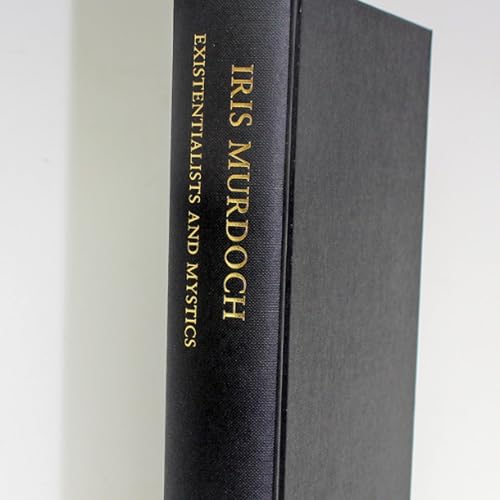
    In this episode we are returning to our close reading of the collection Existentialists and Mystics. For the third podcast of our mini-series, we’ll be discussing Murdoch's review of Gabriel Marcel’s ‘The Image of Mind’ and her essay ‘The Existential Political Myth’. The first is a review of The Mystery of Being by Marcel from 1951 – the first volume of his published volume of Gifford Lectures. Murdoch’s essay 'The Existential Political Myth' was first published in Socratic Digest in 1952. Joining me today is Samuel Filby who was the guest on the first episode of this mini series. He is currently working on his PhD thesis on Murdoch at Northwestern University, Chicago. His work focuses on Murdoch’s aesthetics and moral psychology.
    Show More Show Less
    41 mins
  • 75th Episode Podcast
    Feb 16 2026
    In this 75th Episode Special, Miles is joined by Daniel Read (Kingston University, UK) to answer questions from the Iris Murdoch Society and via the social media channels. You can find out much more, and join the society, here: www.irismurdochsociety.org.uk The questions sent in are: 1. Could Iris Murdoch drive? 2. How should Murdoch’s philosophical seriousness be reassessed in light of recent scholarship on her as a public intellectual? 3. In what ways did Murdoch’s Irish background shape her imagination, ethics, and sense of exile or belonging? 4. How has Murdoch’s relationship with religion and the sacred been represented differently in scholarship versus media portrayals? 5. How should Murdoch’s private life—especially her complex relationships—be integrated (or resisted) in critical interpretations of her novels? 6. What is Murdoch’s place within post-war British women’s writing, and why has she often been treated as an exception rather than part of a continuum? 7. How do contemporary debates about feminism, agency, and power reframe Murdoch’s representation of women? 8. Murdoch insists on the reality of the Good as something external and authoritative. How might that claim speak to contemporary moral and political life, where moral language is often treated as subjective or unstable? 9. Murdoch’s late novels are often described as difficult, bewildering, even radically alien. How should we read the strangeness of the late Murdoch: as decline, experiment, or metaphysical intensification? 10. What do you think is the most important unfinished task for Murdoch scholarship today?
    Show More Show Less
    58 mins