• Ep. 72: The Book of the Courtier
    Jun 1 2026

    This episode explores the courtly culture of Renaissance Urbino through Baldassare Castiglione’s landmark Book of the Courtier (1528), one of the most influential literary works of the Renaissance. After considering Giovanni Santi’s Cronaca rimata and its celebration of Urbino’s artistic world, the discussion turns to Castiglione’s vision of the ideal courtier, shaped by his experiences in the courts of Milan, Mantua, and Urbino under Guidobaldo da Montefeltro.

    Through a series of lively dialogues set in the Ducal Palace, Castiglione examines the qualities expected of the perfect courtier: elegance, wit, athleticism, eloquence, moral virtue, and the effortless display of mastery. Through this text, the episode also explores Renaissance attitudes toward humor, language, and the ideals around women of the court.

    Support/Watch/Follow/Learn: https://linktr.ee/italian_renaissance_podcast

    The Florentine Renaissance Course


    Support the show

    Show More Show Less
    26 mins
  • Ep. 71: Federico da Montefeltro and Urbino feat. Prof. Linda Reynolds
    May 18 2026

    Art Historian Linda Reynolds joins me to discuss the history of the court of Duke Federico da Montefeltro. Ruling over Urbino, the Montefeltro court was among the most important centers in Renaissance Italy. Professor Reynolds first explains how a simple mercenary like Federico was able to rise to the status of Duke. From there, she dives into the Duke's patronage of the arts, looking primary at the architecture of his palace in Urbino and his painters, Piero della Francesca and Justus van Ghent.

    Works Discussed:

    Luciano Laurana, Palazzo Ducale, Urbino, second phase 1464-72 https://commons.wikimedia.org/wiki/Palazzo_ducale_di_Urbino

    The Ideal City, 1480's https://commons.wikimedia.org/wiki/Category:Ideal_City_-_formerly_attributed_to_Luciano_Laurana_-_Galleria_Nazionale_delle_Marche,_Urbino

    Piero della Francesca, Double Portrait of Duke Federico da Montefeltro and Battista Sforza, 1473-75 https://www.uffizi.it/opere/i-duchi-di-urbino-federico-da-montefeltro-e-battista-sforza

    Justus van Ghent, Portrait of Federico da Montefeltro with His Son Guidobaldo, ca. 1475 https://en.wikipedia.org/wiki/Portrait_of_Federico_da_Montefeltro_with_His_Son_Guidobaldo

    Support/Watch/Follow: https://linktr.ee/italian_renaissance_podcast

    The Florentine Renaissance Course


    Support the show

    Show More Show Less
    36 mins
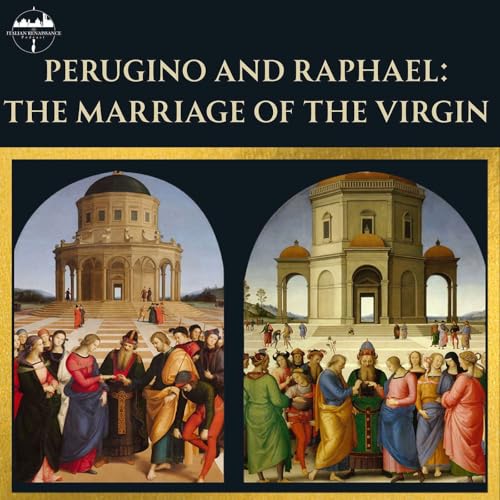
  • Ep. 70: Perugino and Raphael - The Marriage of the Virgin
    May 4 2026

    This episode examines how artistic influence and innovation intersect in the work of Perugino and Raphael, using their two Marriage of the Virgin paintings as a lens. It explores the defining qualities of Perugino’s calm, orderly style alongside Raphael’s more dynamic and spatially refined approach. Set against the cultural importance of the subject in Renaissance Perugia, the comparison reveals how shared compositions can yield very different visual experiences. Ultimately, the discussion highlights a pivotal artistic moment: the transformation of a master’s visual language into something more expressive, marking Raphael’s emergence as one of the most compelling and influential painters of the Renaissance.

    Works Discussed:

    Perugino, Marriage of the Virgin, 1500-1504 https://mba.caen.fr/en/oeuvre/le-mariage-de-la-vierge

    Raphael, Marriage of the Virgin, 1504 https://pinacotecabrera.org/en/collezioni/collezione-on-line/the-marriage-of-the-virgin/

    More on Perugino and Raphael in our online course: https://www.udemy.com/course/the-florentine-renaissance/?referralCode=FF28E9B6B8BB41DD78AF

    Support/Follow/Watch: https://linktr.ee/italian_renaissance_podcast

    Support the show

    Show More Show Less
    22 mins
  • Ep. 69: Perugia and Perugino
    Apr 20 2026

    This episode explores how Perugia functioned as a dynamic center of Renaissance art and how Perugino emerged as its most influential painter. It considers the city’s political, religious, and economic structures as active forces shaping artistic production, while examining how workshop practices, patronage, and regional identity intersected with broader Florentine influences.

    At the heart of the discussion is Perugino’s distinctive style—marked by clarity, harmony, and compositional balance—and the role his workshop played in spreading that visual language across central Italy. The episode ultimately frames Perugia not as a peripheral center, but as a key contributor to the artistic networks that helped define the transition toward the High Renaissance.

    Works Discussed:

    Perugino, Adoration of the Magi, 1470's https://en.wikipedia.org/wiki/Adoration_of_the_Magi_(Perugino,_Perugia)

    Perugino, Apollo and Daphnis, 1475-1500 https://collections.louvre.fr/ark:/53355/cl010064934

    Perugino, Decemviri Altarpiece, 1495/96 https://www.museivaticani.va/content/museivaticani/en/collezioni/musei/la-pinacoteca/sala-vii---secolo-xv-xvi/perugino--la-madonna-col-bambino-e-i-ss--lorenzo--ludovico-di-to.html

    Follow/Support/Watch: https://linktr.ee/italian_renaissance_podcast

    The Florentine Renaissance Course


    Support the show

    Show More Show Less
    27 mins
  • Michelangelo Reimagined: Justin Garascia on his New Play: Mikey!
    Apr 6 2026

    Michelangelo takes to the stage, and playwright and actor Justin Garascia joins us to discuss his dynamic reimagining of the early life of Michelangelo. Set in Renaissance Italy, MIKEY! unfolds as a gothic, queer fever dream, moving between the sculpting of David and the painting of the Sistine Chapel ceiling. As Michelangelo reflects on the life that brought him to this moment, he wrestles with how he wants to be remembered — as a sculptor, not a painter.

    Through a reimagined history, the play asks: what if there was a secret relationship at the House of Medici that shaped the artist’s emotional life and propelled the work we still revere over 500 years later?

    Crowd Fund: https://fundraising.fracturedatlas.org/mikey-a-new-play/campaigns/f6cecfad-a8b2-4ca1-a00f-b50d6d6e053d

    Show Dates:
    Tue, May 19 at 7 PM
    Tue, May 26 at 7 PM
    Thu, May 28 at 7 PM
    Sat, May 30 at 3 PM
    Sun, May 31 at 7 PM

    Tickets on Sale Now: https://thetanknyc.org/calendar-1/2026/5/19/mikey

    Follow along: @mikeytheplay and @justingarascia (Instagram)

    Support/Watch/Follow The Italian Renaissance Podcast: https://linktr.ee/italian_renaissance_podcast

    Support the show

    Show More Show Less
    20 mins
  • Ep. 67: The Sforza Altarpiece
    Dec 8 2025

    The Sforza Altarpiece (Pala Sforzesca) is among the single most important works of art commissioned by Ludovico il Moro. Through this painting, we can trace both the heavy religious history of Milan and the dynastic ambitions of the Sforza court. By investigating this painting, we can further understand the atmosphere leading to the decline of Sforza power.

    Additionally, this painting shows the dramatic influence of the convergence of styles in Milan, from Leonardo da Vinci to the Flemish masters. With this comes the complicated attribution of the work, which until very recently, had remained unknown.

    Work Discussed:

    Giovanni Angelo Mirofoli (Master of the Sforza Altarpiece), Madonna Enthroned with Child, the Doctors of the Church and the Family of Ludovico il Moro (Sforza Altarpiece), 1495

    https://pinacotecabrera.org/collezioni/collezione-on-line/madonna-in-trono-con-il-bambino-i-dottori-della-chiesa-e-la-famiglia-di-ludovico-il-moro-pala-sforzesca/

    Support/Watch/Follow: https://linktr.ee/italian_renaissance_podcast

    The Florentine Renaissance Course


    Support the show

    Show More Show Less
    26 mins
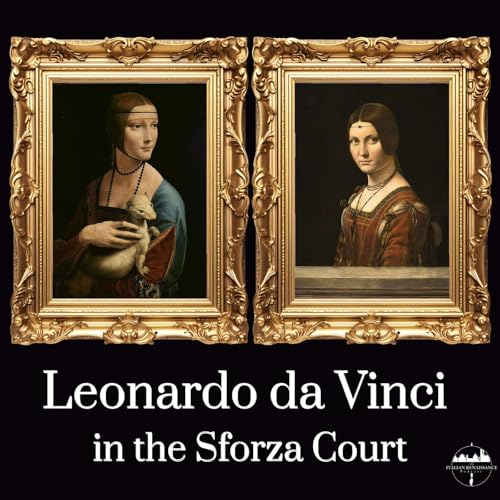
  • Ep. 66: Leonardo da Vinci in the Sforza Court
    Nov 24 2025

    There is no better way to explore the art and politics of the Sforza court in Milan than through the eyes of Leonardo da Vinci. Leonardo spent most of his early career employed by Ludovico il Moro, the regent and eventual Duke of Milan. This episode ties together the drama and intrigue of Sforza court politics with the work Leonardo did during his First Milanese Period (1482-1499).

    Some of Leonardo's most innovative painting arrived in this period. Beyond his Last Supper, the Renaissance master also worked on court portraits. Looking at both Lady with an Ermine and La Belle Ferronniere, we unpack the history of the ladies of the Sforza court and the complex social structures in Leonardo's Milan. Additionally, we explore the sophistication of Leonardo's style and ingenuity, especially as precursors to his Mona Lisa.

    This conversation ultimately ties the complicated threads that unite art, court culture, politics, gender, and romance in Renaissance Milan.

    Support/Watch/Follow: https://linktr.ee/italian_renaissance_podcast

    Works Discussed:

    Leonardo da Vinci, Genevra de' Benci, ca. 1478 https://www.nga.gov/artworks/50724-ginevra-de-benci-obverse

    Leonardo da Vinci, Lady with an Ermine, ca. 1490 https://artsandculture.google.com/asset/lady-with-an-ermine-leonardo-da-vinci/HwHUpggDy_HxNQ?hl=en-GB

    Leonardo da Vinci and workshop, La Belle Ferronniere, ca. 1497 https://collections.louvre.fr/en/ark:/53355/cl010062372

    Salai, Head of Christ the Redeemer, 1511 https://ambrosiana.it/opere/testa-di-cristo-redentore/

    The Florentine Renaissance Course


    Support the show

    Show More Show Less
    33 mins
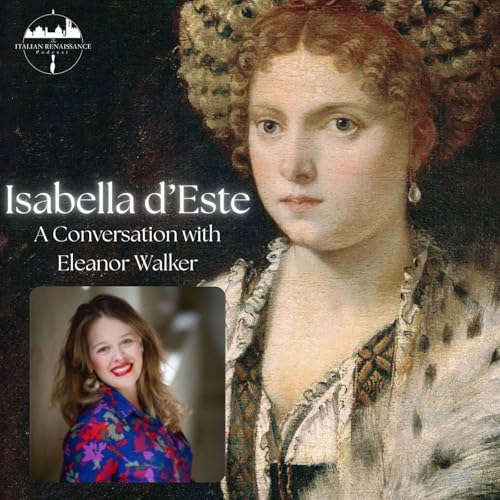
  • Ep. 65: Isabella d'Este feat. Eleanor Walker
    Nov 10 2025

    Art Historian Eleanor Walker joins us this episode to discuss the life and patronage of Isabella d'Este, Marchioness of Mantua. Isabella perfectly bridges the northern courts of Este Ferrara and Gonzaga Mantua, serving as the pivotal figure who united the two courts.

    Eleanor Walker introduces us to the life and vibrant personality of this Renaissance giant, looking at the scope and limitations of women in power in the northern courts. Then we turn to her patronage, diving deep into her portrait by Titian and a copy of another Titian portrait of Isabella by the Baroque master Peter Paul Rubens.

    Works Discussed:

    Titian, Isabella in Black, ca. 1536 https://www.khm.at/kunstwerke/isabella-d-este-markgraefin-von-mantua-1474-1539-1940

    Peter Paul Rubes, Isabella in Red (copied after Titian), ca. 1605 https://en.wikipedia.org/wiki/Isabella_in_Red_(Rubens)

    Support/Watch/Follow: https://linktr.ee/italian_renaissance_podcast

    Jennifer Samit and Eleanor Walker, Women Artists in Their own Words: https://www.merrellpublishers.com/9781858947235

    Jill Burke, How to Be a Renaissance Woman, https://www.amazon.it/How-Renaissance-Woman-Jill-Burke/dp/1788166663/ref=asc_df_1788166663?mcid=84574746f829322698bfc93eb94e80af&tag=googshopit-21&linkCode=df0&hvadid=700814440216&hvpos=&hvnetw=g&hvrand=11473624181355666976&hvpone=&hvptwo=&hvqmt=&hvdev=c&hvdvcmdl=&hvlocint=&hvlocphy=9199215&hvtargid=pla-1888711395289&psc=1&hvocijid=11473624181355666976-1788166663-&hvexpln=0

    The Florentine Renaissance Course


    Support the show

    Show More Show Less
    28 mins