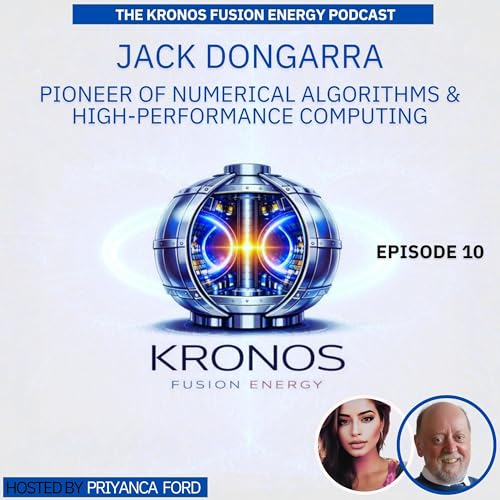
The Kronos Fusion Energy Podcast cover art

The Kronos Fusion Energy Podcast

The Kronos Fusion Energy Podcast

By: Priyanca Ford
Listen for free

About this listen

Welcome to the Kronos Fusion Energy Podcast, your premier source for the latest in fusion technology and sustainable energy innovations. Dive into the heart of fusion energy with us, exploring breakthroughs and challenges in this transformative field. Meet the visionaries reshaping our energy landscape and uncover the potential of clean, limitless power.

Each episode brings you closer to the science fueling our future, from plasma physics to global energy solutions. Perfect for professionals, enthusiasts, or anyone invested in our planet's future, this podcast is your guide to the revolutionary world of fusion energy.

Join our journey towards a sustainable and energy-abundant future. Welcome to the Kronos Fusion Energy Podcast.

Kronos Fusion Energy Incorporated
Economics Science
Episodes
  • From Cryogenics to Accelerators: Philippe Lebrun on the Systems Behind Fusion Energy
    Feb 10 2026

    In this episode of the Kronos Fusion Energy Podcast, Philippe Lebrun joins Priyanca Ford to discuss cryogenics, superconducting magnets, and particle accelerator technology—and how these systems quietly underpin modern science and energy research.

    With more than four decades at CERN, Philippe played a foundational role in the development and industrialization of superconducting accelerator systems, including those that enabled the Large Hadron Collider. The conversation explores why cryogenics is essential for high magnetic fields, why room-temperature superconductors remain elusive, and how accelerator technologies extend far beyond fundamental research into industry, medicine, nuclear energy, and fusion.

    As an Audit Committee Member at Kronos Fusion Energy, Philippe brings a systems-level perspective on reliability, validation, and long-horizon technical risk—offering insight into what it takes to translate advanced physics into dependable, real-world energy systems.

    This episode offers a rare, systems-level view of how superconductivity, accelerators, and cryogenics quietly enable much of modern science and energy research—and why these technologies remain central to the future of fusion energy.

    Show More Show Less
    1 hr and 4 mins
  • From LINPACK to Fusion Digital Twins : Jack Dongarra on the Future of Computing
    Jan 23 2026

    In this episode of the Kronos Fusion Energy Podcast, we are joined by Jack Dongarra, one of the foundational architects of modern high-performance scientific computing and the 2021 winner of the ACM A.M. Turing Award, the highest honor in computer science.

    Jack Dongarra is internationally recognized for his pioneering contributions to numerical linear algebra and high-performance computing, including the development of software libraries such as LINPACK and LAPACK, which form the mathematical backbone of much of today’s scientific computing ecosystem and tools like MATLAB. His career spans decades at the intersection of mathematics, computer science, and large-scale scientific simulation, with leadership roles across U.S. national laboratories and the Department of Energy computing programs.

    In this conversation with Priyanca Ford, Founder & CEO of Kronos Fusion Energy, Jack reflects on his personal journey—from early academic challenges to shaping the foundations of modern scientific computing—and explains how computation has evolved from supporting infrastructure into a true scientific instrument. The discussion explores why most supercomputers fail to reach their theoretical performance, the importance of co-design across algorithms, hardware, and applications, and how AI complements—but does not replace—physics-based numerical methods.

    As a Scientific Advisor to Kronos Fusion Energy, Jack also discusses what it takes to build trustworthy, predictive simulations for safety-critical systems, including verification, validation, uncertainty quantification, and the role of digital twins in fusion energy development.

    This episode covers:

    • High-performance computing and numerical algorithms
    • AI and physics-based simulation
    • Supercomputer architecture and energy costs
    • Co-design and future computing systems
    • Fusion energy digital twins and scientific validation

    This is both a masterclass in scientific computing and a deeply human conversation about curiosity, resilience, and the people behind the code.

    Show More Show Less
    1 hr and 5 mins
  • Celestial Chords : From Planet X to Exploring Fusion Energy with Dr. Batygin
    Nov 11 2024

    In this episode, Dr. Konstantin Batygin, a distinguished planetary scientist and professor at Caltech, delves into the latest advancements in fusion energy, the potential of the upcoming Vera Rubin Observatory in discovering Planet X, and the transformative role of artificial intelligence and quantum computing in scientific research. He also shares insights into his ongoing research on Jupiter's formation and his musical endeavors with The Seventh Season, a Los Angeles-based rock band. This episode offers a unique blend of cutting-edge science and personal passion, providing listeners with an engaging and informative experience.

    https://www.konstantinbatygin.com/

    https://www.linkedin.com/in/konstantin-batygin-38639415/

    https://theseventhseason.band/

    In today's episode, we delve into several captivating topics:

    • Planet X and Telescope Developments: Konstantin discusses the upcoming Vera Rubin Observatory, set to become operational by 2025, and its potential role in discovering Planet X.
    • Differences Between JWST and Vera Rubin Observatory: We explore the distinctions between the James Webb Space Telescope, optimized for close observations and spectrum analysis, and the Vera Rubin Observatory, designed for wide-field searches.
    • Fusion and Material Science Links: Konstantin explains how particle accelerators are utilized in fusion and material science, particularly in isotope production, and touches on advancements like Accelerator Driven Systems (ADS) and accelerator-driven fusion for material innovations.
    • Muon Catalyzed Fusion: We delve into the concept of muons as heavy particles that could theoretically drive fusion reactions, discussing their limitations due to short lifespans and decay tendencies.
    • Cold Fusion and Superconductors: The potential for future cold fusion generators is examined, including the need for advancements in superconductors and material science.
    • AI’s Role in Fusion and Multi-dimensional Calculations: Konstantin highlights AI's potential to handle complex simulations and optimize fusion reactor stability, especially with quantum computing's capability to manage multi-dimensional calculations.
    • Quantum Computing: We discuss the journey from theoretical quantum mechanics to practical quantum computing and how its unique data handling through qubits could enhance complex simulations in fusion.
    • Historical Perspective on Scientific Progress: Konstantin provides insights into historical breakthroughs, such as the delay between early quantum theories and quantum computing, and examples of significant inventions like Fourier Transforms.
    • Research on Jupiter's Formation: We explore Konstantin's ongoing research into Jupiter’s primordial state, using the orbital dynamics of its moons to infer conditions billions of years ago.
    • Excitement for the Future of Fusion and Astronomy: The episode concludes with a discussion on the potential impact of next-generation telescopes and fusion technology in the near future.

    Join us as we explore these fascinating subjects and more.

    Show More Show Less
    52 mins
No reviews yet