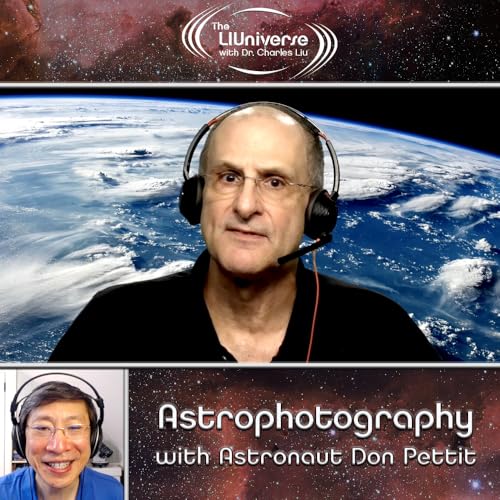
The LIUniverse with Dr. Charles Liu cover art

The LIUniverse with Dr. Charles Liu

The LIUniverse with Dr. Charles Liu

By: theliuniverse
Listen for free

Summary

A half-hour dose of cosmic conversation with scientists, educators and students about the cosmos, scientific frontiers, scifi, comics, and more. Hosted by Dr. Charles Liu, PhD, an astrophysicist at the American Museum of Natural History. Support us on Patreon.Copyright 2022 All rights reserved. Astronomy Astronomy & Space Science Science Science Fiction
Episodes
  • Astrophotography with Astronaut Don Pettit
    May 2 2026
    Can the physics you learned in High School take you to the stars? Who is behind many of your favorite pictures of space? What is it actually like to live and work in space? You might be surprised to know how much of it comes down to the physics you probably learned in class and thought to yourself, “When will this ever be useful?” To answer those questions and more, Dr. Charles Liu and co-host Allen Liu welcome Dr. Don Pettit –NASA astronaut, astrophotographer, chemical engineer, and genuinely one of the most interesting people alive, who was also a science consultant for the movie Project Hail Mary. As you’ll see, the complex physics of space could be critical to your future endeavors in the world of tech, space, and astrophysics. As always, though, we start off with the day’s joyfully cool cosmic thing, which was the famous DART mission (Double Asteroid Redirection Test). It’s a mission where NASA crashed a spacecraft into a small asteroid (Dimorphos) to see if they could literally change the orbit of an asteroid in space. This mission was successful, changing the asteroid’s orbit by nearly 30 mins. This is certainly joyfully cool, as it shows we can take planetary defense measures to change the path of an impending asteroid. Throughout the episode, Don, Chuck, and Allen ping pong back and forth with the following topics: Why he chose chemical engineering (and how that led to becoming an astronaut by consistently choosing passion and innovation over money)Whether being an astronaut is even worth it financiallyHow cities look different from orbit over time (yes, you can literally see lighting technology evolve)The physics behind astrophotography from space (and why those images look so insane)How astronauts drink coffee in zero gravity! Just wait, there is even more that we dive into: from lunar bases, to Antarctica meteorite hunts, to a casual mention of driving a lunar rover simulator like it’s nothing. There’s a lot here that feels huge and abstract, but also weirdly human, like choosing passion over money, or just wanting your morning espresso in space. While Don always had a love for chemistry, he ultimately pursued chemical engineering because he thought he wouldn't be able to get a good job without higher ed (relatable or what?). Then he got a PhD anyway, following his passion. Don also discusses the coffee cup he invented, which is widely used in space and lets you drink espresso like normal. He designed a cup that lets astronauts drink normally in zero gravity using fluid physics. Toward the end of the episode, he talks about going to Antarctica to collect meteorites and what that tells us about the chemistry of space. During this episode, Don’s intrinsic love for creation and scientific innovation shines through. If you like physics, space, or just hearing someone explain complicated things in a way that actually makes sense, you’ll absolutely love this. If you want to know more about Dr. Don Pettit, you can find him on NASA’s website. For the latest updates on his many projects and dazzling astrophotography, check out his Instagram @astro_pettit. (We’ve included some of those photos in the episode - just another reason to watch on YouTube!) We hope you enjoy this episode of The LIUniverse, and, if you do, please support us on Patreon. Credits for Images Used in this Episode: Photo of asteroids Didymos and Dimorphus, NASA’s DART mission target. Credit: NASA/Johns Hopkins APLLunar map depicting craters on the south pole of the Moon. Credit: USGSDon Pettit taking photos on the International Space Station. Credit: NASAChicago as seen from the ISS. Credit: NASA/Don PettitBurj Khalifa, the world’s tallest building, as seen from the ISS. Credit: NASA/Don PettitSao Paulo, Brazil, at Night, April 12, 2003 as seen from the ISS. Credit: NASA/Don PettitStar trail time exposure, taken for approximately 30 minutes during orbital night, assembled from multiple 30 second exposures. Credit: NASA/Don Pettit/Babak TafreshiThe first prototype of Don Pettit’s capillary cup. Credit :NASAAstronaut Samantha Cristoforetti drinking from Don Pettit’s cup on the ISS. Credit: NASAANSMET meteorite hunters in Antarctica. Credit: NASACross-section of a carbonaceous chondrite, the 4.5-billion-year-old Allende meteorite formed along with the solar system. Credit: AMNH/Creative CommonsSpaceborne - Don Pettit’s photography book. Credit: Don Pettit / Press Syndication Group Special thanks to Eleanor Adams for writing this episode description. CHAPTERS 0:00 - Introduction of Astronaut Don Pettit 3:19 - Asteroid Defense Explained (DART Mission & Saving Earth) 10:49 - Don Pettit’s Early Life 14:50 - How Much Does It Pay to Be an Astronaut? 17:11 - What It’s Really Like Living in Space for Months 19:49 - Physics Behind Astrophotography: LEDs and Light Pollution 30:00 - Space Coffee Cup Invention 41:00 - Astrochemistry and Antarctica
    Show More Show Less
    48 mins
  • Finding the “Bubbles” Exoplanet and Crocheting Dinosaurs with Victoria DiTomasso
    Apr 11 2026
    How do we find exoplanets? What is the Milky Way’s “Thick Disk” and what makes it so special? To find out, Dr. Charles Liu and co-host Allen Liu welcome Harvard astronomer Dr. Victoria DiTomasso, who has discovered an exoplanet system that includes exoplanet HD60079 b, which she sometimes calls “Bubbles.” As always, though, we start off with the day’s joyfully cool cosmic thing, a paper just recently published about the exoplanet Teegarden Star b. Dr. DiTomasso explains the difference in exoplanet research between the observational studies she does and the theoretical modeling represented in the paper. She goes on to discuss recent, exciting theoretical work coming out of UCLA that posits that rather than have our water brought to Earth by comets, we started out as a larger, sub-Neptune planet with a larger hydrogen-helium envelope that we’ve lost over time. This is a pattern seen in some exoplanets, especially given the fact that Super Earth and sub-Neptune planets are the most common types of planets we’ve found, yet we have none in our solar system. After we find out why a planet Chuck studied was called Flagellan, it’s time to find out how Victoria goes looking for exoplanets, and how she found Bubbles – with an assist from a team of citizen scientists. You’ll learn about using the transit method for discovering exoplanets and identifying potential targets with TESS, the Transiting Exoplanets Survey Satellite and other instruments. Dr. DiTomasso explains the differences between the Milky Way’s younger “Thin Disk,” the older “Thick Disk,” and the oldest of all, the Milky Way’s “Halo.” Victoria studies the chemistry of stars to categorize them and their planets by age. She’s found 4 stars in the thick disk that have “Hot Jupiters” so far, which is more impressive when you learn that we only knew about one before her work. Then it’s time for a question from the audience. Grace asks, “Has the environment ever been as bad as it is now, and can it heal by itself?” Chuck, Allen and Victoria discuss changing environments on exoplanets and on Earth, the difference between long and short term change, and the possibility of recovery. Finally, Chuck asks Victoria what she does outside of astronomy, and we learn all about her new hobby, crocheting. Don’t miss her show and tell, which includes Fred, the cutest crocheted dinosaur to ever appear on The LIUniverse. Victoria also talks about her other hobby, visiting museums – especially art museums. If you’re watching this episode on YouTube, you get to see one of her current favorite exhibits, which consists of semi-abstracted felted wool sculptures of creatures and supernatural beings (yōkai) at the MassArt Museum (MAAM) in Boston. If you’d like to know more about Dr. Victoria DiTomasso, you can find her on LinkedIn . But to see her latest telescope photos that she took during her observing trip to the Canary Islands, check out her Instagram @victoriaditomasso. (We’ve included some of those photos in the episode - just another reason to watch on YouTube!) We hope you enjoy this episode of The LIUniverse, and, if you do, please support us on Patreon. Credits for Images Used in this Episode: Radial velocity measurements graphic depicting the Radial velocity method to detect exoplanets. – Credit: ESA.Artist concept of the exoplanet Teegarden's Star b, also known as Teegarden b. – Creative Commons/ Bubblesong.Illustration comparing sizes of sub-Neptune exoplanets with Earth and Neptune. – Credit: NASA, ESA, CSA, Dani Player (STScI).Transit method for discovering exoplanets (animation). – Credit: NASA PlanetQuest.All-sky image showing the flat plane of the Milky Way galaxy. – Credit: E. L. Wright/UCLA, The COBE Project, DIRBE, NASA.Illustration of the Milky Way’s halo. – Credit: Halo stars: ESA/Gaia/DPAC, T Donlon et al. 2024; Background Milky Way and Magellanic Clouds: Stefan Payne-Wardenaar.Masako Miki's "Midnight March" features semi-abstracted felted wool sculptures of creatures and supernatural beings (yōkai) at the MassArt Museum (MAAM) in Boston. – Credit: Masako Miki/MAAMPhotos from Victoria DiTomasso’s observing trip to the Canary Islands. – Credit: @victoriaditomasso on Instagram. CHAPTERS 00:00 - Intro and Let’s Meet Dr. Victoria DiTomasso 03:53 - Joyfully Cool Cosmic Thing of the Day: Exoplanet Teegarden Star B 06:20 - Super Earth and Sub-Neptune Exoplanets 12:46 - The Discovery and Naming of Bubbles the Exoplanet 20:32 - The Difference Between Milky Way’s Thin Disk, Thick Disk, and Halo 27:58 - Audience Question: Has the Environment Ever Been this Bad? 36:51 - Crocheted Dinosaurs and Giant Felt Museum Creatures 45:14 - Victoria DiTomasso’s Observing Trip to the Canary Islands #LIUniverse #CharlesLiu #AstronomyPodcast #VictoriaDiTomasso #Exoplanets
    Show More Show Less
    48 mins
  • Supernovas and Space Gold with Dr. Ashley Villar
    Mar 21 2026
    How do stars die? And what happens when they do? To find out, Dr. Charles Liu and co-host Allen Liu welcome Dr. Ashley Villar, who teaches astronomy at Harvard and whose team studies supernovas as they happen. As always, though, we start off with the day’s joyfully cool cosmic thing, the release of a set of new Hubble Space Telescope images of the Crab Nebula and the pulsar at its center. Needless to say, it’s a great start to an episode about a team of scientists who actually study the moment a star explodes and the immediate aftermath. Ashley explains how they have been able to use LIGO, the gravitational wave detector, as a sort of early warning detector that twice gave them enough time to set up their instruments to observe the explosion over the next few hours and days as it unfolds. Professor Villar talks about how neutron star mergers and magnetars may be the source of heavy elements like gold and uranium. Or, as Chuck says, “A gold-filled smoke ring puffing off of a highly spinning, highly magnetic neutron star - what a great picture that would be.” Ashley is looking forward to how the Vera Rubin Observatory is going to change the observation of these events. In the process of explaining, Professor Villar answers an audience question from Jamison, who asks how often stars explode in space. It turns out, in our observable universe, there’s a supernova every 2 seconds! We currently detect about 10,000 of these explosions every year - Vera Rubin will be able to detect 10,000 of these explosions in just two weeks. In order to get a handle on this flood of data, Dr. Villar and her team will be looking for these exotic physics needles in a haystack using machine learning models to look for patterns and abnormalities and “go fishing.” Charles asks Ashley for her take on AI and whether we should be afraid of it or not.(And yes, take the opportunity to plug co-host Allen Liu’s forthcoming book, “The Handy Artificial Intelligence Answer Book.”) Allen and Ashley discuss the difference between how a chatbot like ChatGPT operates and how she trains her models. There was a second part to Jamison’s question about exploding stars: Are we in any danger. Dr. Villar explains that when we just look at our Milky Way, supernovas occur only once a century, so we’re not in any danger. Next, Jessie asks, “How do we know the universe is infinite?” Our answer is, we don’t. That doesn’t stop us from discussing it, though, and the conversation takes us to, among other places, the Nazca lines in Peru and the quantum effect that creates iridescent blue butterfly wings. (You can read the scientific research mentioned in the episode here: https://www.nature.com/articles/ncomms8959) We end with a discussion about supernovas, neutrinos, space dust, gamma ray bursts, and what kind of event it would take to interrupt the normal activities of space telescopes like the James Webb Space Telescope or the Vera Rubin and hijack them for a disruptive observation. And we get a book recommendation from Ashley, “Katabasis” by R. F. Kuang, about a grad student who journeys to hell to get a letter of reference from her deceased advisor. If you’d like to know more about what Professor Villar is up to, you can check out her lab’s website at http://astrotimelab.com/. We hope you enjoy this episode of The LIUniverse, and, if you do, please support us on Patreon. Credits for Images Used in this Episode: New Hubble mosaic of the Crab Nebula. – Credit: William P. Blair et al 2026 ApJ 997 81Previous Hubble photo of the Crab Nebula. – Credit: NASA, ESA, J. Hester and A. Loll (Arizona State University)The Vera Rubin Observatory. – Credit: RubinObs/NOIRLab/SLAC/NSF/DOE/AURA/P. Horálek (Institute of Physics in Opava), CC BY 4.0Nazca line “The Condor”. – Credit: Photo by Roger CanalsBlue butterfly wings in an electron microscope. – Credit: Radislav A. Potyrailo et al.Aragonite plates in a shell. – Credit: Fabian HeinemannSN 1987A (Bright central “star”). – Credit: European Southern ObservatoryArtist’s illustration of Gamma Ray Burst jets. – Credit: International Gemini Observatory/NOIRLab/NSF/AURA/J. da Silva; Image processing: M. Zamani (NSF's NOIRLab) CHAPTERS: 00:00 - Welcome to The LIUniverse 02:14 - Joyfully Cool Cosmic Thing of the Day - Hubble Crab Nebula Images 07:06 - Neutron Star Mergers, Magnetars, and Space Gold 09:18 - How Often Do Stars Explode? 12:35 - Can AI Help Us Find Supernovas? 17:11 - Are We In Danger From Exploding Stars? 19:48 - How Do We Know the Universe Is Infinite? 24:01 - How Does Quantum Physics Impact Color in Butterflies and Supernovas? 31:16 - How to Hijack a Space Telescope
    Show More Show Less
    40 mins
adbl_web_anon_alc_button_suppression_c
No reviews yet