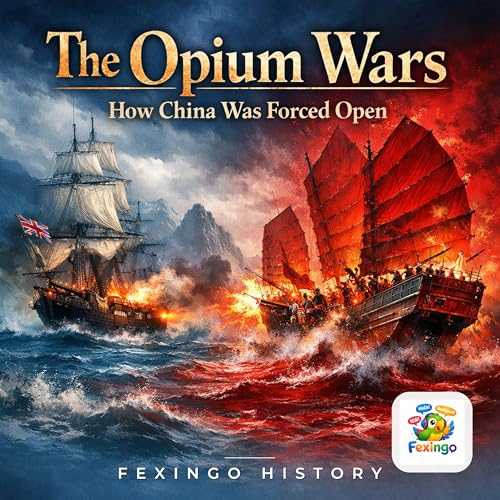
The Opium Wars: How China Was Forced Open — Fexingo History cover art

The Opium Wars: How China Was Forced Open — Fexingo History

The Opium Wars: How China Was Forced Open — Fexingo History

By: Fexingo
Listen for free

From 1839 to 1860, two devastating conflicts forced the Qing Empire to open its borders to foreign trade, reshaping East-West relations for centuries. Lucas and Luna unravel the tangled causes: Britain's illegal opium smuggling, Chinese efforts to suppress addiction, and the clash between the Celestial Empire's tributary worldview and British free-trade imperialism. Follow the naval battles along the Pearl River Delta, the fall of Canton, and the burning of the Summer Palace. Meet key figures like Commissioner Lin Zexu, whose anti-opium campaign sparked war; Lord Palmerston, the hawkish British Prime Minister; and Empress Dowager Cixi, witnessing Qing humiliation. Explore the unequal treaties—Treaty of Nanjing (1842) and Treaty of Tianjin (1858)—that ceded Hong Kong, opened treaty ports, and legalized opium. Delve into debates over extraterritoriality, the Taiping Rebellion's rise amid the chaos, and the long-term consequences: China's Century of Humiliation, the erosion of sovereignty, and today's lingering resentment toward Western intervention. This show examines not just the battles, but the cultural misunderstandings, economic desperation, and moral contradictions that still echo in Sino-Western relations. #OpiumWars #QingDynasty #BritishEmpire #LinZexu #TreatyOfNanjing #HongKong #Canton #TaipingRebellion #SummerPalace #ChineseHistory #Imperialism #OpiumTrade #CenturyOfHumiliation #UnequalTreaties #Palmerston #EastAsia #History #FexingoHistory Keep every episode free: buymeacoffee.com/fexingo© 2026 Fexingo. All rights reserved. Hourly Social Sciences World
Episodes
  • The Opium Wars and the Qing Cannoneers Who Held the Line
    Jun 29 2026
    In this episode, Lucas and Luna explore the forgotten story of the Qing artillerymen at the Bogue Forts, the Chinese cannoneers who faced British naval power in the First Opium War. Lucas explains how the Manchu gunners at Humen trained for years with old Portuguese-style guns, yet were outmatched by British cannonades aboard HMS Nemesis and other steam-powered vessels. The focus is on the battle of Anunghoy in February 1841, where Qing forces under Guan Tianpei tried to hold the Pearl River delta against Charles Elliot's fleet. Lucas describes the tactical setting: the islands of Chuenpi and Taikok with their stone forts, the chains stretched across the river, and the devastating British use of exploding shells. He also discusses how Qing gunpowder quality and firing techniques lagged behind British innovations like the Congreve rocket. Luna asks about the fate of the defenders, and Lucas relates how Guan Tianpei died in action, becoming a symbol of resistance. The episode ends with a reflection on the asymmetry of technology and training that defined the Opium Wars. #OpiumWars #QingDynasty #BogueForts #Humen #GuanTianpei #CharlesElliot #HMSNemesis #Chuenpi #CantoneseHistory #FirstOpiumWar #ChineseMilitary #Artillery #Cannon #PearlRiverDelta #Britain #History #FexingoHistory #EastAsia Keep every episode free: buymeacoffee.com/fexingo
    Show More Show Less
    6 mins
  • The Opium Wars and the Macau Portuguese Neutrality
    Jun 29 2026
    During the First Opium War, the Portuguese colony of Macau navigated a precarious neutrality between Qing China and Britain. This episode explores how Macau's governor, João Ferreira do Amaral, enforced strict neutrality while the city became a haven for British traders, spies, and refugees. We discuss the Macau Patrol Service, the British seizure of Portuguese vessels, the 1845 Macau Boundary Question, and the role of the Senado da Câmara (municipal council). We also look at the Compradors — Chinese middlemen who worked with both sides — and the impact on Macau's economy as Hong Kong rose. Finally, we touch on the 1849 assassination of Governor Amaral, which nearly drew Portugal into the conflict. Specific locales include the Praia Grande, the Barrier Gate (Portas do Cerco), and the Church of St. Paul. #Macau #OpiumWars #JoãoFerreiraDoAmaral #PortugueseNeutrality #PortasDoCerco #PraiaGrande #SenadoDaCâmara #Compradors #Canton #HongKong #QingDynasty #BritishNavy #PearlRiverDelta #1845BoundaryQuestion #MacauPatrolService #History #FexingoHistory #EastAsia Keep every episode free: buymeacoffee.com/fexingo
    Show More Show Less
    6 mins
  • The Opium Wars and the Fall of the Canton System
    Jun 28 2026
    Before the first Opium War, China's foreign trade was strictly controlled through the Canton System, a set of regulations that confined Western merchants to a small district in Guangzhou and restricted their interactions to licensed Chinese middlemen known as the Cohong. This episode explores how the system worked in practice: the daily life of traders in the Thirteen Factories, the role of the Cohong merchants like Howqua, and the tensions that arose from Qing attempts to maintain order. We also look at the collapse of the system after the Treaty of Nanking, which opened five ports and ended the Cohong monopoly. Specific details include the rules against foreign women entering Canton, the 'linguists' and 'compradors' who facilitated trade, and the pivotal role of silver sycee in transactions. Drawing on accounts from American and British traders, we piece together a portrait of a system that was both lucrative and suffocating, and whose downfall reshaped East Asian commerce. #CantonSystem #Cohong #Howqua #ThirteenFactories #Guangzhou #OpiumWars #QingDynasty #TreatyOfNanking #Sycee #Linguists #Compradors #ForeignFactories #EastIndiaCompany #Macau #ChinaTrade #History #FexingoHistory #BritishEmpire Keep every episode free: buymeacoffee.com/fexingo
    Show More Show Less
    9 mins
adbl_web_anon_alc_button_suppression_t1
No reviews yet