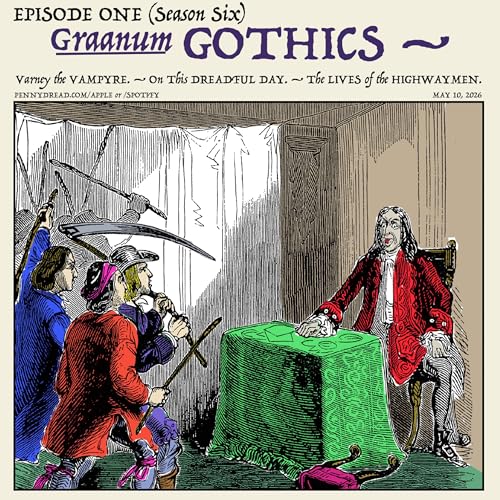
• 6.01: To Ambush a Vampire: How Hard Can it Be? Well … — The Ghost-bride of Broseley Road. — The Murderess and Her Minions. (A “Graanum Gothic” episode.)
    May 10 2026
    SHOW NOTES — for — EPISODE 1 (Season 6)(May 10, 2026)This show cycles through four themes over a four-week cycle, one show per week. This is the GRAANUM GOTHIC theme show, featuring Varney the Vampyre and other Gothic drama. It will be followed by ...The “Twopenny Torrid” theme episode, coming next Sunday;The “Sixpenny Spooky” theme episode, coming two Sundays hence; and finally—The “Ha’penny Horrid” theme episode, coming two fortnights from today. For COMPLETE SHOW NOTES, including art and links to resources, see ⁠⁠pennydread.com/discord.⁠⁠ ———— IN TODAY'S "GRAANUM GOTHICS" EPISODE:03:00: ON THIS DREADFUL DAY (May 10, 1853): A terrible explosion tore through the Duffryn Pit in Glamorganshire, killing dozens of coal miners working in it. ALSO ON THIS DAY (May 10, 1709): The ghost of Broseley Road made her first of what believers in the legend say are many unsuccessful crossings of the River Severn. On this night, Hannah Phillips was on her way home from making preparations for her wedding the following day, and drowned in the river whilst trying to cross it. AND FINALLY (May 10, 1768): An overzealous justice ordered soldiers to fire upon a crowd of unruly protesters who were gathered at Newgate to protest the arrest of popular Mayor John Wilkes, converting an unruly crowd into a dangerous riot. Several innocent bystanders were killed.10:15: VARNEY THE VAMPYRE; or, THE FEAST OF BLOOD, Chapter 55-57: As the embers of Sir Francis Varney’s house start to cool, and the vampire-hunting mob starts straggling off home to bed, the Bannerworths are making ready for their removal from the hall. Soon the coach has come, conveyed them to a cozy little cottage that the Admiral has rented for them, and left Admiral Bell and Mr. Chillingworth alone in the house … waiting for the vampire. Is he coming? We think we can safely assure you, dear reader, that yes, he most certainly is. But … let’s just say complications will ensue.44:40: CATCHPENNY BROADSIDE: Just a short one, more interesting to look at than to read: a rather bad poem on the theme of “Heaven help me, I got the businessman blues,” followed by almost an appeal for charity. The poem is very religious, apparently to get the reader in the mood to practice charity!48:30: THE LIVES OF THE HIGHWAYMEN: A suspiciously black-and-white account of an early-1700s murder-for-hire scheme that bears at least a passing resemblance to the scheme of “Pamela Stone” from the 1995 Gus Van Zant movie, “To Die For.” Was Catherine Hayes guilty? Did she do it? We’ll never really know.1:02:40: A FEW SQUEAKY-CLEAN DAD JOKES from the early-1800s' most popular joke book: "Joe Miller's Jests; or, The Wit's Vade-mecum."GLOSSARY OF EARLY-VICTORIAN SLANG USED IN THIS EPISODE:DANDY-COCKS: A dandy of small stature (a dandy meant basically the same thing it means today, a sort of empty-headed man of fashion. Like what Bertie Wooster’s fierce gunpowder aunts take him to be.) EARWIGS: Cronies or close friends. GRAANUM: From the term “Graanum gold,” a Flash term for old hoarded money.KNIGHTS OF THE BRUSH AND MOON: Drunken fellows wandering amok in meadows and ditches, trying to stagger home. CORINTHIAN: A fancy toff or titled swell. Used here as a reference to Corinthian Tom, the quintessential Regency rake depicted in Pierce Egan's "Life in London" (usually referred to as "Tom and Jerry"). CHAFFING-CRIB: A room where drinking and bantering are going on. GRUNTER: A shilling. Probably a derivative of another slang term for a shilling, “hog.”GUNPOWDERS: Fierce, usually disapproving old ladies. SHOP LOBBERS: Powdered fops. NIPPERKIN: Half an Imperial pint, which is rather a big dose for eye-water! EYE-WATER: Cheap gin. PIKE OFF: Run away. RED WAISTCOAT: The traditional uniform of the Bow-Street Runners, London’s first real professional police force. THERE ARE MORE! But we're out of space here. Please see complete show notes at pennydread.com/discord!
    Show More Show Less
    1 hr and 7 mins
  • 5.38: The bloody dagger of her future bridegroom hurled at her feet! — She dreamed a murder, then saw the room in which it was done! — The prophetess spake, and they died! (The “Sixpenny Spookies.”)
    May 7 2026

    SHOW NOTESforMINISODE 38 (Season 5)

    (May 7, 2026)

    ————

    00:40: THE TERRIFIC REGISTER: An account of a widow living in Rome who in 1774 became a prophetess, and predicted the deaths of the kings of Sardinia and France as well as the Pope himself. Her predictions came true.

    05:35: EARLY VICTORIAN GHOSTLY SHORT STORY, to-wit: LEIXLIP CASTLE, by CHARLES MATURIN: In which, we meet the family of Sir Redmond Blarey — the baronet and his daughter, Miss Anne. Miss Anne wants to know who she is destined to marry, as aristocratic girls often did back then; so she lets an old crone, a servant of the family named Collogue, cast a spell that will show him to her. —— The spell works, sort of; a demonic figure appears, casts a bloody dagger down at her feet, and tells her she will know her future husband by that; and disappears. —— Then a pale, corpse-like suitor comes to call at the family manse …

    35:45: A SHORT GHOST STORY from the scrapbook of Charles Lindley, Viscount Halifax. In which: Lady Goring had a vivid dream of a man murdering an elderly lady, then staging the scene to look like a suicide, in a room of a house she’d never seen. A few months later, she was touring houses to rent, and recognized the house! The previous tenants had left it … after the wife’s mother shot herself, they said.

    39:25: A STREET BROADSIDE on the topic of ghosts, death, and ruin: “The Queer Little Man” (about a ghost, or so he thought) and “Stay a Little Longer” (a merry shopkeeper’s ditty).


    GLOSSARY OF EARLY-VICTORIAN SLANG USED IN THIS EPISODE:

    • ROMONERS: (from intro patter) Swindlers who pretend to have occult powers.
    • OWLERS: (ibid) Smugglers, who move goods about by night when owls are out and about.
    • KNIGHTS OF THE BRUSH AND MOON: (ibid) Drunken fellows running amok in fields and ditches late at night, trying to stagger home.
    • RAG: (From broadside ballad) Money.
    • IT’S ALL MY EYE: (ibid) It’s all nonsense.
    • DUN: (ibid) Bill-collector.
    • NAILED: (ibid) Arrested.
    • SHERRY OFF: (from outro patter) Run away.
    • FLATS: Suckers.
    • GET FLY TO THE FAKEMENT: (ibid) Get wise to the con.
    • CORINTHIAN: (ibid) A fancy toff or titled swell. Used here as a reference to Corinthian Tom, the quintessential Regency rake depicted in Pierce Egan's "Life in London" (usually referred to as "Tom and Jerry").
    • MOABITES: (ibid) Bailiffs.
    • PHILISTINES: (ibid) Another word for Moabites.
    • CRAPING COVES: (ibid) Hangmen. “Crape” is a reference to the mourning worn by “hempen widows” after their husbands have been executed.
    • YE OLD STONE PITCHER: (ibid) Newgate Prison.
    • PADDINGTON FAIR: Execution day at Tyburn, which is in Paddington Parish. Paddington is also a pun, as “pad” was a flash word for “thief” or “robber.”


    Thank you for your support! Please, if you have a moment, rate us on your podcatcher network. If you’d like to do more, we do have a Patreon page; it’s here: https://patreon.com/pennydread


    Show More Show Less
    45 mins
  • 5.37: Sweeney Todd tries to murder Mrs. Lovett! — The hangman hanged, and for a shocking crime! — Trial and punishment of a cruel highway robber. (A “Ha’penny Horrid” Minisode.)
    May 3 2026

    SHOW NOTESforMINISODE 37 (Season 5)

    (May 3, 2026)

    ————

    • 00:01: HANGED TODAY IN HISTORY (April 3): One of the most notorious men to ever serve as a public executioner in England got that way by engaging in a shocking murder himself … that would be John “Jack Ketch” Price, launched into eternity at Tyburn On This Day 308 years ago!
    • 08:45: SWEENEY TODD, THE BARBER OF FLEET-STREET, Chapters 101-102: The boat with Todd and Mrs. Lovett in the stern makes great headway down the Thames. When it gets to London Bridge — the old bridge, with the narrow abutments that choked the river down to a roaring cataract at ebb tides — both passengers insist on being ferried through rather than getting out on the upstream side. While they are shooting the rapid, Todd knocks Mrs. Lovett overboard with a heavy blow to the head. … is this curtains for Mrs. Lovett? Will Sweeney Todd get away with this? We shall see.
    • 37:00: HORRID BROADSIDE: “Account of the TRIAL AND EXECUTION of JOHN AUSTIN Convicted at the OLD BAILEY on Saturday, Nov. 1st, 1783, of a Cruel Highway Robbery on JOHN SPICER, a Poor Man.” (1850s) The headline about covers it — but Mr. Austin played an unusually long game in setting his mark up for this dreadful crime, which he executed with an accomplice and a cutlass.


    GLOSSARY OF EARLY-VICTORIAN SLANG USED IN THIS EPISODE:

    • SHARKS: Lawyers.
    • TOPPING COVES: Hangmen.
    • KNIGHTS OF THE WOODEN RUFF: Prisoners serving a sentence in the pillory.
    • RUM BEAKS: Judges and magistrates who can be bought off.
    • RESURRECTION MEN: Body snatchers — fellows who dig up fresh-buried corpses to sell for a few guineas at the nearest medical college as cadavers.
    • TIP OUR RAGS A GALLOP: Run away as fast as we can.
    • GRABS: Law enforcement personnel.
    • TOUCH, or PUT THE TOUCH ON: To arrest.
    • HELL CATS: Dangerous ladies who frequent the “hells” (gambling dens).
    • BLACKLEGS: Professional gamblers who cheat to win.
    • SPICE ISLANDERS: Swindlers. A double pun: Mace is a spice; a mace-man is a swindler; so a Spice Islander is, as it were, a resident of Swindle Island.
    • SPEELING-CRIB: A “hell” (gambling den).
    • COVENT GARDEN: London neighbourhood that was, in the Regency and early Victorian, famous as a place where bloods, bucks and choice spirits went to sport their blunt. Upscale gambling hells and brothels were conveniently close by the Royal Opera and Drury-lane Theatre.
    Show More Show Less
    47 mins
  • 5.36: The highwaymen make a shocking discovery! — The crab, the chamber-pot, and the Call of Nature. — Introducing Miss Page — our Ninepenny Naughties hostess! (A “Twopenny Torrid" minisode)
    Apr 30 2026

    SHOW NOTES — for — MINISODE 36 (Season 5)

    (April 30, 2026)

    ————

    • 01:30: STREET POETRY: From broadside ballad sheets: “Seventeen Come Sunday,” about a soldier who seduces a neighbourhood lass; “Lark in the Morning,” about the life of a country plough-boy (racy pun intended); and “Fanny Gray,” about love and jealousy. (1840s).
    • 07:30: BLACK BESS; or, THE KNIGHT OF THE ROAD (starring HIGHWAYMAN DICK TURPIN), Chapter 68-70: Tom King settles in and tells his story. It turns out he actually is a man of some rank. But, a lifelong misunderstanding over how high a rank he occupied — involving the unexpected appearance of a previously unknown older half-brother — upended everything for him. Bitterly he went to London to lose himself in the crowds, and there became friends with — a man you don’t meet every day, let’s say, and leave it at that. — A few days later, a terrible storm comes in, and the smugglers put oilskins on and prepare to go out in it for some reason. By now, Dick and Tom suspect they know what that reason is, and it’s a very sinister one indeed ….
    • 37:45: INTRODUCING MISS PAGE: One of the “ladies of the evening” listed and described in Harris’s List of Covent-garden Ladies, a directory for bucks and bloods out on the town in the early 1800s. Miss Page is described as a zestful woman of 20 and very pretty except for her mouth, which is a bit too wide when she laughs, as she often does.
    • 42:00: A RATHER NAUGHTY COCK-AND-HEN-CLUB SONG: "The Crab-fish” (about an unfortunate accident that befalls a lady when she tries to use the chamber-pot, only to find out the hard way that her husband has filled it with cold water and put a live crab in it, intending to cook it for breakfast.)
    • 45:00: A FEW MILDLY DIRTY JOKES from what passed in 1830 for a dirty joke book: "The Joke-Cracker" by Martin Merryman, Esq.

    GLOSSARY OF EARLY-VICTORIAN SLANG USED IN THIS EPISODE:

    • BON VIVANTS: (from intro) Happy-go-lucky partiers.
    • HELL CATS: (ibid) Dangerous ladies who hang around in gambling “hells.”
    • KNIGHTS OF THE ROAD: (ibid) Highway robbers.
    • CORINTHIAN: (ibid) Sporting man of rank and fashion, most famously represented by Corinthian Tom from Pierce Egan’s “Life in London,” the story of the adventures of a wealthy Regency rake named Tom and his country cousin Jerry as they rampage through the streets of London on a continual spree.
    • CYPRIANS: (From the introduction to our Ninepenny Naughties hostess) Ladies of easy virtue, a classical reference to the island of Cyprus, supposedly peopled with sexually frisky ladies.
    • SPORTING THEIR BLUNT: (ibid) Throwing money around.
    • BUMPER: (ibid) Liquor glass.
    • BLUE DEADLY: (ibid) Gin.
    • SLUICE YOUR TOMBSTONES: (ibid) Take a big drink.
    • MORRIS OFF: (from outro) Run away at top speed.
    • BEAKS ON THE NOSE: Police detectives or magistrates on an investigation.
    • DIDDLE COVES: Bartender or landlord in a gin palace or dram shop.
    • DAFFY DOXIES: Racy ladies who enjoy drinking daffy (gin).
    • CAPTAIN LUSHINGTONS: Habitual drunks.
    • BOOZING-KEN: Drinking den.
    • SMITHFIELD: In the early 1800s a notoriously crowded and dangerous neighborhood in which a very unsanitary open-air livestock market was regularly held until the 1850s.
    Show More Show Less
    51 mins
  • 5.35: “Down with the vampire!” the mob shouts, shaking their torches and pitchforks! — “Mother, how long am I to be dead?” — A clever excuse after being caught playing cards in church.
    Apr 26 2026

    SHOW NOTES — for — EPISODE 35 (Season 5)

    (April 26, 2026)

    ————

    Join host Corinthian Finn, a.k.a. Finn J.D. John 18th Baron Dunwitch,* for a one-hour-long spree through the scandal-sheets and story papers of early-Victorian London!

    This show cycles through four segments over a two-week cycle, two shows per week. This is the main show, including the "Penny Dreadfuls" segment. It will be followed by ...

    • The “Twopenny Torrids” minisode, coming this Thursday eve;
    • The “Ha’penny Horrids” minisode, to be posted next Sunday (one week from today); and finally—
    • The “Sixpenny Spookies” minisode, which posts two Thursdays hence.

    For COMPLETE SHOW NOTES, including art and links to resources, see ⁠⁠pennydread.com/discord.⁠⁠

    ————

    • 01:40: ON THIS DREADFUL DAY (April 26, 1855): A woman drew a five-month prison stretch for swindling a man out of 5 shillings by pretending her baby had died.
    • 04:15: VARNEY THE VAMPYRE; or, THE FEAST OF BLOOD, Chapter 52-54: While Sir Francis Varney’s servants are battling to defend the house from the mob, a shout from upstairs lets everyone know that the townies have figured out another way in, and are inside the house. They soon find Varney himself. That worthy, with very provoking coolness, steps behind a curtain and vanishes. — A thorough search of the house for the vampire ensues, which is unsuccessful, although it does lead to the wine cellars. Then someone gets the bright idea of burning the vampire out ….
    • 32:32: “CATCHPENNY” BROADSIDE: A soldier arrested for playing cards in church has a very thorough explanation for how he uses a pack of standard gambling accoutrements as Bible, almanac and prayer book.
    • 41:55: THE LIVES OF THE HIGHWAYMEN: Being a sort of posthumous collaboration with Arthur Griffiths, the late inspector of Her Majesty’s prisons, to describe some of the more subtle and respectable highwaymen of the Georgian and Regency period — the government officials and aristocrats who shamelessly plundered the public cookie jar.
    • 54:00: A FEW SQUEAKY-CLEAN DAD JOKES from the early-1800s' most popular joke book: "Joe Miller's Jests; or, The Wit's Vade-mecum."

    GLOSSARY OF EARLY-VICTORIAN SLANG USED IN THIS EPISODE:

    MACE COVES: Well-dressed young pickpockets.

    PRATE ROASTS: Pretty, high-spirited young maidens.

    KNIGHTS OF THE BRUSH AND MOON: Drunken fellows wandering amok in meadows and ditches, trying to stagger home.

    CORINTHIAN: A fancy toff or titled swell. Used here as a reference to Corinthian Tom, the quintessential Regency rake depicted in Pierce Egan's "Life in London" (usually referred to as "Tom and Jerry").

    CHAFFING-CRIB: A room where drinking and bantering are going on.

    SHE-LION: A shilling.

    GUNPOWDERS: Imperious dowager ladies.

    FLOWERS OF SOCIETY: Slightly contemptuous reference to the rich and famous.

    CLANKER: A pewter drinking pot usually used for ale.

    HEAVY BROWN: Strong ale.

    PIKE OFF: Run away.

    RED WAISTCOAT: The traditional uniform of the Bow-Street Runners, London’s first real professional police force.

    GAMMONERS: Swindlers or gamblers who cheat.

    ROMONERS: Fake occultists and fortune tellers.

    SHARPS: Swindlers.

    OLD ST. GILES: The neighbourhood of St. Giles in the Fields parish, which in the early Victorian age was a notorious slum.

    RUM TE TUM WITH THE CHILL OFF: Most emphatically excellent.


    * The Barony of Dunwitch is located in a deep forest glade west of Arkham (where, as H.P. Lovecraft put it, “the hills rise wild, and there are valleys with deep woods that no axe has ever cut; there are dark narrow glens where the trees slope fantastically, and where thin brooklets trickle without ever having caught the glint of sunlight.”) Actually it is a good 3,000 miles west of Arkham. It is not to be confused with Dunwich, the English seacoast town that fell house by house into the sea centuries ago, or Dunsany, the home until 1957 of legendary fantasy author Edward J.M.D. Plunkett, 18th Baron Dunsany.


    Show More Show Less
    58 mins
  • 5.34: A murder forestalled by a daughter's spooky dream! — The whisky-drinking spirit in the old manor house. — The Dance of the Dead! (Segment 4 — The “Sixpenny Spookies.”)
    Apr 23 2026

    SHOW NOTESforMINISODE 34 (Season 5)

    (April 23, 2026)

    ————

    • 00:45: THE TERRIFIC REGISTER: An account of how a mysterious and persistent knocking turned out to be, mayhap, a ghostly notification of approaching death.
    • 05:20: EARLY VICTORIAN GHOSTLY SHORT STORY, to-wit: THE GHOST AND THE BONESETTER, by J.S. LeFanu: In this episode, a bonesetter — a countryman who has developed the knack for repositioning broken limbs so that they can heal — is called upon to watch his squire’s castle while the squire is away. He is very reluctant, because everyone knows the squire’s deceased father likes to descend from his portrait in the parlour in search of whiskey to drink. ... Sure enough, the old squire steps out of the painting as soon as it’s fairly dark. But he has a very unusual request to make of our narrator ….
    • 35:40: SHE DREAMED HER MOTHER'S MURDER: A short ghost story from the scrapbook of Charles Lindley, Viscount Halifax: A lady had a vivid dream of a man murdering her mother in her bed. She was very unsettled, but when the same dream recurred the following night, she determined to go see her mother and make sure she was OK. When she arrived, the door was opened by her mother’s butler … who she recognized as the murderer in her dream ….
    • 40:45: SOME STREET POETRY on the topic of ghosts, death, and ruin. In this case, we have an early English translation of DER TOTENTANZ, by J.W. von Goethe, which the anonymous translator has titled “The Skeleton Dance.”


    GLOSSARY OF EARLY-VICTORIAN SLANG USED IN THIS EPISODE:

    • AUTEM DIVERS: Pickpockets who work the congregations at religious meetings.
    • ANGELICS: Young maidens in their prime.
    • KNIGHTS OF THE BRUSH AND MOON: Drunken fellows running amok in fields and ditches late at night, trying to stagger home.
    • SHERRY OFF: Run away. From the nautical term, "Sheer off."
    • FLATS: Suckers.
    • GET FLY TO THE FAKEMENT: Get wise to the swindle.
    • MOABITES: Bailiffs.
    • PHILISTINES: Also means bailiffs.
    • CRAPING COVES: Hangmen.
    • YE OLD STONE PITCHER: Newgate Prison.
    • PADDINGTON FAIR: Execution day at Tyburn, which is in Paddington Parish. Paddington is also a pun, as “pad” was a flash word for “thief” or “robber.”
    • BRUSH OFF: Leave. Note this phrase means something slightly different today.

    Thank you for your support! Please, if you have a moment, rate us on your podcatcher network. If you’d like to do more, we do have a Patreon page; it’s here: https://patreon.com/pennydread

    Show More Show Less
    34 mins
  • 5.33: Detective Blunt learns Sweeney Todd’s deadly secret! — Search for stolen trousers led to a dismembered torso! — High society’s favourite murdering stalker. (Segment 3 — The “Ha’penny Horrids.”)
    Apr 19 2026

    SHOW NOTESfor — MINISODE 33 (Season 5)

    (April 16, 2026)

    ————

    01:00: HANGED TODAY IN HISTORY (April 16): Meet James Hackman, creepy homicidal stalker who moved in on a Royal Opera soprano named Martha Ray and, when she would not have him, murdered her and tried unsuccessfully to kill himself. He was hanged for this crime on this day 247 years ago, April 16, 1779.

    Links:

    • ExecutedToday blog entry
    • Wikipedia article on James Hackman

    12:30: SWEENEY TODD, THE BARBER OF FLEET-STREET, Chapters 98-100: We continue following the party Sir Richard Blunt is leading through the vaults beneath St. Dunstan’s. They come through the dark tunnel and into a great stone vault, obviously built for some great edifice that has since been torn down and built over; and there’s a locked door on the other side. Through that, there is another locked door, and then — a dead body. It’s Mrs. Lovett’s spy, poisoned by Todd and thrust through the hole in his parlour floor. Then they hear a footstep overhead, and Todd’s voice carries through the hole in the floor.

    Meanwhile, up in Todd’s shop, Mrs. Lovett is arriving for her appointment to collect her half of the blood money …

    46:25: HORRID BROADSIDE: “Verses on Daniel Good, Who was Executed This Morning May, ’42, for the Murder of Jane Jones.” (1842) A sort of ballad in a galloping amphibrach quadrimeter, telling of the crime and execution of a man who murdered and dismembered his common-law wife and was caught when police officers searching for stolen trousers found her torso in the stable.

    Links:

    • Dr. Angela Platt's blog post on this story

    GLOSSARY OF EARLY-VICTORIAN SLANG USED IN THIS EPISODE:

    • CANARY BIRDS: Prisoners.
    • CONVEYANCERS: Practitioners of larcenous enterprises, from theft to the fencing of stolen goods.
    • KNIGHTS OF THE BLADE: Swaggering companions who are boastful of their prowess and may also claim a military rank — Captain, Major, Colonel — that they don’t really have a right to.
    • TOPPING COVES: Executioners — specifically, hangmen, as “topped” is Flash-cant slang for “hanged” even though it sounds like it ought to refer to decapitation.
    • KNIGHTS OF THE POST: Convicts being punished in the pillory. Also sometimes refers to perjurers who swear to falsehoods for a reward.
    • TIP OUR RAGS A GALLOP: Run away as fast as we can.
    • GRABS: Law enforcement personnel.
    • TOUCH, or PUT THE TOUCH ON: To arrest.
    • HELL CATS: Dangerous ladies who frequent the “hells” (gambling dens).
    • BLACKLEGS: Professional gamblers who cheat to win.
    • SPICE ISLANDERS: Swindlers. A double pun: Mace is a spice; a mace-man is a swindler; so a Spice Islander is, as it were, a resident of Swindle Island.
    • SPEELING-CRIB: A “hell” (gambling den).
    • COVENT GARDEN: London neighbourhood that was, in the Regency and early Victorian, famous as a place where bloods, bucks and choice spirits went to sport their blunt. Upscale gambling hells and brothels were conveniently close by the Royal Opera and Drury-lane Theatre.
    Show More Show Less
    55 mins
  • 5.32: The Coast Guard pounces on the smugglers! — The Maiden’s Surprise. — Introducing Miss Godfrey of 22 Upper Newman-street — our Ninepenny Naughties hostess! (Part 2 — The “Twopenny Torrids.”)
    Apr 16 2026

    SHOW NOTESforMINISODE 32 (Season 5)

    (April 16, 2026)

    ————

    • 01:35: STREET POETRY: From a broadside ballad: “The Old Oak Tree” and “The Old House at Home” — a song of a jilted lover-maid, and another song of longing for one’s childhood home.
    • 04:35: BLACK BESS; or, THE KNIGHT OF THE ROAD (starring HIGHWAYMAN DICK TURPIN), Chapter 65-67: Following the signal lights, the two cutters meet up with the smuggling ship, the Snake, and start transferring packets of smuggled silk. Everyone is a little worried because the Snake is showing a signal light that means the Coast Guard is active tonight, but hope to get away clear without seeing them.
    • Then this hope is suddenly, and explosively, dashed ….
    • 31:25: INTRODUCING MISS GODFREY: One of the “ladies of the evening” listed and described in Harris’s List of Covent-garden Ladies, a directory for bucks and bloods out on the town in the early 1800s. Miss Godfrey is described, somewhat paradoxically, as a tiny, lovely, petite pixie-gamine with the voice of a boatswain or drill sergeant, and an “excellent bed-fellow.”
    • 34:30: A RATHER NAUGHTY COCK-AND-HEN-CLUB SONG: "THE MAIDEN’S SURPRISE; or, THE OLD HAT” (a dirty story in verse about a blooming maiden whose lust was stimulated by an unexpected glimpse of a local swain’s nether member. Cool story, bro, amirite?)
    • 37:20: A FEW MILDLY DIRTY JOKES from what passed in 1830 for a dirty joke book: "The Joke-Cracker" by Martin Merryman, Esq.


    GLOSSARY OF EARLY-VICTORIAN SLANG USED IN THIS EPISODE:

    • HELL HOUNDS: (from intro) Disreputable gamblers who frequent gambling “hells.”
    • ACADEMICIANS: (ibid) Members of an “academy,” that is, a brothel. So academicians were brothel ladies.
    • KNIGHTS OF THE ROAD: (ibid) Highway robbers.
    • CORINTHIAN: (ibid) Sporting man of rank and fashion, most famously represented by Corinthian Tom from Pierce Egan’s “Life in London,” the story of the adventures of a wealthy Regency rake named Tom and his country cousin Jerry as they rampage through the streets of London on a continual spree.
    • CYPRIANS: (From the introduction to Hostess Miss Godfrey) Ladies of easy virtue, a classical reference to the island of Cyprus, supposedly peopled with sexually frisky ladies.
    • SPORTING THEIR BLUNT: (ibid) Throwing money around.
    • FLICKER: (ibid) Liquor glass.
    • JACKY: (ibid) Gin.
    • SLUICE YOUR IVORIES: (ibid) Take a big drink.
    • GAY: (from cock-and-hen-club song, “The Maiden’s Surprise”) Carelessly frolicksome — given to venery and dissipation.
    • LEARY LANKY DOODLE: (ibid) Nonsense verse, but with a real flash word tucked into its midst: “Leary,” which means canny and crafty.
    • IN AND OUT, ROUND ABOUT, DOODLE DOO: (ibid) More nonsense verse with “in and out,” a pretty obvious reference to sex, tucked into its midst.
    • COCKATOO: Another nonsense word (not a reference to the bird) selected because (a) it rhymes with “Tomaroo,” the word in the song this is a parody of; and (b) it contains the ever-titillating word “cock.”
    • MORRIS OFF: (from outro) Run away at top speed.
    • BEAKS ON THE NOSE: Police detectives or magistrates on an investigation.
    • DIDDLE COVES: Bartender or landlord in a gin palace or dram shop.
    • DAFFY DOXIES: Racy ladies who enjoy drinking daffy (gin).
    • CAPTAIN LUSHINGTONS: Habitual drunks.
    • BOOZING-KEN: Drinking den.
    • SMITHFIELD: In the early 1800s a notoriously crowded and dangerous neighborhood in which a very unsanitary open-air livestock market was regularly held until the 1850s.
    Show More Show Less
    42 mins