The Principles of War - Lessons from Military History on Strategy, Tactics, Doctrine and Leadership. cover art

The Principles of War - Lessons from Military History on Strategy, Tactics, Doctrine and Leadership.

The Principles of War - Lessons from Military History on Strategy, Tactics, Doctrine and Leadership.

By: James Eling
Listen for free

About this listen

Professional Military Education in 30 minute sessions. Historic Battles study through current doctrine to gain lessons learned. Tactics, Strategy, Combined Arms, Military Leadership in a format for Unit PME programs. We study the great battles to draw the lessons on strategy, tactics and leadership. Get your lessons learned here rather than in AAR format.(C) Copyright 2018-2024 Political Science Politics & Government World
Episodes
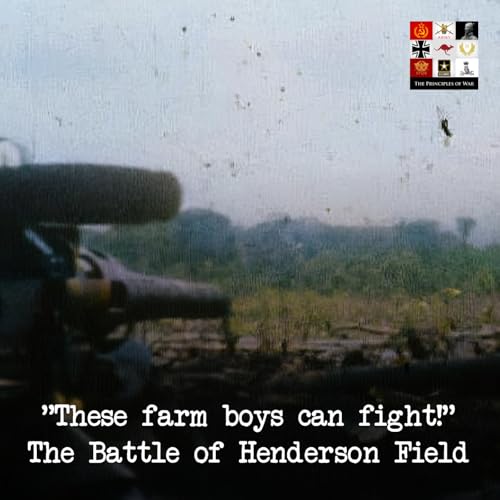
  • 148 - The Battle of Henderson Field - Guadalcanal 1942
    Apr 5 2026

    This episode is the 14th episode in our Guadalcanal series. We look at the Battle of Henderson Field, which is the decisive terrain for the campaign. Had the airfield been lost, it is likely that the US would not have been able to hold Guadalcanal.

    We discuss:

    How do you defend critical terrain against a numerically superior force?
    How should defensive positions exploit terrain to maximize effectiveness?
    How do you integrate combined arms in the defense?
    How does poor communication affect tactical coordination?
    How do you integrate unfamiliar units into ongoing operations?

    The 164th got their introduction into combat at Henderson Field. They were a North Dakota National Guard unit and had only been on Guadalcanal for 10 days. They were bought up to bolster the heavily outnumbered defences. Rather than have the unit deploy into the line and take over a part of the line, Puller had small groups lead into their positions next to Marines. Piecemeal deployment, the last thing you want to happen to your Regiment, but it employed the green troops to fight next to seasoned Marines. At the end of the fight, Chesty Puller said, "These farm boys can fight!"

    Check out the show notes for the Guadalcanal series.

    https://www.patreon.com/cw/principlesofwar - if you've learnt something from this episode and you can afford it, please support the podcast at Patreon.

    Looking for YouTube PME videos? Check out the Principles of War YouTube Channel.

    Great Professional Military Education for your Unit. This episode covers static defence, combined arms, terrain and leadership.

    Show More Show Less
    56 mins
  • 147 - The Japanese tank attack in the Battle of Henderson Field - Guadalcanal
    Mar 29 2026

    This episode looks at the Sumiyoshi's tank attack across the Matanikau - an attempt to draw defenders away from the perimeter of Henderson Field. We also discuss why Muryama coundn;t synchronise his forces and the dysfunction within the Japanese Headquarters.

    We look at -

    What are the consequences of relieving a subordinate commander on the eve of battle? (And what role did Tsuji play in Kawaguchi's dismissal?)
    What happens when multiple attacking elements operate independently without coordination?
    How should armour, infantry, and artillery be coordinated in an assault?
    What is the value of pre-registered artillery fires in defense?
    How can the Japanese achieve tactical surprise despite proximity?
    What is the purpose and risk of outposts forward of the main defensive line?

    Dave Holland is an ex-Marine and was posted to Guadalcanal with the Australian Federal Police. He regularly leads battlefield study tours through the area. He is a world-leading expert on the battles of Guadalcanal and author of Guadalcanal's Longest Fight - The Pivotal Battles of the Matanikau Front.

    Check out the show notes for the Guadalcanal series.

    https://www.patreon.com/cw/principlesofwar - if you've learnt something from this episode and you can afford it, please support the podcast at Patreon.

    Looking for YouTube PME videos? Check out the Principles of War YouTube Channel.

    Great Professional Military Education for your Unit. This episode covers co-operation, the employment of armour and command dysfunction.

    Show More Show Less
    41 mins
  • 146 - Halsey's question for Vandegrift about Henderson Field's defence that influenced Pacific Strategy.
    Mar 22 2026

    This episode looks at the defensive and offensive planning undertaken by the IJA and the USMC. It also looks closely at Vandegrift's meeting with Halsey and the outcome of the meeting. This is a pivotal moment in the campaign. Halsey has taken over from Ghormley and he prepares to back Vandegrift with everything the Navy has to help defend Guadalcanal.

    How does intelligence fusion enable a commander to choose the time and place of battle? The combination of coast-watchers, aerial photography, signals intercepts, prisoner interrogation, and traffic analysis gives Vandegrift sufficient warning to disengage from the Matanikau and assume a prepared defensive posture before the Japanese assault begins.

    What are the compounding effects of logistics failure on combat power? Japanese soldiers carry only five days' rations for a march that takes far longer than planned. By the time the assault goes in, troops are hungry, exhausted, and degraded — before they have fired a shot.

    How does the defence leverage knowledge of terrain? The defenders have patrolled and observed their ground for months, have pre-registered every likely approach, and understand the avenues of attack in detail — advantages the attacking Japanese, navigating by inaccurate maps in pitch darkness, completely lack.

    What is the relationship between strategic commitment and tactical success? The Marines' ability to hold Henderson Field is directly tied to whether higher command is willing to accept naval losses to keep the sea lanes open. Halsey's personal commitment to "give you all I have" is the strategic enabler for everything that follows tactically.

    How does the defender's advantage of fighting on familiar ground translate into combat power? Vandegrift's troops are dug in, know their sectors, have rehearsed their fire plans, and can rotate reserves along interior lines — while the Japanese are exhausted, disoriented, under-supplied, and attacking in darkness across ground they have never seen.

    Dave Holland is an ex-Marine and was posted to Guadalcanal with the Australian Federal Police. He regularly leads battlefield study tours through the area. He is a world-leading expert on the battles of Guadalcanal and author of Guadalcanal's Longest Fight - The Pivotal Battles of the Matanikau Front.

    Check out the show notes for the Guadalcanal series.

    https://www.patreon.com/cw/principlesofwar - if you've learnt something from this episode and you can afford it, please support the podcast at Patreon.

    Great Professional Military Education for your Unit. This episode covers economy of effort, intelligence fusion, and defensive fires planning.

    Show More Show Less
    41 mins
No reviews yet