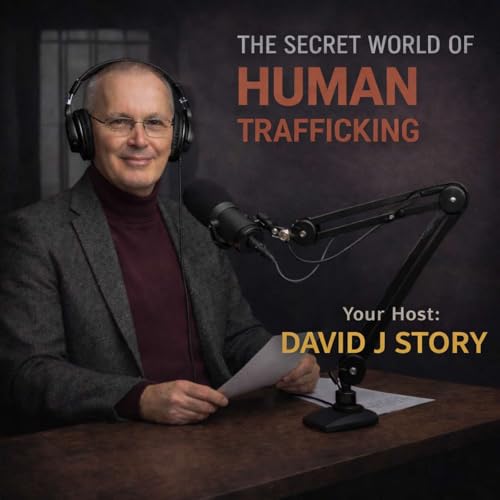
The Secret World of Human Trafficking cover art

The Secret World of Human Trafficking

The Secret World of Human Trafficking

By: DAVID J. STORY
Listen for free

Confronting the reality many refuse to see.


The Secret World of Human Trafficking is a podcast dedicated to exposing the global crisis of human trafficking through informed discussion, expert insight, and real-world awareness.


Hosted by David J. Story, the show examines trafficking operations across the world, breaking down how they function, how victims are targeted, and what systems enable exploitation to continue. Each episode moves beyond headlines to explore the deeper structures that sustain trafficking networks.


The podcast features conversations with:

  • * Law enforcement professionals
  • * Experts working directly with survivors
  • * Leaders from government and private anti-trafficking organizations
  • * Specialists focused on prevention and intervention


Through these discussions, the goal is not only awareness, but education. It helps in equipping listeners with knowledge about how trafficking operates and what is being done to combat it.


While David also discusses the Omega book series, the focus of the podcast remains on real-world trafficking and the people working tirelessly to dismantle these criminal networks.


────────── ❖ ──────────

The views expressed in these episodes are those of the individual host(s) and guest(s) and do not necessarily reflect the official position of David J. Story or The Secret World of Human Trafficking.


While we strive for accuracy, we do not guarantee the validity of all statements made by our guest(s). This program is for informational purposes only and should not be taken as professional legal, medical, or psychological advice.


For more information, please visit our full disclaimer at DavidJStory.com/Disclaimer.

© 2026 The Secret World of Human Trafficking
True Crime
Episodes
  • SWHT Interview with Ex CIA Operative and Pararescurer Nick McKinley
    Jun 24 2026

    Let Me Know Your Thoughts and Question.

    In this episode of The Secret World of Human Trafficking, host David J. Story interviews former CIA operative and pararescuer Nick McKinley, founder of DeliverFund, a nonprofit that provides intelligence and data to thousands of law enforcement officers fighting human trafficking across the United States.

    McKinley explains that modern human trafficking is largely driven through the internet, where predators use social media, gaming platforms, and other online applications to identify and groom vulnerable children. He emphasizes that trafficking is rarely the result of stranger abductions and is more often facilitated through online manipulation and exploitation.

    The discussion covers:

    • How DeliverFund uses data analysis and AI to identify traffickers and support law enforcement investigations.
    • The dangers children face online through social media, gaming platforms, and messaging apps.
    • Common misconceptions about human trafficking, including myths about stranger kidnappings and trafficking economics.
    • The overlap between pornography, commercial sexual exploitation, and trafficking.
    • The importance of parental involvement and limiting unsupervised internet access.
    • The role of technology companies, government policy, and public awareness in combating trafficking.

    McKinley stresses that trafficking is a large-scale problem requiring intelligence-driven solutions, stronger protections for children online, and greater public engagement to identify and stop traffickers.

    Support the show

    Go to DavidJStory.com for more information about the Host/Author and more episodes. Or if you want to be on the show.

    Show More Show Less
    1 hr and 17 mins
  • SWHT A Plea For Help
    Jun 17 2026
    Let Me Know Your Thoughts and Question.David J. Story hosts a podcast focused on human trafficking and is the author of a fictional Omega book series inspired by his personal experiences and concerns about missing children and trafficking. The impetus for his writing and podcasting began during the COVID-19 period after his late wife, Sharon, suffered a severe injury in a pedestrian accident and subsequently died after a prolonged coma. While continuing to work outside the home, Story found himself alone and began researching missing children and trafficking. This research led him to learn that Atlanta is among the top U.S. cities associated with human trafficking, which influenced the premise of his fiction and the subjects addressed in his podcast. The Omega Book Series Story wrote three novels over about two and a half years and is working on a fourth. The series centers around a group called the Omega Group, a collective of ordinary people who form a vigilante-style organization to fight trafficking and rescue victims. The books are fictional and include main characters such as Jack Davidson and Shaylin. The titles mentioned are: Omega 1: The Creation; Omega 2: A Cry for Help; Omega 3: The Head of the Snake; and a work in progress, Inside the Belly of the Snake. The books were a personal creative response to feelings of helplessness and the desire to imagine how regular people might respond if trafficking endangered their loved ones. Podcast Purpose and Reach Story emphasizes that while the novels are fiction, the podcast addresses real-world trafficking issues by inviting experts and sharing factual information. He does not claim to be a trafficking expert himself but uses the show to bring knowledgeable guests to listeners. The podcast has reached an international audience: Story reports distribution across more than twenty-four countries, approximately eighteen platforms, and nearly two hundred cities, indicating a broader-than-expected reception. He finds the response humbling and believes it validates the need to discuss trafficking more openly. Scope and Types of Human Trafficking Story outlines the many forms trafficking takes and stresses that public perception often focuses narrowly on sexual exploitation. He enumerates additional categories: forced labor, bondage, domestic servitude, organ removal, forced begging, child soldiers, and forced marriages. He highlights that trafficking is complex and multifaceted and therefore requires broader awareness and intervention strategies beyond only addressing sexual exploitation. Prevalence and Drivers in the United States Story notes a troubling statistic from 2023: the National Human Trafficking Hotline reported over 17,000 victims in the United States, acknowledging that this number reflects only reported cases and excludes many victims such as runaways and homeless people. He stresses the U.S. is currently the top country for human trafficking in terms of prevalence, which he attributes largely to economic drivers—wealth and demand. The financial ability of consumers to buy sex, pornography, or domestic servitude creates demand that traffickers exploit. Story argues that the country’s relative wealth and power make it a market for trafficking. He also warns that silence and societal reluctance to discuss trafficking enable its growth. Perpetrators, Buyers, and the Role of Families Story condemns traffickers and those who buy sex, especially when victims are children. He expresses shock and moral outrage at reports of children, even as young as one year old, being prostituted or sold by parents or relatives for money or drugs. He challenges the notion that a parent who sells a child loves that child and uses this to underscore the depth of the problem and the moral collapse surrounding trafficking. Limitations of Rescue and the Need to Disrupt Supply Rescue operations alone are inadequate to eradicate trafficking because of limited resources and the sheer scale of victims—potentially hundreds of thousands within the country. Story asserts that while rescues are necessary and valuable, greater emphasis must be placed on disrupting the traffickers and reducing demand. He stresses targeting buyers and traffickers as a strategic priority to prevent further exploitation rather than relying solely on post-victim rescue efforts. Education, Reporting, and Practical Steps Story provides practical guidance and resources for those who suspect trafficking. He promotes education and training to identify trafficking indicators and to learn where to report concerns. He references the National Human Trafficking Hotline and provides the number shared during the episode for reporting tip-offs and seeking help: 1-888-373-7888. He also recommends contacting local law enforcement—911 in emergencies, local sheriff’s offices, the FBI, or Homeland Security—when trafficking is suspected. The recurring message is: if you see something, say ...
    Show More Show Less
    17 mins
  • SWHT African Forced Organ Harvesting, Prostitutions & Bride Kidnapping
    Jun 10 2026
    Let Me Know Your Thoughts and Question.This interview features Clifford Brown, a retired Foreign Service Officer and attorney, discussing his nearly 30-year career with USAID (Agency for International Development) and his work on global development, anti-drug programs, governance, and human trafficking. Brown recounts postings across Africa, Central America, Colombia, Kyrgyzstan, Guinea, Sierra Leone and Peru, and explains the agency's broad remit: projects that fell between military and diplomatic efforts, from health and disaster response to economic development and environmental conservation.Career and ServiceJoined USAID in 1987 after practicing law; served about 27 years overseas in regional and country positions.Roles included legal advisor, management positions, deputy director in Bogota (anti-drug programs), country representative in Kyrgyzstan, and mission director in Guinea.Returned to the U.S., practiced family law and bankruptcy, later worked as a contractor and as a senior advisor with the American Bar Association.Authored Inside USAID: An Odyssey of Foreign Assistance, a collection of field stories illustrating the agency's work and fragile social contexts abroad.Human Trafficking and Organ HarvestingBrown describes disturbing firsthand observations and reports of transnational trafficking networks that move people—particularly women—from Southeast Asia to West Africa and vice versa. Key points:Trafficked women were forced into prostitution aboard ships and in port cities; passports were confiscated and victims were frequently kept under house arrest.When victims resisted, some were killed for organs; Brown links this practice to a broader global demand, citing reports of organ procurement in China and a book (Kill to Order) alleging organs are available quickly for those who can pay.Transport and jurisdictional challenges complicate enforcement: crimes often occur at sea or across borders, making interception, evidence and legal authority difficult.Corruption and weak law enforcement enable traffickers—sometimes law enforcement and political actors are bribed or complicit.Domestic and Local TraffickingBrown highlights bride kidnapping and forced marriages in Central Asia as a pervasive form of domestic trafficking, often tolerated through tradition despite being illegal.He also notes U.S. domestic vulnerabilities: homeless and runaway teens are at high risk of exploitation, and in some places shelters and protections are limited by law.Institutional Loss and Policy ConcernsBrown laments the dismantling of USAID (as he describes it), noting loss of institutional knowledge, project documentation and evaluation capacity that hampered humanitarian, health and development programs.He argues USAID projects often returned economic value to the U.S. (through contractors and services) and addressed fragile social systems that can rapidly unravel.He stresses that geopolitical priorities and military spending often overshadow foreign assistance despite its practical, on-the-ground impact.Responses and Prevention EffortsPublic awareness campaigns in origin countries are one practical approach Brown supports—broadcasts and translated programs to warn potential victims about trafficking recruitment tactics.He describes collaborative efforts with a group (Order of the Eagle) and individuals like Major Jason Hatch to develop prevention programs.Effective law enforcement requires international cooperation, evidence-gathering and mechanisms to assert jurisdiction over vessels and transnational smugglers.Notable Illustrative StoriesAccounts from Guinea: port-based sex trafficking involving Asian crewmen, port collaborators, and transport of organs; violent instability and the difficulty of intervening during conflict.Kyrgyzstan: bride kidnapping traditions, corruption in the energy sector, and a personal incident where Brown’s wife was briefly kidnapped after his public commentary about corruption.Colombia: programs to encourage farmers to grow legal crops instead of coca.Conclusions and RecommendationsBrown emphasizes the scale and brutality of modern trafficking and organ harvesting, the enabling role of corruption, and the need for sustained institutional capacity, international cooperation, and public awareness in origin communities. He advocates restoring and preserving development expertise and records, improving cross-border law enforcement, and investing in prevention and support services (including youth shelters) to reduce vulnerability.The interview closes with references to Brown’s book and a recommended title on organ trafficking; Brown encourages public attention to trafficking and recovery of institutional tools that enable effective responses.Support the showGo to DavidJStory.com for more information about the Host/Author and more episodes. Or if you want to be on the show.
    Show More Show Less
    57 mins
adbl_web_anon_alc_button_suppression_t1
No reviews yet