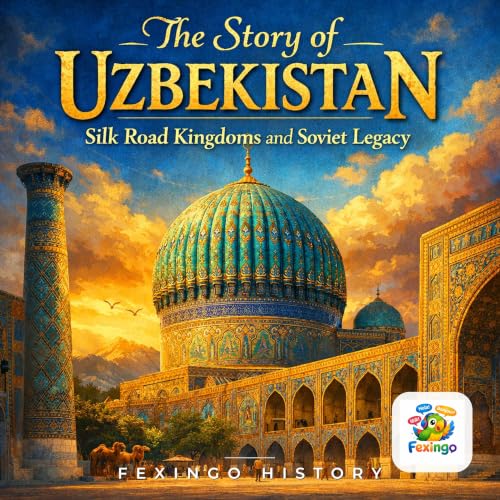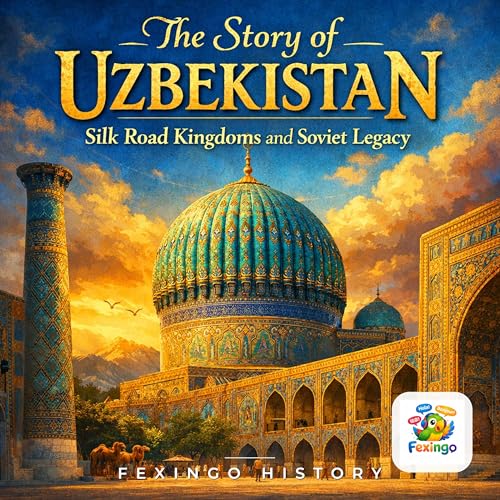
The Story of Uzbekistan: Silk Road Kingdoms and Soviet Legacy — Fexingo History cover art

The Story of Uzbekistan: Silk Road Kingdoms and Soviet Legacy — Fexingo History

The Story of Uzbekistan: Silk Road Kingdoms and Soviet Legacy — Fexingo History

By: Fexingo
Listen for free

In this series, Lucas and Luna journey through the layered history of Uzbekistan, a land where Silk Road caravans once traversed the Kyzylkum Desert and where the blue-tiled domes of Registan Square still echo the glory of the Timurid Empire. From the Sogdian merchants who thrived under Achaemenid and then Hellenistic rule, to the Arab conquests that brought Islam and the Samanid Renaissance, each episode traces the rise and fall of kingdoms that shaped Central Asian identity. The show delves into the rule of Amir Timur (Tamerlane) in Samarkand, the shaybanid Uzbek khanates, and the brutal Russian imperial expansion in the 19th century. It then tackles the Soviet era: the cotton monoculture that drained the Aral Sea, the jadid reformist movement, and the legacy of Stalin’s purges. Post-independence, the hosts explore the authoritarian nation-building under Islam Karimov, the revival of Silk Road tourism, and simmering tensions in the Fergana Valley. Through primary sources like Babur’s memoirs and Soviet secret police files, Lucas and Luna ask: Can a nation balance its Timurid heritage with its Soviet scars? And what does the future hold for this crossroads of empires? #Uzbekistan #SilkRoad #TimuridEmpire #SamanidDynasty #SovietUnion #CentralAsia #RegistanSquare #JadidMovement #AralSea #Babur #IslamKarimov #Khiva #Bukhara #Samarkand #History #WorldHistory #FexingoHistory #Podcast Keep every episode free: buymeacoffee.com/fexingo© 2026 Fexingo. All rights reserved. Hourly Social Sciences World
Episodes
  • The Silk Road's Most Famous Spice: Uzbekistan's Saffron
    Jul 4 2026
    Saffron — the world's most expensive spice — was once a major product of Uzbekistan's Silk Road cities. In this episode, Lucas and Luna explore how Samarkand and Bukhara became hubs of saffron cultivation and trade from the 8th century onward. They trace the plant's journey from Sassanid Persia to Central Asia, its role in Timurid cookery and medicine, and its sudden disappearance after the Mongol invasions. Along the way, they uncover a 10th-century Arab geographer's description of Samarkand's saffron, a 14th-century recipe from the court of Amir Timur, and the modern revival of saffron farming in the Ferghana Valley. The conversation also touches on the spice's use in Uzbek pilaf today and the surprising connection between saffron and the Samanid Renaissance. This episode is a fragrant slice of daily life on the Silk Road that hasn't been covered in earlier shows. #Saffron #Uzbekistan #SilkRoad #Samarkand #Bukhara #Timurid #Samanid #FerghanaValley #SpiceTrade #MedievalCuisine #AmirTimur #AbuRayhanBiruni #IbnHauqal #Pilaf #History #FexingoHistory #CentralAsia #CulinaryHistory Keep every episode free: buymeacoffee.com/fexingo
    Show More Show Less
    6 mins
  • The Tashkent Metro: Soviet Architecture Under Uzbekistan's Streets
    Jul 4 2026
    When the 1966 earthquake leveled much of Tashkent, the Soviet government rebuilt the city with an ambitious project: a metro system that would double as a propaganda showcase. This episode takes you underground through the Tashkent Metro, opened in 1977, to explore its stunning stations—each designed as a 'palace for the people' with chandeliers, marble, mosaics, and murals extolling Soviet values. We discuss how the metro served as both a functional transit system and a Cold War prestige project, with stations named after cosmonauts, revolutionary heroes, and abstract concepts like 'Druzhba' (Friendship) and 'Komsomolskaya.' We also look at the shift after independence, when stations were renamed and redesigned to reflect Uzbek national identity. Along the way, we touch on construction challenges, the role of Uzbek labor, and what the metro means for Tashkent residents today. This episode is a microcosm of Soviet urban planning, Cold War rivalries, and post-Soviet reclamation. #TashkentMetro #Uzbekistan #SovietArchitecture #ColdWar #1966Earthquake #Tashkent #MetroArt #CentralAsia #Propaganda #SovietUnion #PalaceForThePeople #Druzhba #Komsomolskaya #Cosmonauts #UzbekIdentity #PostSoviet #History #FexingoHistory Keep every episode free: buymeacoffee.com/fexingo
    Show More Show Less
    5 mins
  • Alisher Navoi: The Poet Who Shaped Uzbek Language and Identity
    Jul 3 2026
    In this episode of The Story of Uzbekistan, Lucas and Luna explore the life and legacy of Alisher Navoi, the 15th-century poet, statesman, and Sufi philosopher who elevated the Chagatai Turkic language to a literary powerhouse. They discuss Navoi's role in the Timurid Renaissance under Sultan Husayn Bayqara in Herat, his rivalry with the Persian poet Jami, and his monumental works like Khamsa and Muhakamat al-Lughatayn, which argued for Turkic's superiority over Persian in poetry. The episode delves into Navoi's patronage of architecture, including the construction of madrasas and khanqahs, and his influence on modern Uzbek national identity, from Soviet-era canonization to contemporary cultural revival. Lucas also touches on the controversial aspects of Navoi's legacy, such as his involvement in court politics and the suppression of the Hurufi sect. Listeners will gain a nuanced understanding of how one man's pen shaped the linguistic and cultural contours of Central Asia. #AlisherNavoi #ChagataiLanguage #TimuridRenaissance #UzbekPoetry #SufiLiterature #Herat #SultanHusaynBayqara #Jami #Khamsa #MuhakamatAlLughatayn #UzbekIdentity #CentralAsia #PersianInfluence #NavoiLegacy #FexingoHistory #History #Podcast #Uzbekistan Keep every episode free: buymeacoffee.com/fexingo
    Show More Show Less
    9 mins
adbl_web_anon_alc_button_suppression_t1
No reviews yet