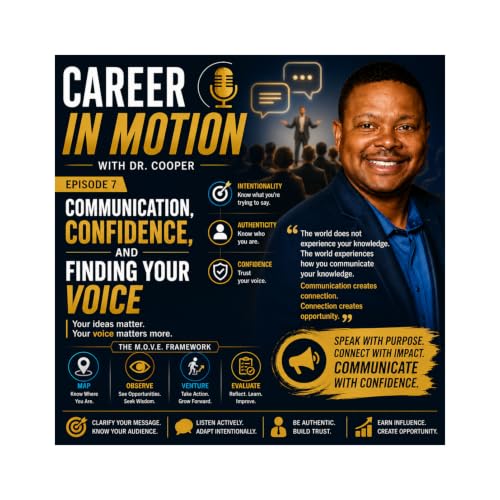
Career in Motion with Dr. Cooper cover art

Career in Motion with Dr. Cooper

Career in Motion with Dr. Cooper

By: Dr. James Cooper
Listen for free

A practical and developmental podcast helping students and professionals build careers through strategic action, reflection, movement, confidence, and adaptability.

James Cooper
Career Success Economics
Episodes
  • Communication, Confidence, and Finding Your Voice | Careers in Motion with Dr. Cooper
    Jun 26 2026

    Episode 7 – RSS Show Notes

    Dr. Cooper explores one of the most important professional skills:

    Communication

    Not simply public speaking.

    Not simply presentations.

    Not simply email.

    Communication is how your experiences, knowledge, skills, and ideas come alive in other people's minds.

    You can have tremendous expertise, experience, and credentials. But if you cannot communicate, the world may never fully understand the value you bring.

    As Dr. Cooper explains:

    Communication is not simply talking. Communication is translation.

    It is the ability to take what is in your mind and intentionally help another person understand it.

    Every interaction involves:

    • a sender
    • a message
    • an audience
    • context
    • perceptions
    • noise
    • interpretation
    • feedback

    Communication is wonderfully messy.

    Within the M.O.V.E. framework, communication falls under:

    E = Evaluate

    Great communicators are constantly evaluating.

    They ask:

    • Am I being understood?
    • Does this message fit my audience?
    • What feedback am I receiving?
    • Should I pivot?
    • Is my message landing?

    Communication, like career movement, requires adaptation.

    The episode also explores three essential ingredients of effective communication:

    • Intentionality
    • Authenticity
    • Confidence

    Listeners are reminded that communication is about connecting.

    Dr. Cooper also challenges the idea that communication is a natural talent, but a developmental skill that can be practiced and improved through:

    • message organization
    • tone
    • delivery
    • listening
    • presence
    • persuasiveness
    • feedback
    • reflection

    At the center of the episode is an important realization:

    The world does not experience your knowledge. The world experiences how you communicate your knowledge.

    Listeners become more intentional, authentic, and confident communicators in their everyday interactions.

    Key Topics Discussed

    • Why communication is a critical career skill
    • Communication as translation and connection
    • The communication process and its complexities
    • Intentionality, authenticity, and confidence
    • Communication as a developmental skill
    • The importance of feedback and adaptation
    • Presence, delivery, and persuasiveness
    • Communication and career movement

    Listener Takeaways

    • Communication is much more than speaking.
    • Great communicators continuously evaluate and adapt.
    • Confidence in communication is built, not inherited.
    • Communication improves through practice and reflection.
    • Intentionality and authenticity matter more than perfection.
    • Listening is just as important as speaking.
    • Strong communication creates connection, trust, and opportunity.

    Career in Motion Challenge

    Choose one communication interaction this week.

    After it is over, spend five minutes reflecting:

    • What was my intended message?
    • Was I understood?
    • Did I adapt to my audience?
    • What feedback did I observe?
    • What would I do differently next time?

    Repeat this process for one week.

    Then ask yourself:

    “Am I becoming more intentional, authentic, and confident in my communication?”

    Show More Show Less
    18 mins
  • When Opportunities Quietly Appear | Career in Motion with Dr. Cooper
    Jun 13 2026

    Episode Description / RSS Show Notes

    Welcome back to Career in Motion with Dr. Cooper — a podcast about careers, confidence, strategy, and movement.

    In Episode 6, Dr. Cooper explores one of the most overlooked yet powerful skills in career development:

    Opportunity Recognition

    Many people spend the early stages of their careers chasing opportunities: jobs, promotions, credentials, and experiences. But over time, something begins to shift.

    Opportunities do not necessarily become more abundant.

    We become better at seeing them.

    As Dr. Cooper explains:

    “Many opportunities do not arrive with a spotlight on them. Sometimes opportunities quietly appear through observation, conversations, timing, awareness, and preparation.”

    This episode explores why opportunities are often misunderstood. Opportunities do not always mean a new job, more money, or a promotion.

    They are hidden within relationships, conversations, projects, problems, responsibilities, learning experiences, and quietly reappearing patterns.

    Dr. Cooper introduces Eleven Ways Opportunities Tend to Appear:

    • Consensus Among Others
    • Necessity
    • Anxiety
    • Avoiding the Obvious
    • Fear of Letting Yourself Down
    • Pattern Recognition
    • Deliberate Planning
    • Expectations
    • Going for the Improbable
    • Passion
    • Persistence

    Through personal stories and reflections, listeners are challenged to think differently about how opportunities materialize and why some people recognize them while others walk right past them.

    At the center of the episode is an important realization:

    The rewards of recognizing and seizing opportunities often lag the moment of opportunity itself.

    Opportunity recognition is not luck; it's a skill.

    The episode closes with a practical challenge designed to help listeners identify opportunities that may already be quietly operating in their current roles and lives.

    Key Topics Discussed

    • What opportunity recognition means
    • Why opportunities often appear quietly
    • The difference between chasing opportunities and recognizing opportunities
    • Why opportunities are more than jobs and promotions
    • Eleven ways opportunities tend to materialize
    • Pattern recognition and awareness
    • Passion and persistence as opportunity catalysts
    • The role of preparation and timing
    • Creating an Opportunity Recognition Map
    • How awareness changes careers

    Listener Takeaways

    • Opportunities often emerge through observation and preparation
    • Rewards frequently lag the moment of opportunity
    • Opportunity recognition is a learnable workplace skill
    • Relationships and conversations can become significant opportunities
    • Patterns and recurring themes deserve attention
    • Courage often precedes confidence

    Career in Motion Challenge

    Create your own Opportunity Recognition Map.

    Step 1:

    Write down the eleven opportunity principles discussed in the episode.

    Step 2:

    Identify one example of each from your own career, education, or personal life.

    Step 3:

    Determine which principle may be quietly operating in your current role right now.

    Step 4:

    Take one action this week that moves you toward that opportunity.

    Then ask yourself:

    “What opportunity is quietly appearing in my life that I have not fully recognized yet?”

    Show More Show Less
    20 mins
  • Confidence Comes from Movement, Specifically Consistency | Career in Motion with Dr. Cooper
    Jun 9 2026

    Episode Description / RSS Show Notes

    Welcome back to Career in Motion with Dr. Cooper — a podcast about careers, confidence, strategy, and movement.

    In Episode 5, Dr. Cooper explores a topic that many professionals misunderstand:

    Where does confidence actually come from?

    Many people assume confidence comes from credentials, titles, achievements, status, or recognition. While those things may influence confidence, Dr. Cooper argues that true confidence is often built somewhere much simpler:

    Confidence comes from movement. Specifically, consistency.

    Drawing from personal experiences, reflections on career setbacks, and lessons learned throughout his professional journey, Dr. Cooper discusses how confidence is often the byproduct of repeatedly showing up, doing the work, and continuing to move forward, even when no one is watching.

    The episode explores three guiding principles that have influenced his life:

    • Let no one define your story.
    • Stay curious and question assumptions.
    • Keep moving forward, especially when things do not go your way.

    Dr. Cooper also shares a powerful insight inspired by a story about Arnold Schwarzenegger, who described success not in terms of outcomes, but in terms of showing up and completing the work.

    Sometimes the win is not the result.

    Sometimes the win is simply:

    • doing the work
    • taking the step
    • showing up
    • maintaining consistency

    Within the M.O.V.E. philosophy, this episode focuses on the relationship between:

    Movement → Activity → Consistency → Confidence

    Listeners are encouraged to think differently about confidence as repeated intentional behavior over time.

    The episode also explores:

    • self-efficacy
    • self-trust
    • self-esteem
    • personal accountability
    • consistency as a professional skill

    At the center of the conversation is one important realization:

    “Self-confidence is trust in yourself”

    Key Topics Discussed

    • The relationship between movement and confidence
    • Why confidence is often misunderstood
    • Self-efficacy and self-trust
    • Consistency as a professional advantage
    • Building momentum through repeated action
    • Accountability and discipline
    • Daily wins and long-term growth
    • The role of intentional activity in career development

    Listener Takeaways

    • Confidence is often built through action rather than waiting for certainty
    • Consistency creates momentum and self-trust
    • Small daily wins compound over time
    • Self-efficacy grows through repeated practice
    • Professional confidence is connected to reliability and follow-through
    • Movement and activity help restore motivation during difficult periods
    • Career growth often comes from doing the work when no one is watching

    Career in Motion Challenge

    This week's Career in Motion Challenge:

    • Identify one skill, responsibility, or task you consistently avoid.
    • Ask yourself why you avoid it.
    • Break it into one small daily action.
    • Commit to doing that action every workday for two weeks.

    Then reflect:

    • Do you feel more capable?
    • Do you feel more confident?
    • Has the task become easier?
    • Has your perception of yourself changed?

    Finally, ask yourself:

    “Was my confidence waiting for success, or was my confidence built through consistency?”

    Show More Show Less
    19 mins
adbl_web_anon_alc_button_suppression_t1
No reviews yet