• BITESIZE | How Your Smartphone Is Changing Your Brain, Focus & Mental Health | Dr Anders Hansen #657
    May 14 2026
    A topic that I’m truly passionate about is the introduction of social media and smartphones into all aspects of our lives - changing the way we think, feel and connect with one another. Feel Better Live More Bitesize is my weekly podcast for your mind, body, and heart. Each week I’ll be featuring inspirational stories and practical tips from some of my former guests. Today’s clip is from episode 381 of the podcast with psychiatrist, globally renowned speaker, and best-selling author Dr Anders Hansen. In this clip, he explains how our attention has become one of the most valuable commodities in today’s world, why our devices are designed to keep us hooked, and he shares some simple ways we can begin to take back control and reconnect with what really matters. Thanks to our sponsor ⁠⁠⁠https://drinkag1.com/livemore Show notes and the full podcast are available at drchatterjee.com/381 Support the podcast and enjoy Ad-Free episodes. Try FREE for 7 days on Apple Podcasts ⁠⁠https://apple.co/feelbetterlivemore⁠⁠ For other podcast platforms go to ⁠⁠https://fblm.supercast.com. DISCLAIMER: The content in the podcast and on this webpage is not intended to constitute or be a substitute for professional medical advice, diagnosis, or treatment. Always seek the advice of your doctor or other qualified health care provider with any questions you may have regarding a medical condition. Never disregard professional medical advice or delay in seeking it because of something you have heard on the podcast or on my website.
    Show More Show Less
    19 mins
  • How To Recover From Burnout (It’s Not What You Expect) with Pippa Grange #656
    May 12 2026
    What if burnout isn't a sign that something is broken in you, but a sign that something needs to change? That's the question at the heart of this conversation – and it’ll shift the way you think about your energy, your career, and how you’re spending your one life. My guest is Pippa Grange, the renowned psychologist, performance coach, and author of Life Reclaimed. Pippa spent 25 years working with the highest performers in the world of business and sport (including her famous stint with the England football team). But her wisdom today is for all of us – particularly anyone who feels like they’re running on empty, or that the way they’re living isn’t working for them anymore. We begin by talking about why overperformance is so prevalent these days, and why it’s not a personal failing but a cultural shift. Pippa describes burnout as something that happens when life’s pace and pressure outweighs our ability to cope. We overperform at work, at home, even socially – and we’ve forgotten what balance looks like. The solution? Her framework of ‘regenerative performance’, built around a simple but powerful cycle: perform, rest, renew. And if that sounds familiar, it’s because it’s happening right in front of us every day – in nature. For Pippa, nature is the most intelligent model we have for sustainable human performance. After all, we’re a part of the natural world – and it’s moving away from these instinctive, biological cycles that has led to our collective burnout. Fortunately, she’s developed four core principles to guide us from overperformance into regenerative performance. They’re all about listening to the intelligence of the body rather than overriding it; tuning into our natural selves to develop sustainable patterns. And she brings the principles to life with practical tools you can use straight away, including a simple midday check-in that takes under a minute – and that I’ll definitely be incorporating into my day. This is a really important conversation, which offers a valuable, viable alternative to giving up. Follow Pippa’s advice and you can reconnect with your natural cycles. You can make meaningful change from within your life, rather than trying to escape it. It’s time to stop pushing through and start reclaiming the life you were meant to lead. The Thrive Tour: Transform Your Health and Happiness, a live show: Book Your Tickets https://drchatterjee.com/live Thanks to our sponsors: https://dohealth.co/livemore https://thewayapp.com/livemore https://boncharge.com/livemore Show notes https://drchatterjee.com/656 DISCLAIMER: The content in the podcast and on this webpage is not intended to be a substitute for professional medical advice, diagnosis, or treatment. Always seek the advice of your doctor or qualified healthcare provider. Never disregard professional medical advice or delay in seeking it because of something you have heard on the podcast or on my website.
    Show More Show Less
    1 hr and 43 mins
  • BITESIZE | How to Sleep Better, Get More Energy & Improve Your Mental Wellbeing | Dr Kristen Holmes #655
    May 7 2026
    In our hyper-connected modern world, where we have access to artificial light and food around the clock, we’ve drifted far from our body’s natural rhythms. But what if reconnecting with these internal clocks could be the key to unlocking better health, and more energy? Feel Better Live More Bitesize is my weekly podcast for your mind, body, and heart. Each week I’ll be featuring inspirational stories and practical tips from some of my former guests. Today’s clip is from episode 479 of the podcast with Global Head of Human Performance and Principal Scientist at WHOOP, Dr Kristen Holmes. In this clip, we discuss practical strategies for harmonising our circadian rhythms in the context of modern life. Kristen explains how factors like late meals and irregular routines can disrupt your body’s natural rhythms, and shares some simple changes that can make a real difference. This episode is packed with actionable insights, and I hope it leaves you feeling empowered to take control of your daily rhythms and experience the transformative effects on your health. For Thrive Tour tickets and info visit: https://drchatterjee.com/live/ Show notes and the full podcast are available at drchatterjee.com/479 Support the podcast and enjoy Ad-Free episodes. Try FREE for 7 days on Apple Podcasts ⁠⁠https://apple.co/feelbetterlivemore⁠⁠ For other podcast platforms go to ⁠⁠https://fblm.supercast.com. DISCLAIMER: The content in the podcast and on this webpage is not intended to constitute or be a substitute for professional medical advice, diagnosis, or treatment. Always seek the advice of your doctor or other qualified health care provider with any questions you may have regarding a medical condition. Never disregard professional medical advice or delay in seeking it because of something you have heard on the podcast or on my website.
    Show More Show Less
    27 mins
  • Why Creativity Is The Most Powerful Health Tool You’re Not Using with Professor Daisy Fancourt #654
    May 5 2026
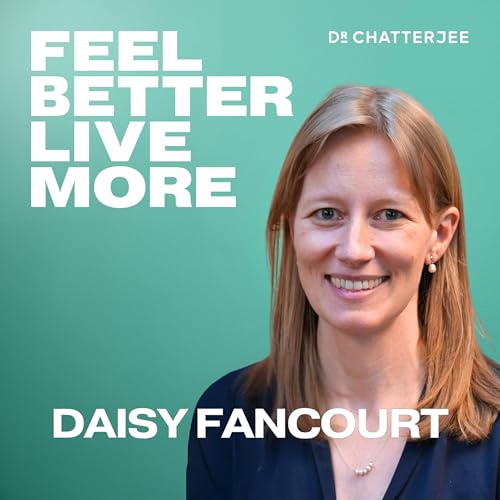
    Most of us know that nutrition, movement and sleep are key pillars of health. But what if I told you that creativity belongs in the same conversation – and the science to prove it has been mounting up for decades? Professor Daisy Fancourt, one of the world’s leading health researchers, has uncovered a wealth of evidence linking engagement with the arts to improved mental and physical health. It’s all collected in her wonderful book, Art Cure, and I only wish it had existed as required reading when I was a medical student. Daisy agrees it’s been a ‘bizarrely well-kept secret’. We think of creative pursuits – music, theatre, dancing, arts and crafts – as ‘nice to haves’ but not necessary parts of life. But she believes a public awareness shift is on the horizon. Just as we’ve come to understand that exercise is an essential component of health, so too will we realise that ‘art as medicine’ is a scientific fact – one to be prescribed not ignored. It’s quite the promise – and a really exciting one to consider. Because for most of us, the arts represent enjoyment. So this health advice could be the easiest and most pleasurable you’ve ever followed! During this conversation Daisy and I discuss what engaging with the arts really means, and why it differs from non-creative, relaxing activities. We talk about the rise in screen-based ‘junk’ art, and why the post-pandemic continuum of virtual experiences can’t match real-world ones. And we explore how the arts tick lots of wellbeing boxes, from arousing nostalgia to firing the imagination, building confidence and communities to getting us moving. Most of us instinctively get it: the creative side of life is good for us. The science behind it though, is extraordinary. From lowering blood pressure to slowing biological ageing, reducing dementia risk to lowering inflammation, these aren’t small effects. Engaging with the arts has even been shown to cut older adults' risk of dying by 31 percent. Yet none of this has made it into mainstream health conversations – until now. There is so much packed into this joyous episode, from the surprising power of music to the unique combination of benefits that come from dancing. Daisy also shares some original ways to incorporate the arts into your life more – you’ll never think of your five a day, or your commute, in the same way again. We’re born creative and embrace it in childhood, but I think we stop prioritising it as adults. This conversation will kickstart it again. Support the podcast and enjoy Ad-Free episodes. Try FREE for 7 days on Apple Podcasts https://apple.co/feelbetterlivemore. For other podcast platforms go to https://fblm.supercast.com. Thanks to our sponsors: https://dohealth.co/livemore https://heights.com/livemore https://drinkag1.com/livemore Show notes https://drchatterjee.com/654 DISCLAIMER: The content in the podcast and on this webpage is not intended to be a substitute for professional medical advice, diagnosis, or treatment. Always seek the advice of your doctor or qualified healthcare provider. Never disregard professional medical advice or delay in seeking it because of something you have heard on the podcast or on my website.
    Show More Show Less
    1 hr and 31 mins
  • BITESIZE | How To Become Less Reactive & Cultivate A Deep Sense Of Calm | Jonny Miller #653
    Apr 30 2026
    Many of us are living with chronically dysregulated nervous systems, yet we mistake this reactive state for normal. Research suggests that our nervous system acts as a lens through which we experience reality. But when that lens is out of balance, we start to see threats where none exist, and respond in an exaggerated way to everyday situations. Today’s clip is from episode 569 of the podcast with Jonny Miller - founder of Nervous System Mastery, a 5-week bootcamp where he has taught over a thousand students how to cultivate calm, rewire reactivity and restore aliveness. In this clip he shares why learning to work with your body can change how you respond to stress, reduce reactivity, and help you move from overwhelm to calm. Thanks to our sponsor ⁠⁠⁠https://drinkag1.com/livemore Show notes and the full podcast are available at https://drchatterjee.com/569 Support the podcast and enjoy Ad-Free episodes. Try FREE for 7 days on Apple Podcasts ⁠⁠https://apple.co/feelbetterlivemore⁠⁠ For other podcast platforms go to ⁠⁠https://fblm.supercast.com. DISCLAIMER: The content in the podcast and on this webpage is not intended to constitute or be a substitute for professional medical advice, diagnosis, or treatment. Always seek the advice of your doctor or other qualified health care provider with any questions you may have regarding a medical condition. Never disregard professional medical advice or delay in seeking it because of something you have heard on the podcast or on my website
    Show More Show Less
    21 mins
  • Why You Can’t Stop Eating Sugar And Ultra Processed Foods with Dr Jen Unwin #652
    Apr 28 2026
    Ever wondered why you can’t stop at just one biscuit? Or why your efforts to eat better go so well for a few days, but you’re soon back where you started – frustrated, ashamed and wondering what’s wrong with you? This episode has the answers you need, along with a roadmap for regaining control. I’m speaking with Dr Jen Unwin, a clinical psychologist who has struggled with and overcome food addiction. And if you’re thinking ‘I didn’t think that was a thing’ then stay tuned for the facts that will convince you otherwise. Over decades trying to understand her own relationship with food, Jen discovered that for a significant number of people, a compulsive habit around sugar and ultra-processed foods is real and damaging. In this enlightening conversation, she explains how sugar lights up the same reward centres in the brain as nicotine and alcohol. And how our hunter-gatherer ancestors may not have needed an ‘off switch’ for eating, but our modern food industry makes it almost impossible for vulnerable people to say no. The research is strong – and Jen is part of a charity campaigning to have food addiction formally recognised by the World Health Organization. That way millions of people would be able to get help from their doctors, in the same way as people with drug and alcohol misuse disorders – instead of being dismissed for a lack of discipline or willpower. Many of us get cravings or have a fondness for sweet or ‘blissy’ foods. So when does that tip into addiction? Jen shares a clever, six-point, self-assessment tool called CRAVED, which you can use right now to understand whether your relationship with food might be problematic. And we get super practical, with advice on whether cutting down or going cold turkey is right for you, how to handle social situations when everyone around you is indulging, and how to set up your home environment for success. Whether you score one or six on the CRAVED scale, I’m certain there’s something in this conversation for everyone. And if you’re someone who has been battling this quietly, perhaps feeling ashamed or hopeless, I honestly believe Jen’s message might mark a turning point for you – one that helps you see a way forward. Fill out our audience survey via https://drchatterjee.com/survey Support the podcast and enjoy Ad-Free episodes. Try FREE for 7 days on Apple Podcasts https://apple.co/feelbetterlivemore. For other podcast platforms go to https://fblm.supercast.com. Thanks to our sponsors: https://dohealth.co/livemore https://thesleepreset.com/podcast https://boncharge.com/livemore Show notes https://drchatterjee.com/652 DISCLAIMER: The content in the podcast and on this webpage is not intended to be a substitute for professional medical advice, diagnosis, or treatment. Always seek the advice of your doctor or qualified healthcare provider. Never disregard professional medical advice or delay in seeking it because of something you have heard on the podcast or on my website.
    Show More Show Less
    2 hrs and 1 min
  • BITESIZE | The Truth About Caffeine with Neuroscientist Dr Tommy Wood #651
    Apr 23 2026
    Today’s guest, like myself, is passionate about empowering individuals to take control of their health by simplifying the wealth of information that exists and giving people practical, realistic recommendations. Feel Better Live More Bitesize is my weekly podcast for your mind, body, and heart. Each week I’ll be featuring inspirational stories and practical tips from some of my former guests. Today’s clip is from episode 404 of the podcast with Dr Tommy Wood. Tommy is Assistant Professor of Paediatrics and Neuroscience at the University of Washington, US. In this clip, we aim to cut through some of the confusion about caffeine, including how it may affect your energy, focus, sleep, stress levels and even performance in ways you may not expect. We discuss why caffeine isn’t simply ‘good’ or ‘bad’, why timing and dose matter, and how finding what works for you may be the most important thing of all. Thanks to our sponsor ⁠⁠⁠https://thewayapp.com/livemore Show notes and the full podcast are available at drchatterjee.com/404 Support the podcast and enjoy Ad-Free episodes. Try FREE for 7 days on Apple Podcasts ⁠⁠https://apple.co/feelbetterlivemore⁠⁠ For other podcast platforms go to ⁠⁠https://fblm.supercast.com. DISCLAIMER: The content in the podcast and on this webpage is not intended to constitute or be a substitute for professional medical advice, diagnosis, or treatment. Always seek the advice of your doctor or other qualified health care provider with any questions you may have regarding a medical condition. Never disregard professional medical advice or delay in seeking it because of something you have heard on the podcast or on my website.
    Show More Show Less
    16 mins
  • How To Stop Limiting Yourself And Liberate Your Full Potential with Nir Eyal #650
    Apr 21 2026
    This podcast could change the way you think about every goal you’ve set, every relationship you’re struggling with – and every story you tell yourself about what you’re capable of. It all comes down to something most of us have never thought to question: our beliefs. And what you’ll hear in this conversation might be the most practical, liberating idea you come across all year. I’m speaking with Nir Eyal, the bestselling author of Hooked and Indistractable, whose powerful new book Beyond Belief draws on years of research into the psychology of why we limit ourselves – and how to stop. Nir opens the conversation with a striking claim: human beings never perceive reality as it truly is. Our brains filter everything through our existing beliefs and expectations, and most of the time, we have no idea it’s happening. The good news? Once you understand this, you can start choosing beliefs that actually work for you. In this conversation, we explore why persistence – not talent or intelligence – is the number one predictor of whether you’ll reach your goals. Nir reveals the crucial difference between pain and suffering, including the astonishing story of a man who underwent surgery without anaesthetic and felt no suffering at all. We talk about why positive thinking may not be the motivator you think it is, and what the research says you should do instead. And Nir shares his crucial insight that beliefs are tools, not truths. So we can choose which to adopt based on whether they serve us. Nir shares some personal stories of how he’s used his tools to lose weight, repair relationships and reframe his ADHD diagnosis as a skills gap not a debilitating condition. But what you’ll love most about listening is the clear, practical framework he gives us for doing the same. You’ll learn how to spot the beliefs that are draining you and ask, could the opposite be true, even just for a while? Whether you’re navigating a health challenge, a difficult relationship, a career crossroads, or just that nagging voice telling you it’s too late, tune in for the solution. It’s never too late to swap limiting beliefs for ones that liberate you instead. Fill out our audience survey via https://drchatterjee.com/survey Support the podcast and enjoy Ad-Free episodes. Try FREE for 7 days on Apple Podcasts https://apple.co/feelbetterlivemore. For other podcast platforms go to https://fblm.supercast.com. Thanks to our sponsors: https://dohealth.co/livemore https://thewayapp.com/livemore Show notes https://drchatterjee.com/650 DISCLAIMER: The content in the podcast and on this webpage is not intended to be a substitute for professional medical advice, diagnosis, or treatment. Always seek the advice of your doctor or qualified healthcare provider. Never disregard professional medical advice or delay in seeking it because of something you have heard on the podcast or on my website.
    Show More Show Less
    1 hr and 50 mins