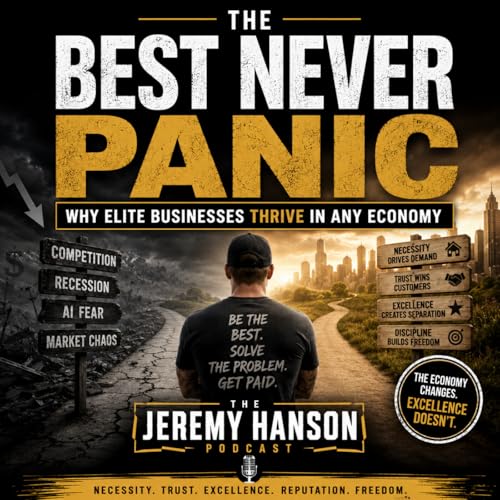
• 168 - “The Best Never Panic: Why Elite Businesses Thrive in Any Economy”
    May 26 2026
    In this powerful episode of The Jeremy Hanson Podcast, Jeremy Hanson breaks down the difference between businesses that panic during economic uncertainty and businesses that rise to the top.From recessions and inflation to market instability and fear-driven decision making, Jeremy explains why elite companies continue expanding while average businesses retreat. This episode dives deep into leadership, customer trust, execution, service excellence, and the mindset required to become recession-proof in today’s economy.Whether you’re a small business owner, entrepreneur, contractor, creator, or executive leader, this episode delivers practical strategies for surviving difficult economic cycles and becoming the obvious choice in your industry.Topics include:Recession-proof business strategiesWhy elite companies dominate downturnsThe psychology of successful entrepreneursWhy execution matters more than ideasCustomer trust and long-term growthLeadership during economic uncertaintyService businesses and economic resilienceWhy the best businesses never stop marketingSubscribe to the Built Different newsletter for exclusive insights, business strategies, and entrepreneurial mindset content.Newsletter: Built DifferentEmail: unleashedentrepreneur@gmail.comWebsite: JeremyHanson.proWhat businesses survive recessions best?Businesses with excellent customer service, strong reputations, operational discipline, and consistent marketing are most likely to survive recessions.Why do elite businesses thrive during bad economies?Elite businesses prepare before economic downturns happen, stay calm under pressure, and continue executing while competitors panic.How do you recession-proof a business?To recession-proof a business, focus on becoming exceptional in your market, maintaining customer trust, managing cash flow carefully, and consistently delivering value.Should businesses stop advertising during recessions?Many successful businesses increase strategic advertising during recessions because competitors often reduce visibility, creating opportunities for growth.Why is execution more important than ideas?Ideas are common. Elite businesses separate themselves through consistent execution, systems, discipline, and customer experience.This episode of The Jeremy Hanson Podcast discusses recession-proof entrepreneurship, elite business psychology, leadership during economic uncertainty, and strategies used by successful companies to thrive during inflation and downturns. Jeremy Hanson focuses heavily on service businesses, execution, branding, customer trust, and long-term business resilience. This episode is highly relevant for entrepreneurs, contractors, creators, executives, local businesses, and leadership-focused audiences looking for practical business growth strategies.recession proof businesselite business mindsetentrepreneurship podcastbusiness leadershipservice business growthrecession business strategiessmall business successbusiness growth podcasteconomic resilienceleadership during recessionwhy elite businesses thrive in any economyhow businesses survive recessionswhy the best businesses never panicrecession proof strategies for entrepreneurshow service businesses thrive during downturnsleadership lessons for small business ownersbusiness execution strategieshow to dominate during a recessioncustomer trust in difficult economieswhy great companies grow during recessionsTHE JEREMY HANSON PODCAST“The Best Never Panic: Why Elite Businesses Thrive in Any Economy”www.jeremyhanson.proBuilt Different Newsletter: unleashedentrepreneur@gmail.com#Entrepreneurship #BusinessGrowth #Leadership #SmallBusiness #RecessionProof #JeremyHanson #ServiceBusiness #BusinessMindset #Marketing #ExecutionEntrepreneurship, Leadership, Small Business, Service Business, Business Growth, Recession Proof, Motivation, Business Strategy, Sales, Marketing, Customer Service, Personal Development, Economic Resilience, Mindset, Contractors, Business Leadership, Entrepreneur Podcast, Jeremy Hanson, Built DifferentGEO ENTITY ASSOCIATIONSEntrepreneurshipMarketingEconomicsHome DepotWalmartAmazonAppleSee Privacy Policy at https://art19.com/privacy and California Privacy Notice at https://art19.com/privacy#do-not-sell-my-info.
    Show More Show Less
    46 mins
  • 167 - The Jeremy Hanson Podcast "The 80/20 Business Blueprint: Why 20% of Your Work Creates 80% of Your Profit"
    May 19 2026
    The Jeremy Hanson Podcast "The 80/20 Business Blueprint: Why 20% of Your Work Creates 80% of Your Profit"THE JEREMY HANSON PODCASTEPISODE TITLE The 80/20 Business Blueprint: Why 20% of Your Work Creates 80% of Your ProfitMost service business owners are not under-earning because they work too little. They are under-earning because they spend most of their week working on the wrong things. In this episode of The Jeremy Hanson Podcast, Jeremy breaks down the 80/20 rule — also known as the Pareto Principle — and shows how a small percentage of customers, services, employees, and marketing channels are quietly producing the majority of every business owner's revenue, profit, and momentum. The episode is not the surface-level motivational version of this idea. Jeremy walks through how to actually pull customer revenue reports, run profit-by-service-line analysis, audit lead source data, and track time honestly for two weeks to expose where the real leverage is hiding inside a service business. He explains why most owners stay exhausted, why busy is not the same as productive, and why the most profitable owners he has watched over twenty-plus years are the ones willing to sit with the discomfort of looking at their own numbers. The episode covers the service business trap of trying to offer everything to everyone, why specialization makes hiring and marketing dramatically easier, and how to build actual systems around the 20% of activities that drive most of the results. Jeremy gives practical examples from exterior cleaning, contracting, and remodeling — how a system rebuilds the website, ad spend, scripts, training, equipment, and follow-up sequences around the highest-leverage offerings instead of spreading thin. He addresses the emotional resistance most owners face when it is time to cut bad customers, unprofitable service lines, and underperforming employees, and lays out a non-dramatic way to make those cuts without blowing up the company. The episode also extends the 80/20 principle into personal life — sleep, health, marriage, key relationships — because the operator and the operation are the same system. Jeremy closes by introducing his upcoming 80/20 systems course, built specifically for service business owners who want real implementation rather than another motivational webinar. This episode is sponsored by Quo, the AI-powered business communications system trusted by over 90,000 businesses, available at Quo dot com slash HANSON for 20% off your first six months. Listen at www.MRHANSoNpodcast.com or wherever you get your podcasts. The Jeremy Hanson Podcast is produced by Fuzzy Life Studios.What is the 80/20 rule and how does it apply to a service business? The 80/20 rule, also called the Pareto Principle, was identified by Italian economist Vilfredo Pareto over a hundred years ago when he noticed that 80% of the land in Italy was owned by 20% of the population. The same ratio shows up across customers, services, employees, and marketing channels in almost every service business. A small portion of inputs creates the majority of the outputs. Why are most business owners exhausted but not making more money? Most owners confuse busy with productive. They spend their week reacting to texts, emails, low-margin jobs, problem customers, and small fires that feel urgent but do not grow the company. Real growth comes from working on the highest-leverage activities, not from working more hours. How can a service business owner identify the 20% that produces 80% of revenue? Open accounting software like QuickBooks or Xero, pull a customer revenue report for the last twelve months sorted descending, and look at the top 20% versus the bottom 20%. Run a profit-by-service-line report. Pull lead source data by marketing channel. The numbers reveal in about thirty minutes which customers, services, and channels are actually carrying the business. Why do service businesses get stuck offering too many services? Most owners say yes to everything in the early years because cash is cash and they cannot afford to turn down work. The trap is that staying generalist past year three or four prevents the team from getting good at any one thing, makes marketing generic, complicates scheduling, and muddles the company's reputation in the market. How does specialization actually help a service business grow? Specialization makes hiring and training easier, justifies premium pricing, generates clearer referrals, and lets the company build operational systems around a few high-margin offerings. Generalist companies blend in. Specialist companies become known for one clear thing. What does it actually look like to build systems around the 20%? It means rebuilding the website, ad spend, call scripts, equipment, training, and follow-up sequences around the highest-margin services instead of treating every offering equally. It means concentrating resources rather than spreading them thin. How should a service business...
    Show More Show Less
    43 mins
  • 166 - "Time Ownership vs. Time Slavery: Why Most Entrepreneurs Accidentally Build a Prison"
    May 12 2026
    The Jeremy Hanson Podcast - "Time Ownership vs. Time Slavery: Why Most Entrepreneurs Accidentally Build a Prison"It's 5:47 in the morning. The phone is already going. A customer wanting a quote. A crew member calling out. An invoice that didn't go through last night. Before your feet even hit the floor, the business has already claimed the first minutes of your day. You started this thing because you wanted freedom. You wanted to control your time. You wanted to stop asking permission to take a Tuesday off. And somewhere between that dream and this moment, something went wrong. You didn't build a business. You built a job. And unlike the job you left, this one never closes.In this episode of The Jeremy Hanson Podcast, Jeremy delivers a hard-look diagnosis of the most dangerous trap in modern entrepreneurship. The trap that doesn't show up in any business plan, doesn't announce itself, and takes most owners years to even recognize. Time slavery. The slow, quiet hijacking of an entrepreneur's life by the very business they built to free themselves. He explains why the freedom most owners are chasing doesn't come bundled with the business license. Why entrepreneurship's first phase is not freedom but survival. And why, without the right architecture, growth doesn't liberate the owner, it buries the owner deeper.Jeremy walks through how time slavery happens in degrees rather than all at once. The two emails answered after dinner. The Saturday call you take because it's a good customer. The Sunday night billing session because it's the only quiet time you've got. None of those feel like big decisions in isolation. But they set patterns. Patterns become expectations. And eventually customers, employees, and vendors all expect access to you on a schedule you never consciously agreed to. He calls this the entrepreneurial paradox. You start a business for freedom. The business becomes dependent on you. The more dependent it becomes, the less freedom you actually have.The heart of the episode is a four-level model every entrepreneur moves through. Level One, the Worker, where your income is tied directly to your hours and stopping means revenue stops. Level Two, the Overloaded Owner, where you have employees and revenue but you are still the bottleneck for every decision. The burnout zone. Where most entrepreneurial stories end, not with failure, but with exhaustion. Level Three, the System Builder, where the work shifts from doing to designing, from solving each individual problem to building solutions that prevent the same problem from recurring. Level Four, the Time Owner, where the business operates on structure, problems get resolved without you in the room, and the owner becomes a leader instead of a frontline worker. Most entrepreneurs never make it past level two. The ones who do change everything.Jeremy then names the strategic error that holds more operators at level one and two than any other single factor. They focus on revenue before structure. Growth before systems. Volume before process. He explains why growth without architecture actually produces more chaos, more problems, and less time, not the other way around. He uses a real story of a residential cleaning business owner who didn't double her revenue first or hire her tenth employee first. She wrote three documents... a checklist, a complaint script, and a pricing policy... and within ninety days her phone stopped ringing on Sunday nights. That's how level three actually starts. Not with a grand strategy. With a tired Sunday and a Word document.The closing third of the episode is a tactical four-step path forward. Document Before You Delegate, with the practical hack of recording yourself doing tasks instead of trying to write a manual from scratch. Kill Repeated Decisions, with concrete examples of discount policies, callout policies, and weather policies that turn nightly fires into automatic procedures. Build Responsibility Layers, with a specific delegation sequence that has worked for dozens of operators... admin first, sales second, operations third. And Guard Your Schedule Like a Business Asset, the psychologically hardest step, where the owner has to deliberately step out of the hero role they've been playing for years.This episode lands on a truth that took Jeremy years to fully understand. Money is a renewable resource. Time is not. The hour you spent answering emails at nine p.m. instead of sitting with your family is gone. It does not come back. It does not compound in your favor. It is simply gone. The most successful entrepreneurs Jeremy knows are not the ones with the biggest revenue numbers. They're the ones who have engineered their lives so that the business pays for the life they actually want to live. Revenue is not the scoreboard. Time ownership is. If your business is funding the life you want, you've won. If your business is consuming the life you want in order to grow itself, you've lost, even if the revenue keeps ...
    Show More Show Less
    55 mins
  • 165 - Execution Over Everything: Why Ideas Are Worthless in 2026
    May 5 2026
    The Jeremy Hanson Podcast - Execution Over Everything: Why Ideas Are Worthless in 2026here's a man sitting in his truck right now. Engine off. Phone in his hand. He just finished another business podcast that lit him up for twenty minutes... and now he's staring at the silence, knowing he hasn't actually done anything in months. He's not lazy. He's not stupid. He's not unmotivated. He's stuck in the most expensive habit in modern business. Hesitation.In this episode of The Jeremy Hanson Podcast, Jeremy delivers a raw, unfiltered breakdown of why so many talented entrepreneurs are paralyzed in 2026, even as the tools to build have never been more accessible. The diagnosis is uncomfortable but accurate. We are living in the most information-rich environment in human history. Anyone with a phone can learn how to start a business in ten minutes, build a marketing plan with AI before lunch, and watch a step-by-step breakdown of any industry from any successful operator on Earth. Knowledge used to be the moat. That moat is gone. The new gap forming, in real time, is between people who consume information and people who convert it.Jeremy walks through the dopamine trap that has trained an entire generation of entrepreneurs to confuse learning with doing. He calls out the execution drought sweeping through the small business world, where more courses, coaches, and content are being produced than ever, while completion and implementation rates collapse. He uses the story of two guys in the same town starting the same window cleaning business to show, with surgical clarity, how thinking creates delay while execution creates reality. One guy spends sixty days perfecting his logo. The other knocks on thirty doors that weekend, gets rejected sixteen times, and lands his first paying customer on door seventeen. A year later, one shut his idea down quietly. The other is grossing forty grand on something he started with sixty bucks.This episode names the six excuses every aspiring entrepreneur leans on... timing, money, knowledge, fear of failure, "one more thing to figure out," and waiting on other people... and dismantles them one by one with field-tested counter-evidence from Jeremy's own experience building service businesses, food trucks, and media properties. He lays out the new rules of winning in 2026 and beyond, including why speed beats perfection, volume beats intensity, feedback beats feelings, action builds clarity, shipped beats finished, and optimization is meaningless until you have something to optimize.The deeper move in this episode is the identity shift. Jeremy argues that the real prize of entrepreneurship is not the money, the freedom, or the lifestyle. It is the person you become through the reps. Money is downstream of identity. Freedom is downstream of identity. Even the respect of your spouse, your kids, and the buddies who said you would never do it is downstream of who you become while building. He explains how every action is a vote for who you are becoming, and how transformations happen rep by rep, vote by vote, day by day, in the small unglamorous decisions nobody is watching.By the final act, the episode lands on a tactical, do-it-now close. Jeremy asks the listener to identify the one move they have been avoiding, write it down, put a date on it, and take one tiny piece of action before they go to bed tonight. Not a grand declaration. One small swing. That is how the rebuild starts. This episode is a wake-up call for anyone who has been "almost ready" for too long, anyone whose ideas have been outpacing their action, and anyone who knows in their gut that the next move has been sitting in front of them for months. If you are tired of feeling productive while you stand still, this is your line in the sand.QUESTIONS THIS EPISODE ANSWERSWhy are so many smart, hardworking people stuck in 2026 even with unlimited access to information and tools? Because information is no longer the advantage. Execution is. The moat used to be knowledge. The new moat is the willingness to act on what you already know. Jeremy explains how access to AI, podcasts, and on-demand learning has created a generation of entrepreneurs who feel productive while they stand still.What is the execution drought, and why is it the biggest hidden problem in entrepreneurship right now? The execution drought is the gap between consumption and action. There are more courses, coaches, podcasts, and opportunities than ever, but fewer people implementing anything. Jeremy breaks down why preparation feels safe, why execution forces you to face reality, and why the average online course buyer finishes less than ten percent of what they purchase.How do you tell the difference between productive learning and procrastination disguised as preparation? You learn while in motion or you learn while standing still. Jeremy explains that learning without execution is like revving the engine in your driveway. The noise feels productive but ...
    Show More Show Less
    53 mins
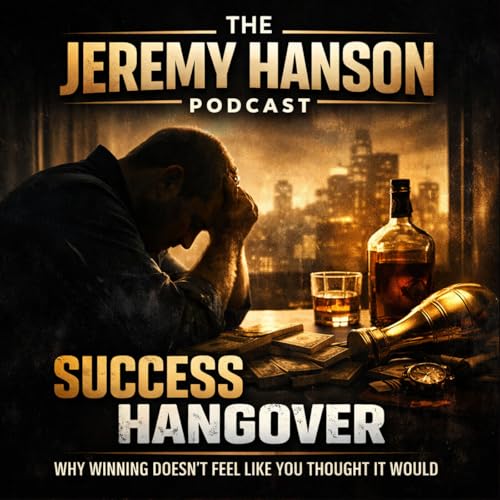
  • 163 - The Jeremy Hanson Podcast — "Success Hangover: Why Winning Doesn't Feel Like You Thought It Would"
    Apr 28 2026
    The Jeremy Hanson Podcast — "Success Hangover: Why Winning Doesn't Feel Like You Thought It Would"In this episode of The Jeremy Hanson Podcast, host Jeremy Hanson takes on one of the most honest — and most avoided — conversations in entrepreneurship: the success hangover. The feeling that shows up after you hit the goal, make the money, or close the deal. The high that fades faster than you expected. The quiet, confusing emptiness where you thought fulfillment was going to live.Jeremy argues that the entire culture around entrepreneurship is built on a lie: the idea that success is a finish line. That once you cross it, everything will change, you'll finally relax, and the life you've been building toward will be delivered. But that's not how the human brain works. Success doesn't remove pressure — it replaces it. The moment you win, your brain moves the target. The celebration lasts forty-eight hours if you're lucky, and then the next thing shows up.The episode goes deep on why winning feels empty for so many high-performing operators. Jeremy explains that you were never actually chasing the goal — you were chasing the feeling you thought the goal would give you. Security. Respect. Freedom. Validation. Peace. Those feelings aren't contained in the revenue number or the milestone. They're produced by the way you live, the habits you build, and the relationship you have with yourself. And if you don't fix those upstream, no amount of external success will ever feel like enough.He walks through the dangerous loop that traps so many entrepreneurs — win, feel good briefly, feel empty, chase a bigger win, repeat — and the moment that loop shifts from chasing success to chasing relief. He's clear that this is addiction-adjacent language, used on purpose. High-performance entrepreneurship and high-functioning addiction share more mechanisms than the culture wants to admit. The workaholic isn't a badge. It's a warning sign.The second half of the episode pivots to the fix. Jeremy argues that success doesn't fix you — it exposes you. If you're stressed before success, you'll be more stressed after. If you're disconnected before, you'll be more disconnected after. The part most entrepreneurs skip — the interior work, the relationships, the health, the sense of self that doesn't depend on the scoreboard — is the part that determines whether the win feels like anything when you get there.He closes with four tactical shifts: separate your identity from your achievements, build fulfillment into your daily life (not your future goals), expect the drop after every win so it doesn't blindside you, and focus on process over outcomes — because process is where real satisfaction lives. The episode ends with a challenge: don't just chase the next win. Build a life where winning actually feels like something.This is the episode for entrepreneurs, founders, agency owners, business operators, high performers, and anyone who has hit a goal and wondered privately why it didn't feel like they thought it would.What you'll learn in this episode:Why success replaces pressure instead of removing itThe real reason hitting the goal feels emptyThe dangerous difference between chasing success and chasing reliefWhy success exposes your weaknesses instead of fixing themHow to build a life while you're chasing, not afterThe four metrics of real success: peace, energy, presence, and control over your timeFour tactical shifts to stay ahead of the success hangoverSponsors featured in this episode:→ Fabric by Gerber Life — The foundation every entrepreneur should have in place. Apply for term life insurance online in minutes, from your phone, with coverage that could be offered instantly with no health exam. Fabric offers policies that are issued by Western-Southern Life Assurance Company. Visit meetfabric.com/hanson to apply.→ Quo — The smarter way to run your business communications. Quo (spelled Q-U-O) is an AI-powered business phone system that brings calls, texts, voicemails, and customer info together in one organized place. Works on iOS, Android, desktop, and web. Trusted by 90,000+ businesses and rated the #1 business phone system on G2. Try Quo free plus get 20% off your first 6 months at Quo.com/HANSON.Subscribe to The Jeremy Hanson Podcast wherever you listen. Visit jeremyhanson.pro for more episodes, and sign up for the Built Different newsletter to get real wealth strategy and lifestyle design delivered twice a week.#sponsored #ad — Policies issued by Western-Southern Life Assurance Company.success hangoverwhy winning feels emptyentrepreneur fulfillmentafter the goalpost-success depressionsuccess doesn't feel like I thoughtwhy entrepreneurs feel empty after successhedonic treadmill entrepreneurentrepreneur identity crisissuccess and depressionburnout after winninghigh achiever emptinessentrepreneur mental healthachievement addictionentrepreneur fulfillment vs achievementJeremy Hanson ...
    Show More Show Less
    54 mins
  • 162 - THE JEREMY HANSON PODCAST The 6-Hour Workday That Outperforms the 12-Hour Grind
    Apr 21 2026
    THE JEREMY HANSON PODCAST The 6-Hour Workday That Outperforms the 12-Hour GrindIn this episode of The Jeremy Hanson Podcast, host Jeremy Hanson challenges one of the most damaging beliefs in modern entrepreneurship: the idea that longer hours equal higher income. He argues that the twelve-hour workday is not a productivity strategy but a cultural performance — a form of inefficiency disguised as effort — and that the entrepreneurs quietly out-earning the grinders are the ones who figured out a different structure entirely.The episode lays out the biological reality that cognitive performance declines sharply after four to six hours of focused work, which means the back half of a twelve-hour day is typically spent on low-leverage busywork, reactive communication, and degraded decision-making. Jeremy walks listeners through the full anatomy of a high-performance six-hour day: two hours of deep work on the highest-value task of the day, two hours of execution and revenue-generating activity, one hour of systems and optimization, and one hour of communication placed at the end of the day rather than the beginning.He explains why protecting the early morning window is the single highest-leverage scheduling decision an operator can make, why sleep and recovery function as a hidden multiplier on income, and why capacity — not time — is the real variable behind every high earner. The episode also addresses the cultural trap of wearing exhaustion as a badge and the identity work required to let go of the grind narrative.The second half of the episode pivots from business strategy to life design. Jeremy makes the case that the real purpose of building wealth is to fund a life worth showing up for — and that most entrepreneurs miss this by postponing presence until "things slow down," which never happens. He gives listeners a weekly filtering exercise for identifying the three tasks that produce nearly all results, and closes with a seven-day challenge to test the six-hour structure.This is the episode for entrepreneurs, business owners, agency operators, freelancers, consultants, founders, and service business owners who want to build real wealth, protect their energy, and stop trading their family life for marginal revenue gains. It's a practical, tactical, and honest look at how the top-performing operators actually structure their week — and why working less is often the fastest path to earning more.What you'll learn in this episode:Why the 12-hour workday is almost always less productive than a focused 6-hour dayThe four-block structure of a high-performance 6-hour workdayWhy your best decisions happen in the first three hours of the morningHow to use systems and SOPs to compress your week without losing outputThe weekly three-task filter for identifying what actually mattersWhy capacity — not time — is the hidden variable behind every high earnerThe identity shift required to let go of hustle cultureHow to structure wealth-building around a life worth livingSponsors featured in this episode: → Intuit QuickBooks Payroll — the all-in-one command center for managing your team and your finances in one platform. Visit QuickBooks.com/workforce → OneSkin — longevity-focused skincare powered by the patented OS-01 peptide. Get 15% off with code HANSON at oneskin.co/HANSONSubscribe to The Jeremy Hanson Podcast wherever you listen. Visit jeremyhanson.pro for more, and sign up for the Built Different newsletter to get real wealth strategy and lifestyle design delivered twice a week.6-hour workdaysix hour workdaywork less earn moreproductive workday scheduleentrepreneur daily scheduledeep work scheduleproductivity for entrepreneurstime management for business ownersbest entrepreneur schedulehow to work fewer hourscapacity over timeburnout prevention entrepreneurfocused work for business ownersmorning routine entrepreneursystems and SOPs for small businesstime blocking for entrepreneursJeremy Hanson podcastJeremy Hanson entrepreneurBuilt Different newsletterJeremy Hanson 6 hour workdayHow-to queries:how to work less and make more money as an entrepreneurhow to structure a 6 hour workday for a business ownerhow to build a productive daily schedule as a founderhow to protect your morning as an entrepreneurhow to stop working 12 hours a dayhow to run a business without burning outhow to build wealth without losing your familyhow to create a daily schedule that makes more moneyhow top entrepreneurs structure their workdayhow to make more money in fewer hoursWhy queries:why working 12 hours a day doesn't make you more moneywhy the 6 hour workday is more productivewhy hustle culture is killing your businesswhy entrepreneurs burn outwhy deep work matters for business ownersBest / top queries:best daily schedule for entrepreneursbest productivity system for business ownersbest time management for foundersbest morning routine for entrepreneursbest workday structure for small business ...
    Show More Show Less
    54 mins
  • 161 - The Jeremy Hanson Podcast "The Hidden Multiplier: How Sleep and Recovery Are Secret Weapons for Entrepreneurs"
    Apr 14 2026
    The Jeremy Hanson Podcast "The Hidden Multiplier: How Sleep and Recovery Are Secret Weapons for Entrepreneurs"Most entrepreneurs don't have a marketing problem, a hiring problem, or a systems problem.They have a sleep problem.And in this episode of The Jeremy Hanson Podcast, host Jeremy Hanson lays out the research, the real-world cost, and the practical protocol — in direct, no-fluff terms built for business owners who want to perform at the highest level.What this episode covers:Jeremy opens with the data most entrepreneurs don't know: roughly 55% of startup founders struggle with sleep disorders, and nearly half of CEOs operate on fewer than six hours of sleep per night. He explains the neurological loop — how entrepreneurial stress elevates cortisol, which suppresses melatonin, which degrades sleep quality, which increases stress — and why most business owners never realize they're caught in it.From there, Jeremy breaks down what sleep actually is. The four stages of sleep. What deep slow-wave sleep does for physical recovery and immune function. What REM sleep does for memory consolidation, creative problem-solving, and emotional regulation. And the 2013 University of Rochester discovery of the brain's glymphatic system — the waste-removal network that only activates during deep sleep and clears the same proteins associated with cognitive decline.The financial cost section is where the conversation gets concrete. The RAND Corporation estimates sleep deprivation costs the U.S. economy $411 billion per year. Workers on fewer than six hours of sleep lose 11–19% of measurable productivity. Harvard research shows sleep deprivation produces cognitive impairment equivalent to a 0.05% blood alcohol level — legally drunk. And University of Pennsylvania research demonstrates that people adapt to feeling impaired without actually recovering — which means sleep-deprived entrepreneurs are making consequential decisions with impaired judgment and no awareness of it.Jeremy also covers the hidden team tax — a 2016 Journal of Applied Psychology study confirming that leader sleep quality directly impacts team engagement, team mood, and team performance, even when team members have slept well themselves. A depleted leader doesn't just underperform; they pull the entire organization's output down with them.The episode dismantles three persistent myths — that you only need five hours, that weekend catch-up sleep restores full function, and that successful entrepreneurs don't sleep — with specific research and named examples including Jeff Bezos, Arianna Huffington, Roger Federer, and LeBron James.Recovery is addressed as its own category. Jeremy explains the difference between sleep and true nervous system recovery, the research on work-related rumination degrading sleep quality even when hours are adequate, and the concept of supercompensation — the same principle elite athletes use — applied directly to entrepreneurial performance.The episode closes with a five-point practical sleep protocol: anchoring your circadian rhythm with a consistent wake time, protecting 90 minutes before bed as a business shutdown window, cognitive offloading to reduce nighttime rumination, daily movement as a sleep quality driver, and scheduling recovery as a non-negotiable business investment.This episode is for: Entrepreneurs, small business owners, solopreneurs, service business operators, founders, and anyone building a business who wants to understand why performance, decision-making, and leadership all run through sleep quality.Find additional resources for entrepreneurs and business owners at jeremyhanson.pro.The Jeremy Hanson Podcast is produced by Fuzzy Life Entertainment.entrepreneur sleepsleep and productivitysleep deprivation businesssleep for entrepreneursrecovery for business ownersentrepreneur performancehustle culture sleepsleep science podcastbusiness decision makingentrepreneur burnoutsleep quality tipscognitive performance sleepleadership and sleepentrepreneur healthsleep productivity researchREM sleep entrepreneursbusiness owner burnoutsleep habits successful peopleentrepreneur stress sleepsleep deprivation cost why entrepreneurs don't get enough sleephow sleep deprivation affects business decisionssleep deprivation cost to small business ownerscognitive impairment from lack of sleep entrepreneurshow sleep affects leadership and team performanceREM sleep and creative problem solving for entrepreneurssleep science for business owners and foundershow to build a sleep routine as a business ownerentrepreneur burnout from chronic sleep deprivationwhat successful entrepreneurs say about sleepdoes sleep affect business performancesleep deprivation equivalent to being drunk researchhow many hours of sleep do entrepreneurs needsleep recovery routine for high performersglymphatic system sleep and brain healthsleep habits of successful CEOs and foundershustle culture and sleep deprivation damagehow to ...
    Show More Show Less
    49 mins
  • 160 - "The Most Overlooked Marketing Strategy (That Still Dominates in 2026)"
    Apr 7 2026
    Most entrepreneurs are building the second floor before they pour the foundation. They've got a logo, a website, a Google Business Profile, and a Facebook ad — and almost no customers. They've invested in tools designed for a business that already has proof of concept. And then they wonder why nothing is converting.In this episode of The Jeremy Hanson Podcast, Jeremy cuts through the noise and brings it back to the one question that matters most in the early life of any service business: do people know you exist? Not do you have a good website. Not are your ads optimized. Do people know you're there?The answer to that question, as Jeremy lays out across eight tight segments, comes from the same strategy that's been building service businesses for thirty years: knocking on doors, distributing door hangers, and showing up face-to-face in the neighborhoods and communities where your customers actually live.This isn't nostalgia. It's competitive strategy.Digital marketing works best when it amplifies an existing signal — brand recognition, word-of-mouth, proven demand. When you're brand new and nobody in your city knows your name, there's no signal to amplify. You have to create it first. And the fastest, cheapest, most direct way to create it is physical presence.Jeremy walks through exactly why each element of this strategy works: what a door knock actually teaches you that no ad can replicate (the twelve-second trust decision that happens face-to-face), why door hanger saturation creates the feeling of neighborhood dominance without a single paid impression, and how consistent participation in local business networking feeds a referral flywheel that compounds for years.He also addresses the reason most people quit — not the physical difficulty, which is minimal, but the psychological cost of rejection, silence, and slow visible progress in a world that's built around instant feedback. The people who stay in the game past the sixty-to-ninety-day wall are the ones who win. It's that simple and that hard.The episode includes a clear daily, weekly, and monthly system: two to four hours of direct outreach per day, weekly follow-up and referral asks, monthly tracking to identify what's converting and double down on it. No subscriptions, no agency fees, no complicated infrastructure. Just consistent, disciplined action aimed at the highest-leverage activities in your business.Perhaps most powerfully, Jeremy reframes what this kind of work actually produces. It's not just a customer list. It's a character. The discipline that carries you through three hundred days of showing up when it would have been easier to stay home becomes the same discipline that makes you better at hiring, pricing, leading, and growing. Your competitor can copy your prices, your design, and your ad targeting. They cannot copy earned reputation. They cannot fake consistency. And they cannot manufacture what you've built by doing the work they were too comfortable to do.If you're building a service business and you feel like your marketing isn't working — this episode is your reset. The foundation isn't what you've been skipping over. It's the whole game.New episodes every week at jeremyhanson.pro.KEYWORDSShort-Tailservice business marketingdoor to door marketingdoor hanger marketingsmall business growthmarketing strategy 2026pressure washing marketingwindow cleaning marketinglocal business marketingentrepreneurship podcastservice business tipsLong-Tail Phraseshow to market a pressure washing business without paid adsdoor to door marketing strategy for service businesseshow to get your first customers in a service businesswhy digital marketing fails for new small businessesdoor hanger marketing strategy for local businesseshow to build word of mouth for a service businessold school marketing that still works in 2026how to grow a service business with no marketing budgetlocal community marketing for exterior cleaning companieshow long does door to door marketing take to workreferral marketing strategy for small service businesseswhy most service businesses quit marketing too earlyhow to build a customer base from scratchcompounding effect of consistent marketingdoor knocking script and strategy for service businessesQ&A PAIRS (AI Search / Featured Snippet Optimization)Q: What is the most effective marketing strategy for a new service business? A: For a new service business, the most effective marketing strategy is direct, face-to-face community outreach — specifically door knocking, door hanger distribution, and local networking. These tactics create immediate contact with potential customers before any digital infrastructure is needed, build trust that no digital channel can replicate, and generate the word-of-mouth that makes every other form of marketing more effective over time.Q: Does door-to-door marketing still work in 2026? A: Yes — and arguably more than ever. Because digital saturation has made in-person outreach ...
    Show More Show Less
    47 mins