Living the Could Life cover art

Living the Could Life

Living the Could Life

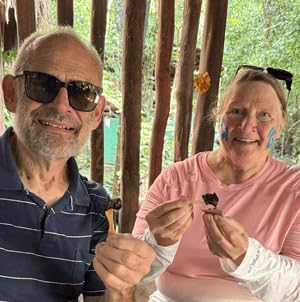
By: Robert and Theresa
Listen for free

About this listen

Life becomes different for those who experience later-in-life challenges. Living The Could LIfe offers tips adjusting your life so that you can still travel and do all the things that you love. No toxic positivity here, just lived experiences from hosts and guests.© 2026 Living the Could Life
Episodes
  • 70-Days to Change
    Mar 25 2026
    Getting Ready to Travel In this episode, we walk through the 70‑Day Change Plan — why it works, how it supports slow, sustainable change, and what it looks like to rebuild your life one honest day at a time. This is the foundation of the Living the Could Life approach. Transcript Click Here for Transcript Disclaimer: Before we dive into today's episode, a quick but important note. The information shared in this podcast is for general educational and entertainment purposes only. We love sharing our insights, but please remember, this content does not constitute medical, health, or professional advice. Every body and every situation is unique. You should always consult with a qualified medical specialist or healthcare professional before starting any new program, making lifestyle changes, or acting on any information you hear today. Your health is your responsibility, so let's keep it safe. Theresa: Welcome back to Living the Good Life, the podcast where we talk about rebuilding a life after change, the kind of change that shifts your energy, your identity, your body, or your sense of what's possible. Today, we're diving into something that sits at the center of this entire project, the language of good, the science of neuroplasticity, and a 70-day rhythm that helps your brain adapt to a new reality. Be sure you listen to the disclaimer. At the beginning, everything here that we say is just for education and entertainment. We're not doctors, lawyers, medical professionals. Oh, and by the way, I'm Teresa. Robert: And I'm Robert. This isn't just theory. This is lived experience, neuroscience, aging research, and the kind of gentle, sustainable change that actually works, especially for people navigating body changes, chronic illness, or later life transitions. We're going to talk about Helmstetter, McGill, Yale, habit formation, and the two very different meanings of could. Theresa: And this is a bit of a review. We did talk about the meanings of could last week, but they fit in again with the 70-day change plan. There's probably a point that we all had where we realized we weren't going back to who we were and how our body was before it changed. Your energy changed, your capacity changed, and you kept waiting for the old version of yourself to come back online, kind of like a system reboot that just needed one more time. But it didn't. And eventually, we all have to face the truth. We weren't going back. We had to learn to build a new life from where we were and where we are now in this body with this energy and with this reality. And that's where this whole 70-day idea started to take shape. For example, we recently built a house and are still building it. And my vision changed during that period. So although we were already building a house for aging in place. Robert: And that included things like 36-inch-wide doors to accommodate a wheelchair if that was ever necessary, lighting so that there were no dark areas in the house. Theresa: Walk-in shower, vanities where a wheelchair could fit under, and extra handrails, like double railings on any stairs. I found the basement stairs created a lot of psychological friction, like it was a magnet pulling me into the space. So we just extended a wall or a half wall so that I didn't feel like I was being pulled down the steps. Robert: And we also made the surfaces between the entryway and the basement steps, we made them very different so that they're visually distinctive. Theresa: That's right, and that helps me a lot. We also put tape on every other step because stairs for me look like they could be flat. And I am aware those are going to the basement. Robert: And this is what we're talking about today, neuroplasticity. If you've never heard that word before, it simply means this, your brain is capable of change, real change, structural change, even after illness, even after trauma, even after years of feeling stuck or slowed down or shut down. Theresa: Neuroplasticity is a science that proves your brain can form new pathways, not through force, not through willpower, but through small, repeated signals. Signals like noticing what felt easier today and signals like paying attention to what surprised you, what's given your body a moment of awareness instead of judgment. Robert: And here's the hopeful part. Your brain doesn't need perfection to rewire itself. It needs consistency, it needs gentleness, it needs repetition. Theresa: Think about somebody recovering after a stroke. In the beginning, they might only be able to move a finger or lift a spoon and with help, but with repeated tiny movements, the same motion, practice again and again, the brain starts building new pathways around the damaged ones. Over weeks and months, those small signals add up. A hand that couldn't grip begins to hold, a leg that couldn't step begins to walk. Robert: Not because the person tried harder, but because the brain responded to repetition. That's neuroplasticity in action...
    Show More Show Less
    26 mins
  • Could Has Two Meanings
    Mar 17 2026
    The active could helps us travel with body changes Living the Could Life focuses on the meanings of "could". One is polite or passive while the other "could"results in action. Learning to travel with a compromised or changed body takes some adjustments, but with small steps, there is still the possibility of being able to travel in an acceptable manner. Traveling with body changes will become the new norm. Living The Could Life contains affiliate links. They don’t cost you anything, but we may earn a small commission if you use them. We may have been hosted on a trip, excursion or other travel-related event. We may have received or experienced a product for review. Any opinion is our own. Transcript Click Here for Transcript one selected Robert: Welcome to Living the Could Life. Today we are discussing the two definitions of could and how it applies to adaptation. I'm Robert. Theresa: And I'm Theresa. In linguistics and behavioral psychology, there's a well-documented distinction between the two ways could is used. It essentially comes down to modal strength, which we will call possibility, and the direction of the focus, which we will call agency. This takes me back to many years ago when I studied linguistics and actually Robert and I were in the same class. Robert also continued on with linguistics. Robert: Yes, I did. I actually minored in linguistics with a specialty in algebraic linguistics. But back to the topic at hand. There's a moment in every reinvention when you realize you're not trying to go back anymore. You're trying to go forward. And that shift doesn't happen all at once. It happens in small, meaningful increments. Theresa: Today we're talking about how all those pieces come together. Through the way our brains store meaning, through the way we adapt over time, and through the power of one small word, could. Robert: We're bringing in some ideas that help explain why could works so well. That's the fuzzy trace theory. How we remember the meaning of things, not the details. We'll get to that a little bit later. Theresa: Okay, so we are now going to discuss the two different coulds. And we'll be talking a lot about the two different versions of could. There's the polite, hesitant could. The one that avoids commitment. And then there's the possibility could. The one that opens a door. Robert: The possibility could is the one that helps us rebuild after life changes. It's the one that says, I could try this, instead of I should be able to do this. Research, particularly in the fields of neurolinguistics and cognitive psychology, categorizes these coulds as follows. First, the possibility could. The suggestion. It highlights that an option exists in the external world, but doesn't necessarily link it to the person's internal drive. The research on linguistic hedging shows that this type of could creates a mental safety net, because it implies something might not happen as much as it might. The brain processes it as a hypothetical or a gist. The effect is excellent for brainstorming or reducing pressure. If you tell someone, we could try this, it lowers their threat response, because it feels like a low stakes choice, rather than a command. This polite, past, softened could is the could people already know. What it does, it softens a request. Could you pass the salt? Makes a suggestion without pressure. You could try this route. Describes past ability. I could run five miles when I was younger. It frames a hypothetical. We could go if the weather clears. Its emotional tone is gentle, noncommittal, optional, often used to avoid imposing. This is a could that feels small, polite, nostalgic. The one that makes people think could is passive or uncertain. Theresa: Then there is the forward-looking, agency-restoring could. This is the could that is reclaiming. The one that describes a present or future possibility. What does this could do? It opens the door to what's still possible. You could rebuild. You could try again. It signals potential, not pressure. Life could look different from here. And it creates space for adaptation. You could become someone new. It also acknowledges limits while still offering direction. You could do this at your own pace. Its emotional tone is expansive. It's future-facing. It's permission-giving. And it's grounded in reality, not fantasy. This is the could that aligns with disability, adaptation, reinvention, and emotional honesty. It's not about politeness. It's about possibility. Robert: Let's compare the suggestion versus the action. The could, as suggestion, implies hedging or possibility. Theresa: Whereas, the action could implies ability or agency. Robert: As suggestion, I'm thinking this is one option among many. Theresa: And as action, I can say I am capable of this. Robert: The psychological state of suggestion is curiosity or exploration. Theresa: And the action could, its psychological state is competence and mastery. Robert: So, the best usage of ...
    Show More Show Less
    29 mins
  • About Living the Could Life
    Mar 10 2026
    About this Episode: This episode introduces who we are, why we created Living the Could Life, and why we are here. If you’ve suddenly found that your body's performance doesn't sync with your mental attitude, you have come to the right place. Navigating disability, chronic illness, aging, or any kind of life change was not in your plans? Join us. This is basically an introduction to us and what we hope to share in upcoming episodes. Transcript Click Here for Transcript Theresa: Welcome to the very first episode of Living the Could Life. I'm Theresa. If you're here, you're probably someone who's had to adapt your life several times, maybe by choice, maybe not, or maybe you're still figuring out what the next chapter looks like.Either way, you are in the right place. Robert: And I'm Robert, your co-host, the guy who scopes out the area, takes photos of inaccessible places, and who's trying hard to earn his seeing-eye guy vest. Yep, you sure are. Theresa: You should have your vest really soon. You're getting really good at this. The show isn't about pretending everything is fine, easy, or trivial. It's all about adaptation. It's about the difference between what travel should look like, no pun intended, and what it could look like now. Don't expect any toxic positivity from us. We are here to support each other, be realistic, and share ideas. And since this is our first full episode, we want to start with the heart of the brand, where this idea came from, what it means, and why we're choosing to tell these stories now. By the way, we should tell you a bit more about ourselves. I'm Theresa, a travel writer who, in later life, suffered NAION, also known as Non-Arteritic Anterior Ischemic Optical Neuropathy. Basically, it's a stroke of the eye, and I started with that happening in my right eye. But did you know you can still be fairly independent with one well-functioning eye? It took a bit of adaptation, but I did okay for several years, until one day, the vision in the other eye rebelled. Maybe it thought it was being overworked. There was just a 20% chance of the same thing happening in my good eye, the left eye, and I never expected it to happen twice. I had no pre-existing condition that made me a candidate for it in the first place. But that second eye has a blurred tiny crescent moon area. So now, what was my good eye is now my bad eye, and vice versa. I didn't see that coming. Although I lost my independence, my ability to drive, and the ability to do many things that I took for granted, my condition is considered an impairment rather than a disability. Not sure who decides on that classification. It's obviously somebody without this impairment. Robert: I'm Robert, a former high school math teacher, now enrolled in the Seeing Eye Guy certification program. I even have a business card for proof of that. I never expected to be a caregiver so soon after my early retirement due to how COVID had changed teaching. We both enjoy travel, and now I have suddenly started noticing things that I never really paid attention to before. Like finding escalators and elevators, looking for trip hazards, and such. Theresa: Likewise. The idea of this podcast started spinning in our brains when we realized that we really hadn't seen much information about dealing with body changes that affect us later in life. For me, travel, something that always had meant freedom, joy, escape, independence, escape, and independence, suddenly became complicated. I often traveled solo in the past. I was accountable only to myself. I didn't have to do a lot of planning, and I wasn't the default tour guide. I was independent. And I was there thinking, okay, so what now? What could this look like? Not what it should look like. Not what it used to look like. Just what's possible from here. I was definitely not ready to give up travel, even though for a brief moment, a very brief moment, I considered lying on the couch with Robert waving palm fronds above me, and me drinking wine while eating bonbons. I don't think you would really do that. Robert: It's not really in your nature. Theresa: Well, nature's changed. Travel memories flashed before me. We had bicycled several times around New Zealand, in Mexico, and even did a transcontinental tour from the Pacific Ocean to the Atlantic Ocean. We hiked the Inca Trail. We took many adventurous trips. We camped. We did day trips. And now, my big adventurous trip is walking from the front door down the staircase to the car. And this was another incentive that made us think that Living the Could Life was important to not only us, but to many others. Giving up travel by somebody like me with a dominant gene and wanderlust would be incredibly harsh. There had to be alternatives. Robert: And that's something we're to talk about a lot here. Alternatives, adaptations, possibilities, grief, loss, and more. One of the themes you'll hear again and again on this show is adaptation, especially when it happens...
    Show More Show Less
    17 mins
No reviews yet